

Two Truths and a Lie is a fun get-to-know-you game. You make three statements. Two are true, and one is a lie. Other players try to guess the lie, which is why the game works best when you come up with a believable lie.
Let’s play a round:
In my work writing about the boating industry, I’ve been to the Galapagos Islands and Fiji two times each.
In my work writing about the dog industry, I’ve attended auctions where breeders and rescuers had bidding wars into the thousands of dollars for puppies.
In my work writing about the franchising industry, I’ve interviewed the CEOs of McDonald’s and Burger King.
Now, you guess which two of those statements are true, and which one is the lie.
That’s the fun version of this game based on a believable lie. The not-so-fun version happens all the time in the political world, where individuals or groups pushing various policies will make statements that sound an awful lot like they could be true, but that in reality are totally false.
These lies are most believable when they’re embedded around a single statement that actually is true, to lend them credibility.
Last week, in my home state, the New Jersey AFL-CIO demonstrated this technique in the following email, which went out to legislators statewide. The email is about the independent-contractor rule that the previous administration of Governor Phil Murphy proposed, and that the current administration of Governor Mikie Sherrill has rightfully now paused to reconsider:
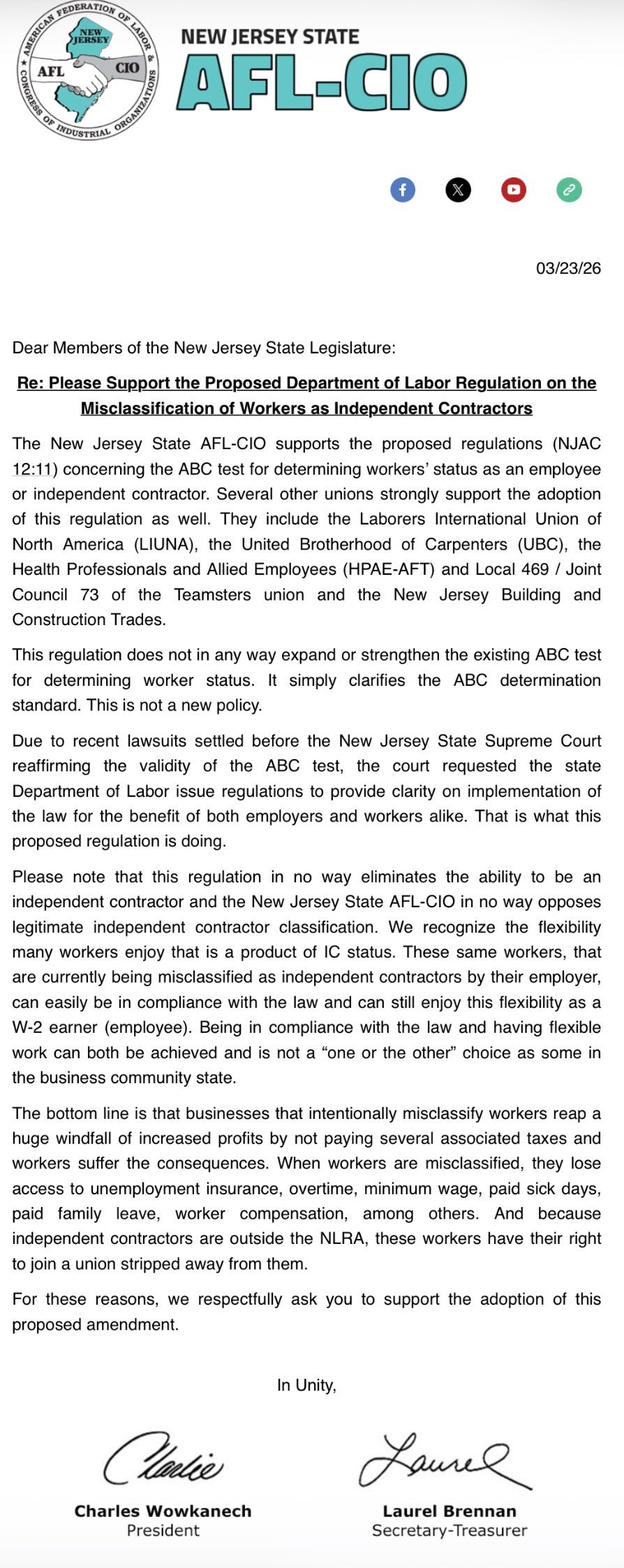
In that email’s six paragraphs, I count four lies and one truth.
And the truth, when it comes to the proposed independent-contractor rule, is just as damning as the lies.
Lie Number One
Let’s start with paragraph two of the New Jersey AFL-CIO’s email, which claims that the state’s proposed independent-contractor rule doesn’t make new policy, but instead simply clarifies the ABC Test that’s used to determine independent-contractor status.
Here is the actual press release that the Murphy administration distributed when it put forward the rule proposal:
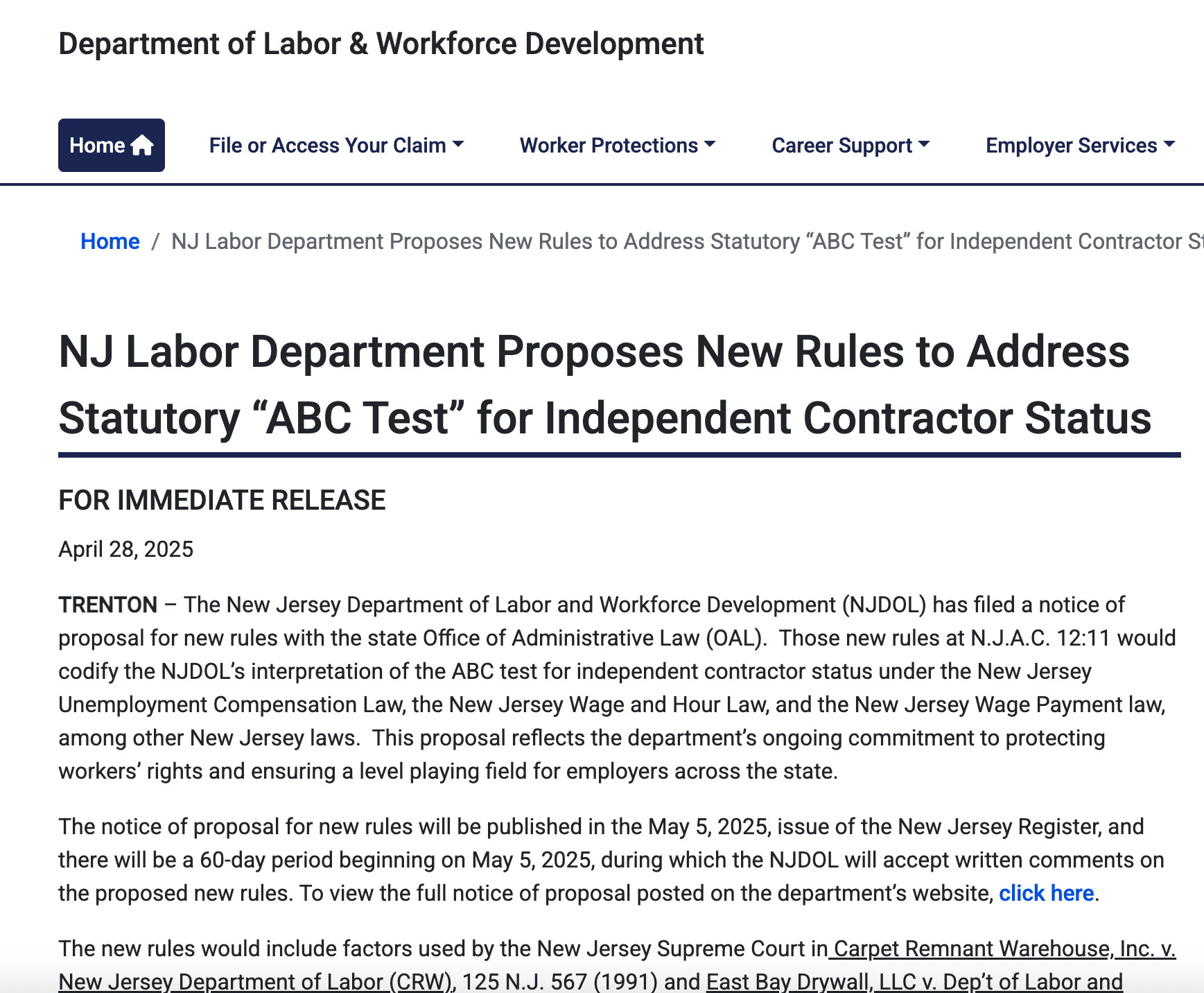
The term “new rules” appears a dozen times in the headline and body copy of the Murphy administration’s own press release. And right there in the first paragraph, as you can read for yourself, the press release makes clear that these “new rules” would “codify the NJDOL’s interpretation of the ABC Test for independent contractor status.”
That interpretation would, according to all kinds of experts, make new policy. It would go beyond the bounds of existing statute and case law; would redefine independent-contractor status throughout the state; would defy the will of the state Legislature; and would impose the most extreme and rigid independent-contractor policy in the nation, according to:
Three of the most powerful Democrats in the New Jersey Senate
The Democrat who serves as New Jersey Senate majority whip
Numerous Republicans in the New Jersey Senate and Assembly, including these and these
Various lawyers including this one and this one and this one and this one
It would also risk undermining access to justice, according to the state’s Office of the Public Defender; jeopardize public safety by decimating the roadside assistance network, according to AAA; be potentially catastrophic for the Early Intervention System that helps infants and toddlers with disabilities, according to people who provide such services; risk children’s safety, according to the New Jersey Recreation and Park Association Public Affairs Committee; and create unworkable assumptions for nonprofits dealing with everything from mental-health issues to the arts, according to the New Jersey Center for Nonprofits.
Indeed, this is all different ways of describing some pretty horrible new policy.
And sadly, we’ve heard this variety of the believable lie in the Garden State before, back in 2019, when unionist and then-state Senate President Steve Sweeney proposed legislation that would have imposed California’s career-crushing version of the ABC Test on New Jerseyans, while claiming his bill was simply a codification of existing regulations.
That bill, which also faced enormous public opposition, rightfully failed to advance—even despite the New Jersey AFL-CIO pushing hard for it, too.
Lie Number Two
The second lie in the New Jersey AFL-CIO’s email to legislators is in paragraph three, which claims the proposed rule would provide clarity for the benefit of those of us who would be subjected to it.
Anyone who has read the proposed rule knows this is false. New Jersey’s Labor Department states outright that the factors it lays out to determine independent-contractor status would not be the only factors it may consider when determining whether someone is properly classified. The Department phrases this in various ways, with this being one example:
“Proposed new N.J.A.C. 12:11-1.5 would also state that the factors are not exhaustive and that the factors listed should not be used as a checklist.”
In other words, if this rule were implemented, none of us would have any way of knowing how to stay within its bounds, because the bounds would be undefined. We couldn’t go down a checklist of requirements and figure out whether we had satisfied them or not. Any random factors could be used to determine legal independent-contractor status. The Labor Department could use a Ouija Board, the fact that a groundhog sees its shadow, or a Polymarket wager to determine independent-contractor status, and it would still technically be within the proposed rule’s wording about stated factors being non-exhaustive.

That’s not providing clarity. It’s doing precisely the opposite.
As one attorney wrote: “The Proposed Rule will likely lead to needless litigation as it does not provide clarity, consistency, or an accurate, even-handed application of New Jersey legal principles to either traditional or modern work relationships that independent workers enter into with New Jersey businesses.”
Another attorney put it like this: “Almost only counts in horseshoes. In the law, likely counts for nothing. Businesses need clarity. … [W]hat certainty can any regulated party have that they are correctly applying the test?”
Lie Number Three
Lie number three is in paragraph four of the New Jersey AFL-CIO’s email, which claims that the organization itself in no way opposes legitimate independent contractors.
The rest of the paragraph then conflates legitimate independent contractors with misclassified employees, calling us “these same workers.” It says that being a W-2 employee is no different from having the kind of flexibility that independent contractors enjoy, going so far as to say that the very idea of choice in how we achieve the flexibility we want in our lives is a false concept.
This paragraph in the New Jersey AFL-CIO’s email isn’t a one-off, either. It’s a variation on what the organization wrote in its public comment about the state’s proposed independent-contractor rule:
“Workers can perform the same exact jobs they currently are performing—including app-based delivery and transportation services—when classified as an employee. There is no prohibition of a worker holding multiple part-time jobs with several companies, performing the same work they do as independent contractors, but filing a W-2 as an employee rather than a 1099 as an independent contractor.”
The New Jersey AFL-CIO is not demonstrating respect for independent contractors, or even basic comprehension of how we are different from part-time employees. Instead, the organization is trying to convince legislators that there’s no difference between being an independent contractor who has total control over her work, and an employee who has multiple bosses telling her what to do.
This is an utterly ridiculous claim on its face. Also ludicrous is the idea that companies will create traditional jobs for people currently working as independent contractors. The Labor Department’s own proposed rule states outright that it will not create any jobs—full-time, part-time or otherwise.
Just as we all saw happen in California with overly restrictive independent-contractor policy, the most likely outcome would be independent contractors losing the income and careers that we currently have, and that the vast majority of us wish to keep because we prefer to be independent contractors.
For us, the choice is quite real.
Lie Number Four
The fourth lie in the New Jersey AFL-CIO’s email is in paragraph five, which states that because independent contractors fall outside the National Labor Relations Act, we have our right to join a union stripped away from us.
That’s not how rights work here in the United States of America.
We have lots of rights, which we may or may not be exercising at any given time. We have the right to free speech whether we choose to speak or not. We have the right to bear arms whether we choose to own a gun or not. We have the right to a speedy trial whether we are involved with the justice system or not.
When we choose to be independent contractors, we are not having our ability to be an employee and to join a union stripped away from us. We are choosing to exercise a different freedom: the freedom to go into business for ourselves, to be our own bosses, something that about two-thirds of Americans tell Gallup they would prefer to be. The ability to make this choice is a freedom that has existed since the day the United States was founded.

The essence of freelance busting is that unionists like the New Jersey AFL-CIO are trying to strip away our freedom to be self-employed, because if we are our own bosses, then they cannot unionize us. By law, they have to respect our choice and leave us alone.
Overly restrictive independent-contractor policy isn’t about granting new rights to us. It’s about granting new rights to union organizers who have become so detached from reality, they now call the business model of being our own bosses—a business model that has helped millions of entrepreneurial Americans to thrive—a danger to the nation’s future.
The One Truth
Arguably the most damning part of the New Jersey AFL-CIO’s email is the one paragraph that’s entirely true. That’s the first paragraph, which states that several other unions—including LIUNA, the United Brotherhood of Carpenters, the Health Professionals and Allied Employees, the Teamsters and the New Jersey Building and Construction Trades—all support the state’s proposed independent-contractor rule.
That’s accurate. Union organizers are the only real base of support for freelance busting here in New Jersey, with independent contractors ourselves, the broader business community and pretty much everyone else in the state standing 99% opposed among the estimated 9,500 written public comments on file.
In fact, at the public hearing in Trenton last summer, the only people who testified in favor of this proposed rule were either on a union payroll or affiliated with organizations that have strong union ties. That was the only support in the standing-room-only crowd of witnesses who testified for more than three hours straight, 3-to-1 in opposition. I noted the full list of these unionist witnesses in my testimony last year before the U.S. Senate HELP Committee, where I also said in my opening statement that what’s happening is not targeting employee misclassification. It’s weaponizing regulatory language to attack independent contractors.
We are supposed to have government of, by and for the people. Not government of, by and for the union organizers. New Jersey’s proposed rulemaking pits extremism against entrepreneurism, which is why the only way to support it is by playing games like Four Lies and a Truth.
Nobody should be playing this game. Ever. Not here in New Jersey, and not anywhere else, either.