

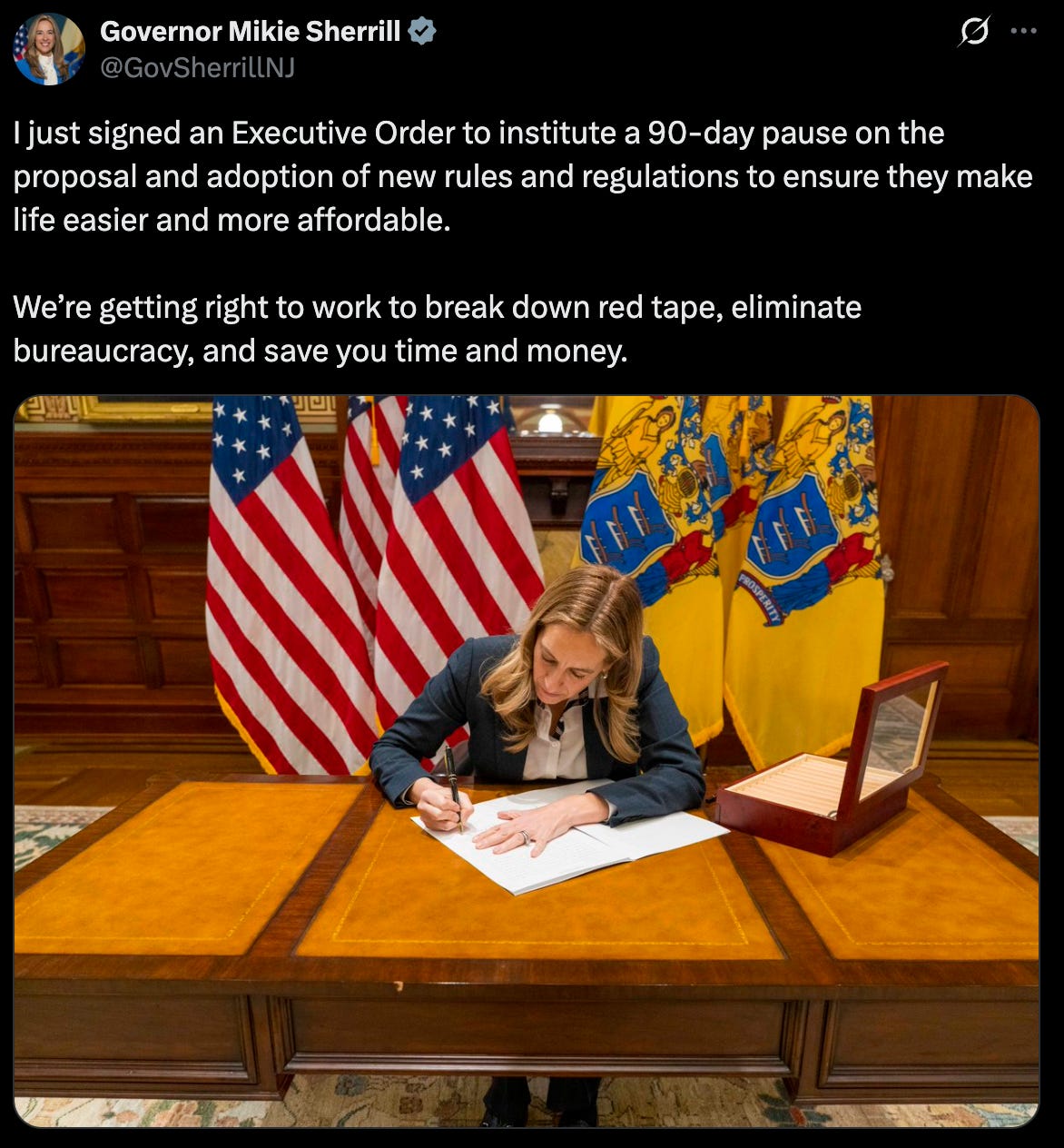
On Friday, New Jersey Governor Mikie Sherrill instituted a 90-day pause on rulemaking. She announced the move on X:
The paperwork can be found here. It’s Executive Order No. 7.
Lawyers, lobbyists and advocates have been parsing the language in the executive order since Friday to try and determine whether it means the Murphy administration’s proposed independent-contractor rule—which is still live at New Jersey’s Department of Labor & Workforce Development—is now paused for 90 days so the Sherrill administration can review and consider it, or if the rule must be withdrawn altogether.
I’ve heard smart people say they believe the wording in this executive order means a pause, and I’ve heard other smart people say they believe it means withdrawal.
Either way, I think this is a good development in terms of trying to stop this proposed rule from being adopted.
Here are the clauses from the executive order that people are debating, and why.
The Pause Interpretation
Governor Sherrill’s executive order, like her social-media post, is clear-cut about the 90-day pause going into effect so her administration can review all rulemaking that’s still in the works from the Murphy administration. That’s common sense. No incoming governor would want to be stuck with brand-new rules that are inconsistent with the new administration’s plans.
If we assume that the independent-contractor rule is paused, but not withdrawn, then the next step is to understand the criteria that the Sherrill administration would use to review it.
One of the reasons Executive Order No. 7 lists for the 90-day pause in rulemaking is the following:
“… this review of proposed administrative rules is especially necessary to address the current economic and affordability crisis in New Jersey, and to ensure that the regulatory processes of state government do not have the effect of impeding the creation, growth, or expansion of business enterprises, hindering job creation, or undermining this Administration’s commitment to making government effective, accountable, transparent, and user-friendly…”
That bit made quite a lot of people believe that the Sherrill administration, either during or at the end of the 90-day pause, would ultimately jettison the Murphy administration’s proposed independent-contractor rule.
There are two main reasons why:
Attorneys say the proposed rule poses an existential threat to independent contracting and would almost entirely eviscerate any chance of establishing independent-contractor status in New Jersey. That seems to fall directly under what Executive Order No. 7 says about ensuring that government is not “impeding the creation, growth, and expansion of business enterprises.” This proposed rulemaking—according to everything attorneys and other experts laid out in the thousands of public comments—would stop people from creating the smallest of small businesses as independent contractors, and would make it incredibly hard, if not impossible, for larger businesses to work with independent contractors to grow.
There are about 9,500 written public comments on file about this proposed rule, and 99% of them are opposed. That seems to fall directly under Executive Order No. 7 too, in the part about the Sherrill administration being committed to making government more accountable to the people. The people have spoken quite loudly in opposition to this proposed rule. A government that is accountable to the people would have rescinded this rule proposal a long time ago.
However, Governor Sherrill’s executive order also states this:
“…this review of pending rule proposals, nevertheless, should not lead to any actions that would compromise the public health, safety, welfare, or security; obstruct or impair essential operations or functions of any administrative agencies or authorities; adversely impact compliance with any court order or statutory deadline; or prejudice the State of New Jersey with respect to the receipt of funding or assistance from the federal government or the ability to obtain any certifications from the federal government…”
That right there is a big, fat loophole that could be used against independent contractors.
We do not yet know the name of Governor Sherrill’s nominee for Labor Commissioner. We know that she held her first Cabinet meeting on Friday, and that Murphy-era Labor Commissioner Robert Asaro-Angelo (who may have remained in the job if Sherrill wanted him to stay) did not appear to be there. Asaro-Angelo’s apparent absence suggests that Sherrill intends to replace him, but we don’t know the candidate she’s considering, and whether he or she would share Asaro-Angelo’s hostility toward independent contracting.
If Governor Sherrill replaces Asaro-Angelo with another hardcore freelance buster, then that person could attempt to make the case that failing to finalize the proposed independent-contractor rule would:
compromise public welfare by allowing employees to remain misclassified, and;
impair essential functions of the Labor Department as it attempts to stop employee misclassification.
Now, I’m no lawyer, but I think those arguments in favor of finalizing the rule proposal would be a stretch.
As I’ve been reporting for months on end, the thousands upon thousands of pages of public comments filed as part of this rulemaking process—along with the Murphy administration’s own stated results after eight years of following this freelance-busting strategy—demonstrate quite clearly that what’s happening goes far beyond attempting to stop employee misclassification
Leading legislators say that what’s happening with this proposed rulemaking appears to go beyond the bounds of statute and case law, threatening the livelihoods of properly classified independent contractors and attempting to bypass the Legislature in a way that is inconsistent with legislative intent. Leading economists say that what’s been happening in recent years is already harming the state’s W-2 employment, self-employment and overall employment, with a disproportionate and negative effect on women, and that the proposed rulemaking would create more problems than it solves.
So, assuming that the Sherrill administration does indeed want to support businesses and be accountable to the public, then the proposed independent-contractor rule would be reviewed, considered and dumped into the Atlantic Ocean with cinderblocks to weigh it down, so that it never can see the light of day again.
At a minimum, based on Governor Sherrill’s executive order, there is real reason to hope that’s what will happen next.
But there’s another wrinkle to consider as well.
The Withdrawal Interpretation
Executive Order No. 7 also describes situations where proposed rules must be withdrawn, but this language is less clear-cut than the requirement for a 90-day pause. I’m hearing conflicting opinions about whether the withdrawal language in the executive order might apply to the proposed independent-contractor rule.
The executive order defines a “proposed rule” like this:
“‘Proposed rule’ means a rule proposed by publication in the New Jersey Register within the past 12 months, or within the past 18 months if the relevant agency has issued a notice of substantial change to the proposed rule, which has neither been adopted nor expired, or a proposal filed with the Office of Administrative Law (‘OAL’) for publication but not yet published in the New Jersey Register.”
That definition of “proposed rule” appears to include the Labor Department’s proposed independent-contractor rule. It was proposed by publication in the New Jersey Register within the past 12 months, and it has neither been adopted nor expired.
However, the executive order also states this, about withdrawal of a proposed rule:
“With respect to any proposed rule that may have been filed with OAL but has not been published in the New Jersey Register, the head of the State agency proposing the rule shall withdraw the proposed rule in a manner consistent with the Rules for Agency Rulemaking and the practices and procedures of the OAL.”
This is the part of Governor Sherrill’s executive order that has people debating about the independent-contractor rule possibly being withdrawn.
As noted above, the independent contractor rule was published, in proposal form, in the New Jersey Register. But as I reported on January 20, it was not published in final adoption form in the New Jersey Register prior to the Murphy administration ending.
However, it’s possible that it has been filed with the Office of Administrative law in final adoption form, but not yet published. That’s possible because Governor Murphy’s labor commissioner, Robert Asaro-Angelo, could have sent the finalized rule to the Office of Administrative Law on January 8, before the Murphy administration left office on January 20. If that happened, then the final version of the independent-contractor rule would not be published in the New Jersey Register until February 2, which is a week from now:
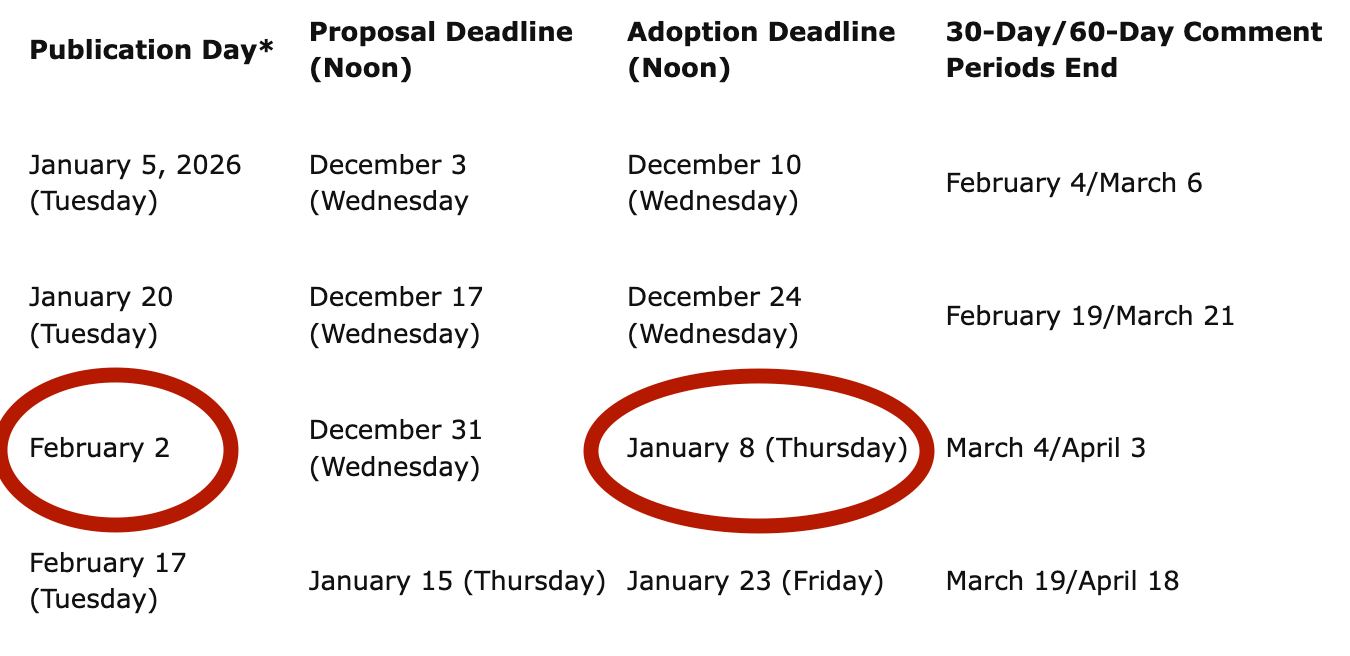
The question I hear people debating is whether such a move might fall under the executive order’s language about “a proposal filed with the Office of Administrative Law for publication but not yet published in the New Jersey Register.”
I did try to contact the Office of Administrative Law today, hoping its team might shed some light, but nobody is answering the phone. I assume that everyone is still busy digging out from the big snowstorm.
What we do know is that if Asaro-Angelo attempted this kind of last-minute move as the Murphy administration prepared to leave town, it would be precisely the type of thing that part of Executive Order No. 7 appears intended to block. Governor Sherrill’s executive order explicitly states that her administration:
“… should be afforded sufficient opportunity to examine the proposed rules and regulations prior to their adoption to ensure they are not inconsistent with the policies and priorities of this Administration…”
We need more clarity about this withdrawal section of the executive order. But for now, there appears to be agreement that the independent-contractor rule proposal is at least paused for 90 days so the Sherrill administration can consider it anew.
Here’s hoping that one way or the other, and sooner rather than later, this deeply misguided rule proposal will be gone for good.