

See if you can spot the pattern that goes back for the better part of a decade now when it comes to the way the New Jersey AFL-CIO characterizes the problem of employees being misclassified as independent contractors.
New Jersey AFL-CIO, 2019:
“The issue of worker misclassification, where workers are intentionally classified as independent contractors rather than as employees, has been a significant problem in New Jersey and throughout the nation for over 20 years and continues to grow.”
New Jersey AFL-CIO, 2020:
“Six bills seeking to reform the broken system by which certain employers intentionally misclassify their employees as independent contractors are strongly supported by the New Jersey State AFL-CIO.”
New Jersey State AFL-CIO President Charles Wowkanech, 2022:
“This illustrates that the gig is up, companies that intentionally misclassify employees in order to increase their profits at the expense of worker rights are now on notice – this unlawful practice is not tolerated here in New Jersey.”
2025, oral testimony of New Jersey AFL-CIO Legislative Director Eric Richard at the public hearing about the state Labor Department’s proposed independent-contractor rule:
“It needs to be understood that certain industries continue to see widespread, rampant, intentional misclassification. So the job we need to do is far from over. Heightened enforcement by the State Department of Labor is essential, and we look forward to continuing to work with the DOL to bring to their attention to information about what we see in workplaces throughout the state.”
New Jersey AFL-CIO, 2025, written public comment about the proposed independent-contractor rule:
“Despite the significant amount of work done to address the misclassification of workers as independent contractors, certain industries continue to see widespread, rampant, intentional misclassification. For this reason, the job is far from over. Heightened enforcement by the State Department of Labor and Workforce Development is essential and the adoption of these rules are important steps that should be approved to accomplish this.”
New Jersey State AFL-CIO President Charles Wowkanech, May 2026, in defense of the newly adopted independent-contractor rule:
“The intentional misclassification of workers by unscrupulous business negatively impacts workers in all sectors of our economy. From app-based transportation companies to health care to construction to public sector to trucking and entertainment production, among others, workers are being cheated out of earned benefits and wages, and that must end.”
I knew this pattern of claims from the New Jersey AFL-CIO well: Employee misclassification is widespread and rampant, and it’s harming workers across all sectors of our economy. That’s why we need new laws and regulatory rulemaking to crack down on the business practice of independent contracting.
All of which is why it caught my attention on May 11, when I was sitting in the State House in Trenton, and I heard acting New Jersey Labor Commissioner Kevin Jarvis—the former legislative affairs coordinator of the New Jersey State AFL-CIO—say the following as he testified before the New Jersey Senate Labor Committee:
Those “big numbers” of misclassified workers, as the acting Labor Commissioner had just described it, didn’t sound like very big numbers to me.
I did some quick math in my notebook:
4,700 people across seven years is an average of 671 people per year
1,400 people in the past two years is an average of 700 people per year
My home state of New Jersey has an estimated 1.7 million independent contractors. So, when it was my turn to testify later that day, I began by saying this:
Fast forward to yesterday, when there was another public hearing at the State House in Trenton, this one before the Senate Budget and Appropriations Committee.
It turns out that I’m not the only one who did the math.
‘I Don’t Know the Answer’
At yesterday’s hearing, state Senator Declan O’Scanlon asked Eric Richard, the legislative director of the New Jersey AFL-CIO, how many complaints the state Labor Department had actually received from independent contractors who say they are misclassified.
You can watch yesterday’s full Q&A exchange in the extended video at the top of this page. The highlights are that Senator O’Scanlon explains how he personally asked acting Commissioner Jarvis for the number of complaints the Labor Department was receiving from independent contractors, because what legislators are hearing from the public doesn’t align with the idea of widespread employee misclassification.
Richard replies by saying that a lot of independent contractors don’t know they’re misclassified until they apply to the Labor Department for unemployment.
O’Scanlon says when that happens, it’s indeed a problem, but if it’s a big problem, then the number of independent contractors doing it should be somewhere around 100,000.
Richard ultimately replies to the question that Senator O’Scanlon asked him: How may complaints is the state Labor Department actually receiving?
“I don’t know the answer to that, sorry.”
Senator O’Scanlon then says the figure that acting Labor Commissioner Jarvis gave him was the same figure that I had found so notable when I’d heard Jarvis say it last month: an average of about 700 complaints per year.
That’s 0.04% of people who earn some or all of our income as independent contractors in New Jersey.
And virtually all of the complaints, Senator O’Scanlon said yesterday, came from people working in a just one industry: rideshare and delivery drivers.
The Hits Just Keep on Coming
Since 2018, based largely on the urging of the New Jersey AFL-CIO, the State of New Jersey has:
created a governor’s task force on employee misclassification
issued a report from that task force that said 10% to 30% of employers misclassify at least one employee, and that “misclassification is widespread and especially prevalent in construction, janitorial services, home care, transportation, trucking and delivery services, and other labor-intensive low-wage sectors”
tried to pass a law severely restricting all kinds of independent contractors the same way California did, with the state Senate President comparing those of us who challenged that legislation to Russian disinformation agents
enacted 10 other laws to combat employee misclassification
created a government agency office to combat employee misclassification
granted what the state Department of Labor & Workforce Development called “first-of-its-kind” penalty power to combat employee misclassification
ignored 99% opposition during the public-comment process and proceeded to adopt a 200-plus-page rule about the interpretation and application of independent-contractor regulatory language
We have now heard twice, during recorded testimony at the New Jersey State House, that all of this was done when only about 700 independent contractors a year, on average, are filing complaints with the Labor Department.
As much of a gut punch as this realization must be to every legislator who has trusted the New Jersey AFL-CIO, and who voted for and defended all these years’ worth of freelance busting against all kinds of independent contractors across our state, this news is only the latest in a string of revelations that have left quite a lot of us scratching our heads.
There’s been mischaracterized state-level data and research that found its way into testimony before the U.S. Congress, where unionists including the national AFL-CIO are trying to restrict independent contracting all across the country.
Shifting claims about eye-popping amounts of missing money from the State of New Jersey’s coffers that never seemed to add up, just as they failed to add up in California.
Statements about money returned to misclassified employees in New Jersey that seemed awfully paltry for a so-called rampant problem.
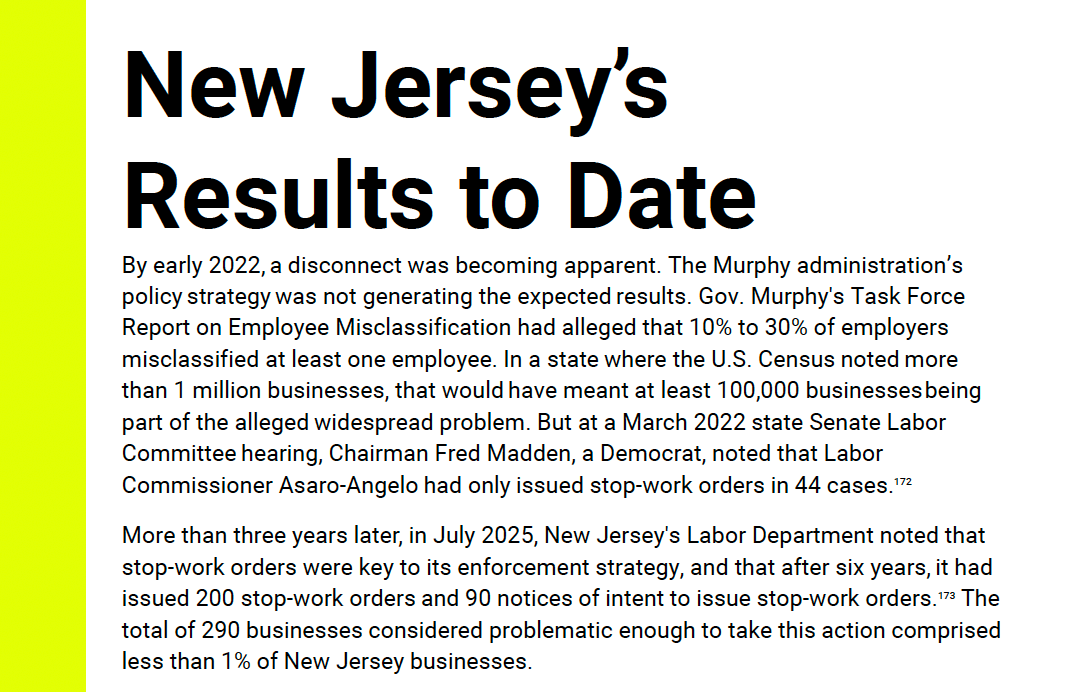
Revelations about stop-work orders in New Jersey that seemed surprisingly rare if so many companies were actually misclassifying their employees.
And don’t even get me started about how antiquated data and statistics from as long ago as 1984 have been used to weaponize regulatory language and attack legitimate independent contractors across hundreds of professions at the state and federal levels alike.
I wrote about the disconnect between what the New Jersey AFL-CIO and its fellow freelance busters have been saying, and what has actually been happening in my home state, in my “Extremism and Entrepreneurism” report that came out in February. Here’s the start of that section:
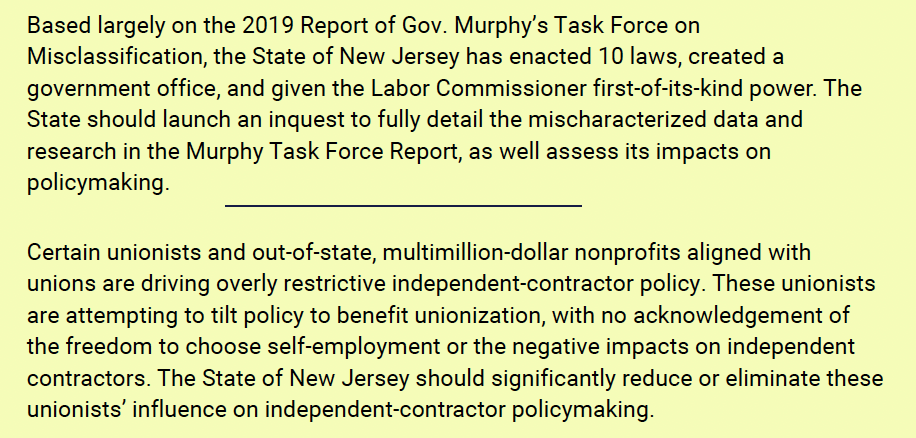
And these are two of the seven recommendations my report makes at the end:
What we learned at yesterday’s hearing at the New Jersey State House, yet again, is that those of us standing up for everyone’s freedom to be our own bosses should have been the ones that lawmakers listened to all along.
New Jersey’s Legislature should invalidate the Labor Department’s newly adopted, deeply misguided independent-contractor rule before it takes effect on October 1, and then stop letting the AFL-CIO run the table when it comes to this policy area.
Instead, give us independent contractors a meaningful seat at the table to fully expose and end this freelance-busting madness that we’re being relentlessly, remorselessly forced to endure.


