

I assumed, when I read this article about the new book Disposable Workers by Paul Osterman—and when I saw praise from David Weil, the philosopher king of freelance busting—that the book would call for a nationwide version of the ABC Test that makes it harder to be an independent contractor.
And I can report, after reading Osterman’s book, that this was indeed an accurate assumption.
But I also learned something important by slogging my way through this latest missive about self-employment from Harvard University Press.
The freelance-busting brigade has a central problem in their argument that, surprisingly even after all these years, they still can’t figure out how to solve.
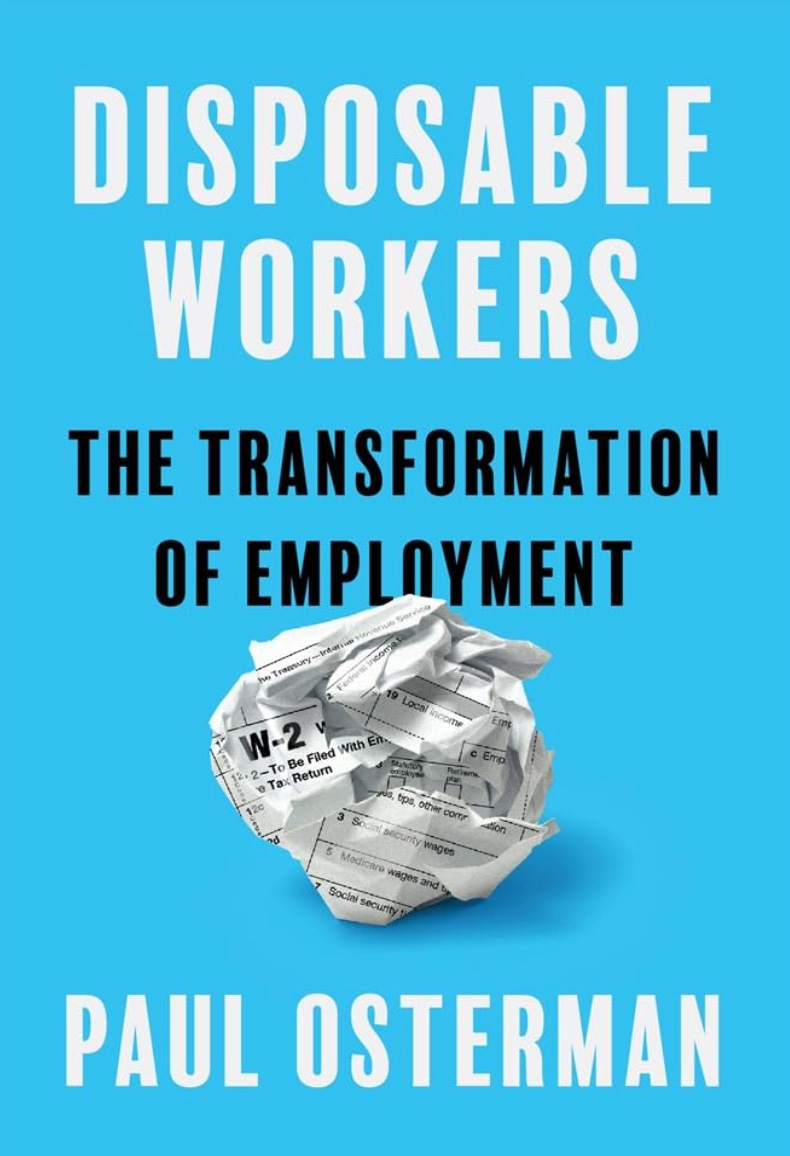
Osterman’s book is rooted in the idea of injecting a term he coined, “disposable workers,” into the policy debate. He isn’t just talking about independent contractors with his definition; he’s also talking about some full-time employees he sees as lacking in what employment should provide, such as in-house training and the opportunity for promotions within the same company. In Osterman’s view, adjunct professors who aren’t eligible for tenure fit his definition of “disposable workers” right alongside rideshare and delivery drivers. Neither, in his opinion, are on a real ladder to success.
Whether or not his thinking is correct isn’t why I read this book. What matters to me is understanding his concept of “disposable workers,” because the terminology is similar to the term Weil coined, the “fissured workplace,” from Weil’s own 2014 book. Both frameworks are intended to give an easy label to a perceived problem that these authors believe needs to be solved in the workforce as a whole.
And as we all learned from Professor Weil, when someone like Osterman—who is professor emeritus of human resources and management at the MIT Sloan School of Management—frames a complex policy debate in two catchy words, those words can have an outsized impact. Lawmakers who believe that people being independent contractors means we have a “fissured,” or broken, workforce are also going to be inclined to believe that even the most successful independent contractor is a “disposable worker,” and then write “protective” legislation and regulations accordingly.
In fact, the power of two well-chosen words is so significant that I coined the term “freelance busting” to help swing the debate back. My two-word frame creates an entirely different understanding of what’s going on in this area of labor and employment policy. From my perspective as an independent contractor, unionists who want fewer people like me in the workforce are trying to shut down an entire pathway to achieving the American Dream.
Now, to be fair, I think both Weil and Osterman would say their books are intended to deepen our understanding of the way Americans work. I would argue with that description, and I could critique more than a few parts of Osterman’s book that made me do a double take, such as when he suggested it was better to be a valued dishwasher at his friend’s restaurant than to be a well-paid staff attorney at a law firm.
For now, I want to focus on one important point. This book, just like others of its ilk, eventually belies its intent to deepen our understanding of independent contractors and the broader workforce.
Disposable Workers ultimately just pushes the same union-backed “solutions” that are in fact radical, and that keep failing amid widespread public outrage in the real world.
‘Being a Freelancer is Desirable’
My biggest beef with Weil’s Fissured Workplace book has always been that in a nation where the vast majority of independent contractors say year after year that we prefer the way we’re working, Weil couldn’t find a single happy independent contractor to so much as mention in any of his 424 pages. Oren Cass, in his book The Once and Future Worker, took a similarly dismissive approach to tens of millions of us all across the country, prompting me to write a piece titled “Hi There. We Exist.”
The thing these tomes have in common is that their authors talk about us, without us. They come from a worldview that being a unionized employee is the ideal, so by definition, self-employed people are a lower form of worker. Happy and successful independent contractors, to them, are as mythical as unicorns. It doesn’t even occur to them to think of us as equals making a choice about how we wish to work, the same as many unionized employees choose a different path because they feel that it suits them better.
To his credit, Osterman doesn’t do what Weil and Cass did in this regard. Osterman writes about us differently in Disposable Workers. He not only acknowledges that happy and thriving freelancers like me exist, but he also writes that we can be happier than traditional employees with similar earnings, and that it would be wrong to take away our pathway to success:
“It is clear that, for many people, being a freelancer is desirable. Therefore, any policy initiative aimed at entirely eliminating this choice or making it harder to obtain this status would be misguided.”
Agreed.
Osterman also does another thing in this book that I rarely see with discourse from the freelance-busting brigade: He acknowledges that rideshare and delivery drivers, traveling nurses and other traditional union-organizing targets might be in situations more complicated than the one-size-fits-all headlines suggest.
He even acknowledges that they, too, may want their status quo as independent contractors to remain, even as some so-called “protected” employees may want their own lives to change:
“… about two-thirds of ride-share drivers are part-time and most have health insurance through another job or spouse. Accordingly, these folks may not be strong advocates for change. One can make the same point about heterogeneity among contractors, where, for example, travel nurses are happy with their situation, but in non-union settings being a contractor for a staffing firm providing building cleaners or security guards is problematic, to say the least.”
So there is at least some nuance in what Osterman writes about all of us in this book, as well as an acknowledgment that simply reclassifying us all as unionizable employees might not go over so well—a refreshing change of attitude that’s more aligned with the reality of the intense pushback we’ve all seen to sweeping and overly restrictive ABC Test legislation and regulations in recent years.
Which is what makes it so frustrating that at the end of the book, Osterman outright calls for the ABC Test to be implemented nationwide anyway.
On the one hand, he’s acknowledging that independent-contractor status is working out just fine for many of us, while on the other hand, he’s advocating for regulatory language that wipes our preferred status away.
The Insolvable Problem
Osterman’s big policy recommendation is to implement the ABC Test through federal legislation like the Protecting the Right to Organize Act. This recommendation undoes every bit of effort Osterman makes throughout the rest of his book to try and show some respect for those of us who are happily and successfully self-employed, and who wish to remain independent contractors.
His policy recommendation also makes it evident, yet again, that no matter how the freelance-busting brigade tries to frame or reframe the current state of the workforce—and no matter what lip service they may pay us in saying they have no problem with legitimate independent contractors—their ultimate goal is to inject regulatory language that attempts to make most or all of us unionizable employees, whether we like it or not.
It’s deeply disappointing to see the way Osterman describes the ABC Test in his book. His description of this regulatory language as an “ideal solution” aligns him with everyone else in the freelance-busting brigade who turns to intellectual dishonesty in pushing this kind of policymaking.
Osterman writes:
“The ideal solution would begin with legislative clarification of how to define an employee. A straightforward approach would be federal adoption of the so-called ABC rule, already in use by over thirty states to define employee status for state employment rules and for programs related to minimum wages, unemployment insurance, and workers’ compensation. This rule makes the assumption that everyone is an employee unless the employer can prove otherwise, and to succeed, that employer needs affirmative evidence on three criteria: that the work is done without the direction and control of the employer, that the work is outside the usual scope of the employer’s business, and that the person doing the work has their own independent business or trade doing that kind of work.
“Simple and clear as that might seem, getting such a thing through Congress seems impossible…”
Well, yes, Professor Osterman, getting the ABC Test into federal law through the PRO Act has proved impossible—because there is opposition on both sides of the political aisle to what the version of ABC that’s in the bill actually does.
Here in the real world, the ABC Test is not so simple, and the only thing that’s clear is that its impacts are increasingly bad. In multiple states where this so-called “solution” has been tried in recent years, the outcomes have not been nearly as rosy as this book’s description suggests. A former chairman of the National Labor Relations Board went so far as to state that the PRO Act, as written, would “substantially unravel and change large segments of the U.S. economy.”
What Professor Osterman leaves out of his book’s description of the ABC Test, and what is so intellectually dishonest about the description he does give, is the way unionists are trying to edit and finagle and twist the ABC Test’s language so that it will hit a broad swath of legitimate independent contractors.
Is the ABC Test actually being used in dozens of states, as Osterman claims it is? Technically yes, but also, no. There is no uniform ABC Test to begin with, even between some neighboring states that use versions of it.
Just a few examples:
Pennsylvania has the ABC Test for certain purposes, but it omits the B prong. That makes Pennsylvania’s version of the ABC Test different from, say, California’s version that has all three prongs;
At the same time, California’s version of the B prong is different from New Jersey’s version of the B prong, so even though both those states have all three prongs, they’re not actually the same;
California’s version—the one the federal PRO Act emulates—tanked self-employment and overall employment in California, and led to statewide legislation intended to protect working people in more than 100 professions from the ABC Test, either in part or in full;
In New Jersey, we are all living through a regulatory-rulemaking nightmare where the state Labor Department just tried to interpret the ABC Test prongs in ways that attorneys called unprecedented and said would almost entirely eviscerate anybody’s ability to be an independent contractor at all. Lawyers called this latest variation on the ABC Test an existential threat to flexible, independent work itself. The public rose up and submitted thousands of written comments that were 99% opposed, but the state Labor Department wrote in response that, among other things, economic consequences would not be considered. The state is now proceeding with plans for an amended version of the rule to take effect October 1, notably using the same misleading word as Osterman, “clear,” in the press release: “NJDOL Adopts Clear Rules on Worker Classification...”
Those are just a few of the states involved with the ABC Test, but you get the point about how problematic this regulatory language is.
It is accurate to say that the ABC Test has been around for a long time, and that versions of it are in use in many states.
It is also accurate to say that what’s been happening in more recent years with this regulatory language is new, it is destructive—especially to women—and it is deeply unpopular with the general public. As I testified in summer 2025 before the U.S. Senate HELP Committee, those of us trying to protect our chosen careers as freelancers from this madness now see the ABC Test as regulatory language being weaponized to attack us.
There is quite simply no way to square Osterman’s call for a nationwide ABC Test with his statement that policy initiatives are wrong if they are aimed at eliminating freelancing or making it harder to be a freelancer. These stances have opposite meanings. As I wrote in my recent report about all the public comments the State of New Jersey received, we are experiencing a battle of “Extremism vs. Entrepreneurism.” Osterman is suggesting that he respects the entrepreneurs at the same time that he calls for regulatory language the extremists wield against us.
That disconnect is precisely why books with policy recommendations like Osterman’s should have no central place in the independent-contractor debate.
Yes, he acknowledges our existence in Disposable Workers. That’s unusual among the books that will sit on the same shelf as his, and it’s a welcome change. But it should not be the bar for having one’s ideas become central in this debate.

We need real solutions for the real world that stop true cases of employee misclassification while also respecting and protecting everyone’s freedom to choose self-employment. Branding even the happiest, most financially successful independent contractors as “disposable workers” creates a negative spin that will unfairly disadvantage us in the continuing policy discussion.
This book is worth reading if you want to understand how the language of the independent-contractor debate may evolve in the months and years to come, but overall, Osterman’s policy prescription is just more of the same.
Freelance busting has never been palatable in the history of the United States, and it never should be, no matter what language surrounds it.