

Yesterday, the New Jersey Monitor published an article quoting acting Labor Commissioner Kevin Jarvis about the state Labor Department’s widely opposed independent-contractor rule that is scheduled to take effect October 1:
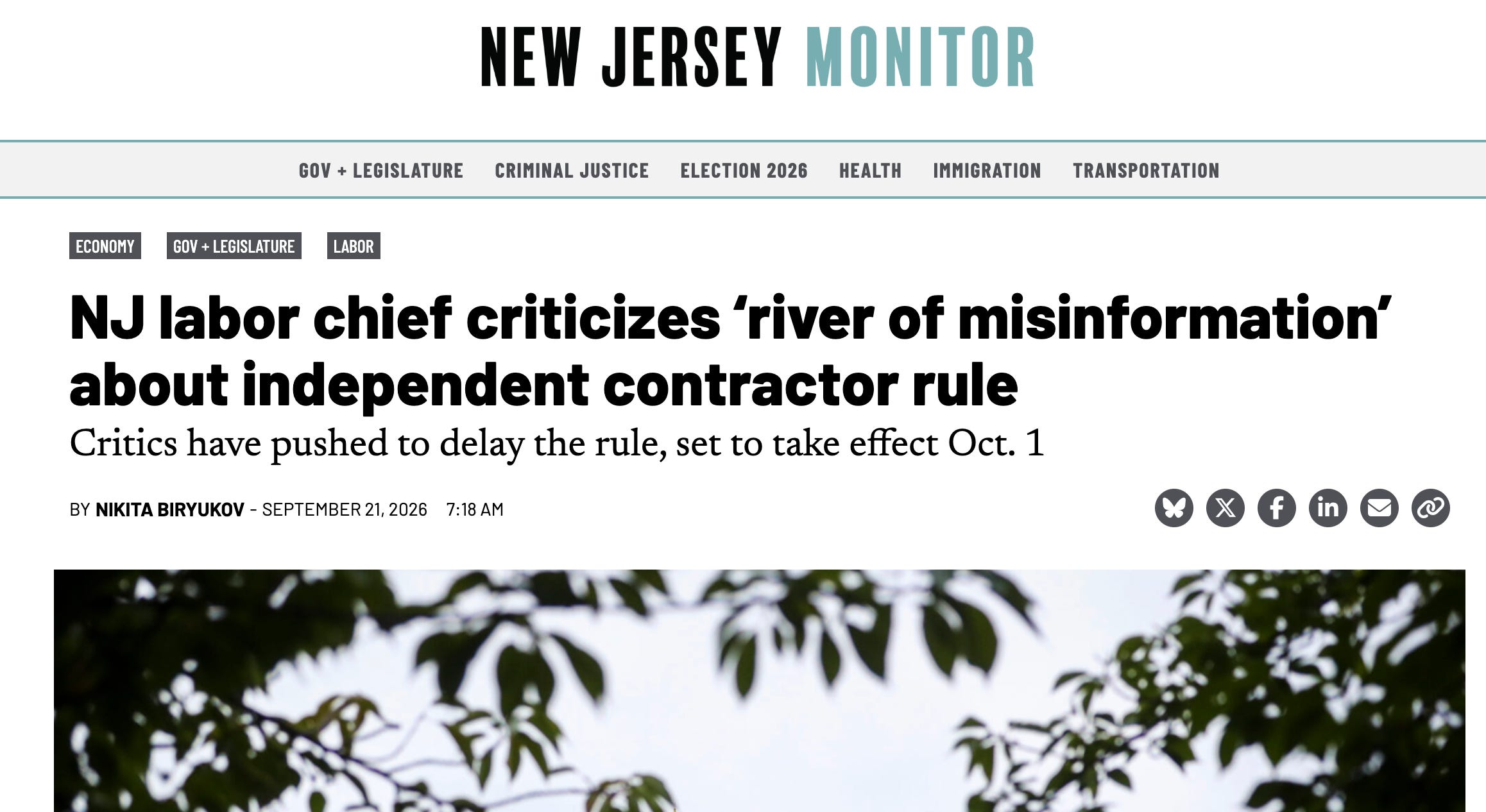
Among the things Jarvis says in this article, trying to defend the way the New Jersey Labor Department plans to interpret the ABC Test to determine who is a legal independent contractor:
“There’s absolutely some frustration because we’re swimming upstream against a river of misinformation. This is not a new test. This is not a change in enforcement. The reason the regulations were adopted is because the New Jersey Supreme Court recommended the department exercise its regulatory authority.”
Jarvis also is quoted as saying:
“All the groups I keep hearing from who keep saying it’s going to take away their flexibility or it’s going to change how they do their business and it’s some sort of an expansion, I’ve asked on multiple occasions for someone — anyone — point to me what specific reg is different than the way it was before. I’ve yet to get an example.”
The reporter added, citing Jarvis for attribution without directly quoting him:
Employers are not barred from giving employees flexible hours, Jarvis said, and law does not limit workers to a single job.
I seriously do not know where to start with this article. Those three blocks of text are such a lawyerly parsing of words that do a masterful job of obfuscating the whole truth, we all should see what acting Commissioner Jarvis said as a work of true creative art.
So let’s go big time here. Let’s go really long. Since we have less than two weeks left before New Jersey’s freelance-busting rule will take effect—and since at least some members of the New Jersey Legislature are still apparently confused about why they need to step in and stop these relentless, remorseless attacks on our incomes and careers—let’s go all the way back to 2013 and set everybody straight on as many of the facts as I can fit into one of these Substacks.
Because in order for everyone to understand what’s happening right now in my home state of New Jersey—and to understand why acting Commissioner Jarvis is leaving out so much of the rest of the story—you have to realize that we have been here before. There’s been a buildup to this moment.
Quite a big buildup, actually. One that spans from sea to shining sea.
And year after year, time and again, it’s been our side that has always ended up being proven right in the end, no matter how many “officials” like Jarvis point their fingers at us and accuse us of being wrong.
David Weil: The Philosopher King of Freelance Busting
Believe it or not, a lot of what’s happening here in New Jersey in the year 2026 started more than a decade ago in Washington, D.C.
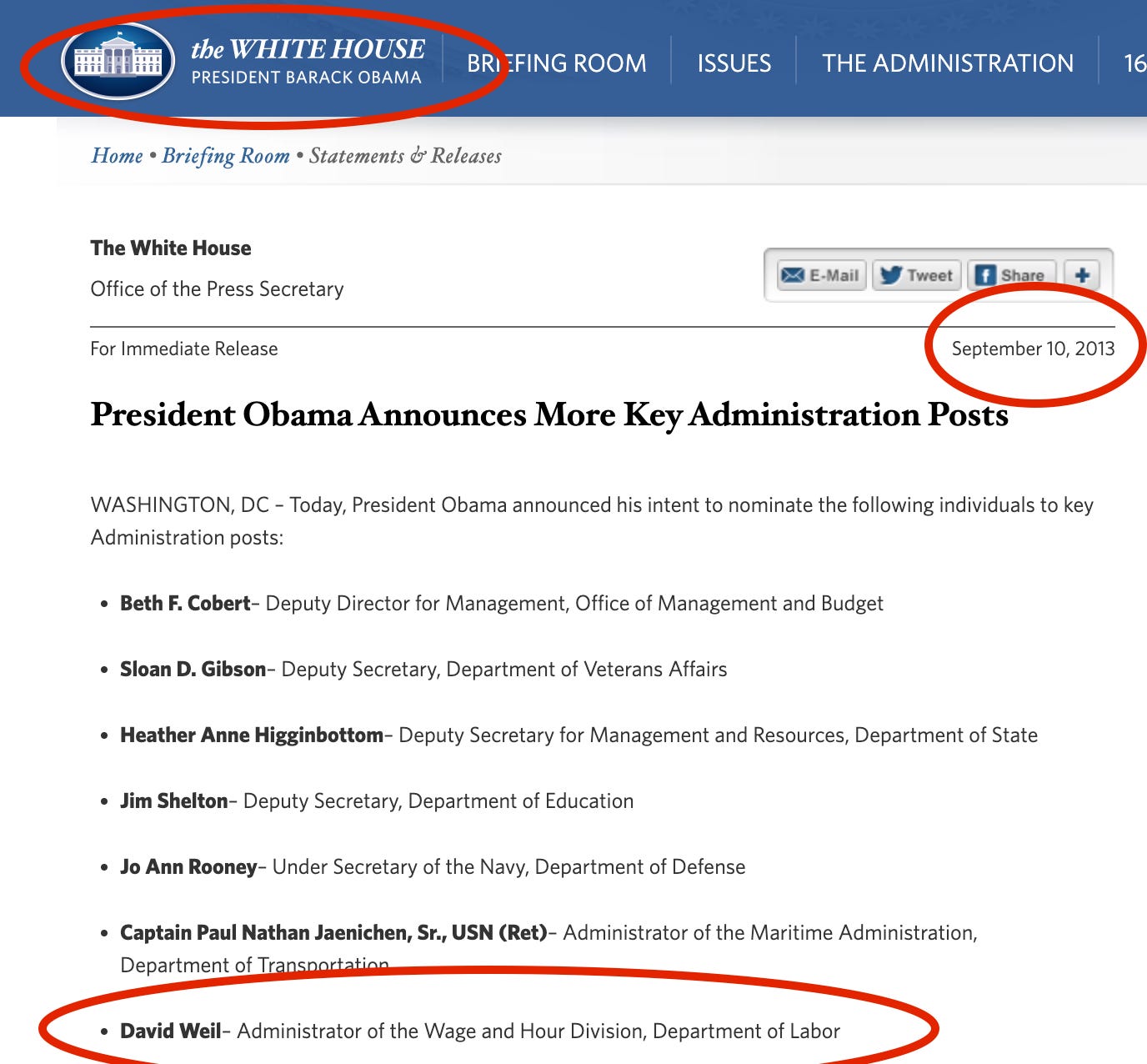
In September 2013, President Obama nominated an academic named David Weil to serve as administrator of the Wage and Hour Division of the U.S. Department of Labor. It looked like any other nomination, put out from the White House in a list:
Weil, by the time he was nominated to this significant role in the federal government, had been writing for the better part of two decades about his ideas to help regrow unions. He’d written about how there were basically two ways to think about nonconforming people like independent contractors. One way, he wrote, is that we are “a fundamental challenge to unionism.” Another way, he wrote, is that we are a “strategic challenge” that requires unionists to “develop methods to organize and represent” us.
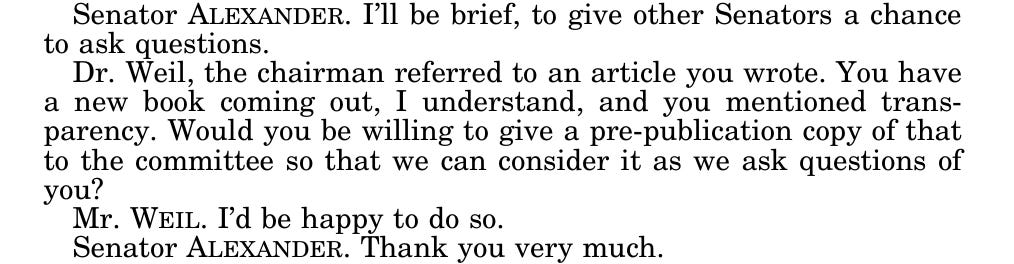
In December 2013, Weil had his confirmation hearing before the U.S. Senate HELP Committee, where it came out in an exchange with U.S. Senator Lamar Alexander, a Republican from Tennessee, that Weil was working on a new book:
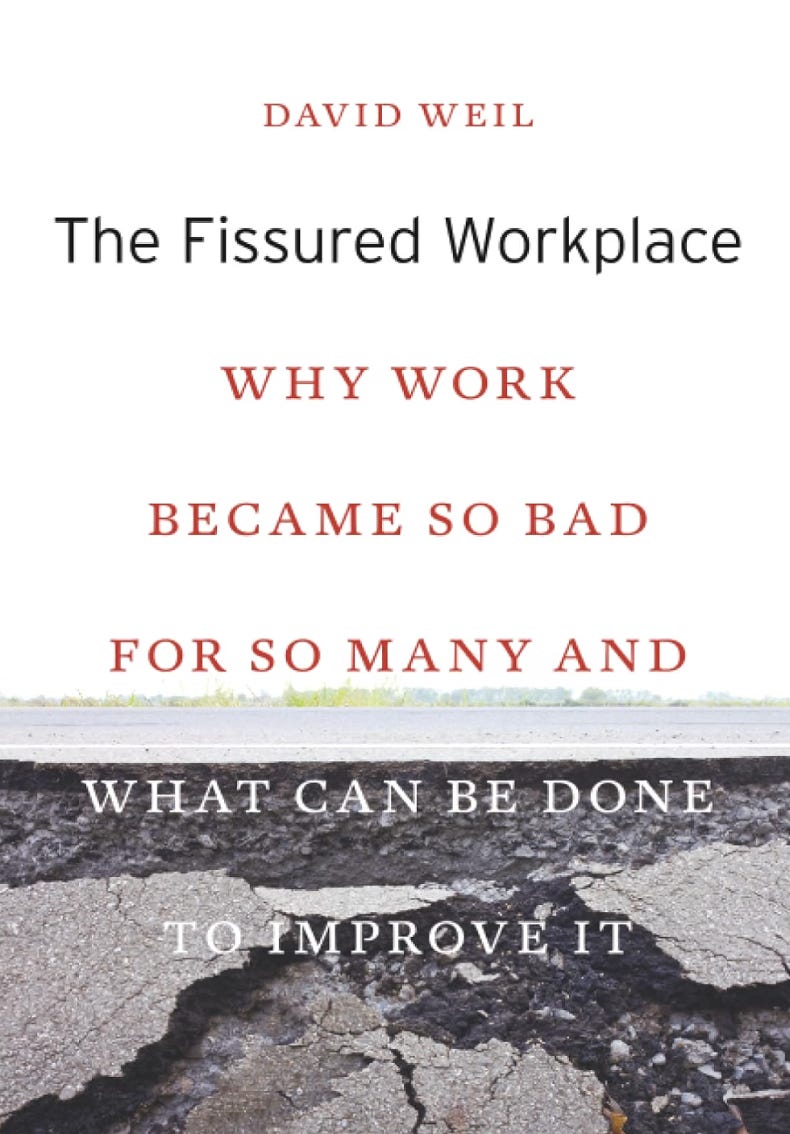
As it turned out, that book, released about two months later in February 2014, was a 424-page diatribe that Harvard University Press published about everything that’s wrong with independent contracting in America.
Weil didn’t seem to speak with any independent contractors while researching his book—not that there weren’t plenty of us who could’ve set him straight in a nation where only 8% of us of us would rather have the kind of traditional job that Weil wants to force us all into.
Instead, Weil made the case that we’re all essentially victims of a broken system. He coined a term—the fissured workplace—to describe his idea that the government needs to put our nation’s way of working back together into his ideal of more unionized company employees.
Two months after that book landed, in April 2014, the U.S. Senate confirmed Weil for the U.S. Labor Department role. And a little more than a year after that, in July 2015, Weil decided not to wait for Congress, the courts or any kind of a public-comment process to play out before he instituted his own personal beliefs nationwide.
Pay close attention: This is the first part that’s an awful lot like what’s happening in New Jersey today.
From inside his lofty perch at the U.S. Department of Labor in 2015, Weil issued what’s known as an interpretation. He basically said sure, the Fair Labor Standards Act exists as words on paper. It’s a law that Congress passed in 1938. It’s not new. But from here on out, this is the new way that I’m going to interpret what this law means as I enforce what I perceive to be violations of it.
Attorneys at the time wrote:
“Under the statute's definition of employment, the DOL would find that most workers qualify as employees, not independent contractors. … The bottom line is that businesses are facing a time of unprecedented uncertainty as the government continues to change the definition of both who is an employer and who is an employee.”
More attorneys at the time wrote:
“The DOL’s new interpretation of the FLSA test for classification purports to eliminate independent contractor status for most workers … Purportedly spurred by the receipt of ‘numerous complaints from workers alleging misclassification’ and the history of ‘successful enforcement actions against employers who misclassify workers,” the interpretation ignores decades of legal precedent concerning the classification of employees and independent contractors in a way that will now challenge many legitimate independent contractor relationships.”
Weil’s interpretation of who would get to earn income legally as an independent contractor didn’t last long at the U.S. Labor Department. The first Trump administration came in and withdrew it, and it no longer exists.
But the idea was planted about independent-contractor policy, that it was possible to turn all kinds of self-employed people into unionizable employees not just by passing new laws, but also by issuing new interpretations of existing laws.
And that idea was about to spread all across the country, ultimately leading to what we are experiencing in New Jersey right now with the ABC Test.
The Strategy Meetings
In 2018, a report came out, co-authored by four members of Congress: Mark DeSaulnier of California, Mark Pocan of Wisconsin, Donald Norcross of New Jersey and Debbie Dingell of Michigan.
This report makes clear where the foursome, all big union supporters, got a lot of their ideas:
“In March 2016, after working together on the U.S. House Committee on Education and the Workforce, Congressmen Mark DeSaulnier and Mark Pocan met with Wage and Hour Administrator Dr. David Weil from the Obama-era Department of Labor.”
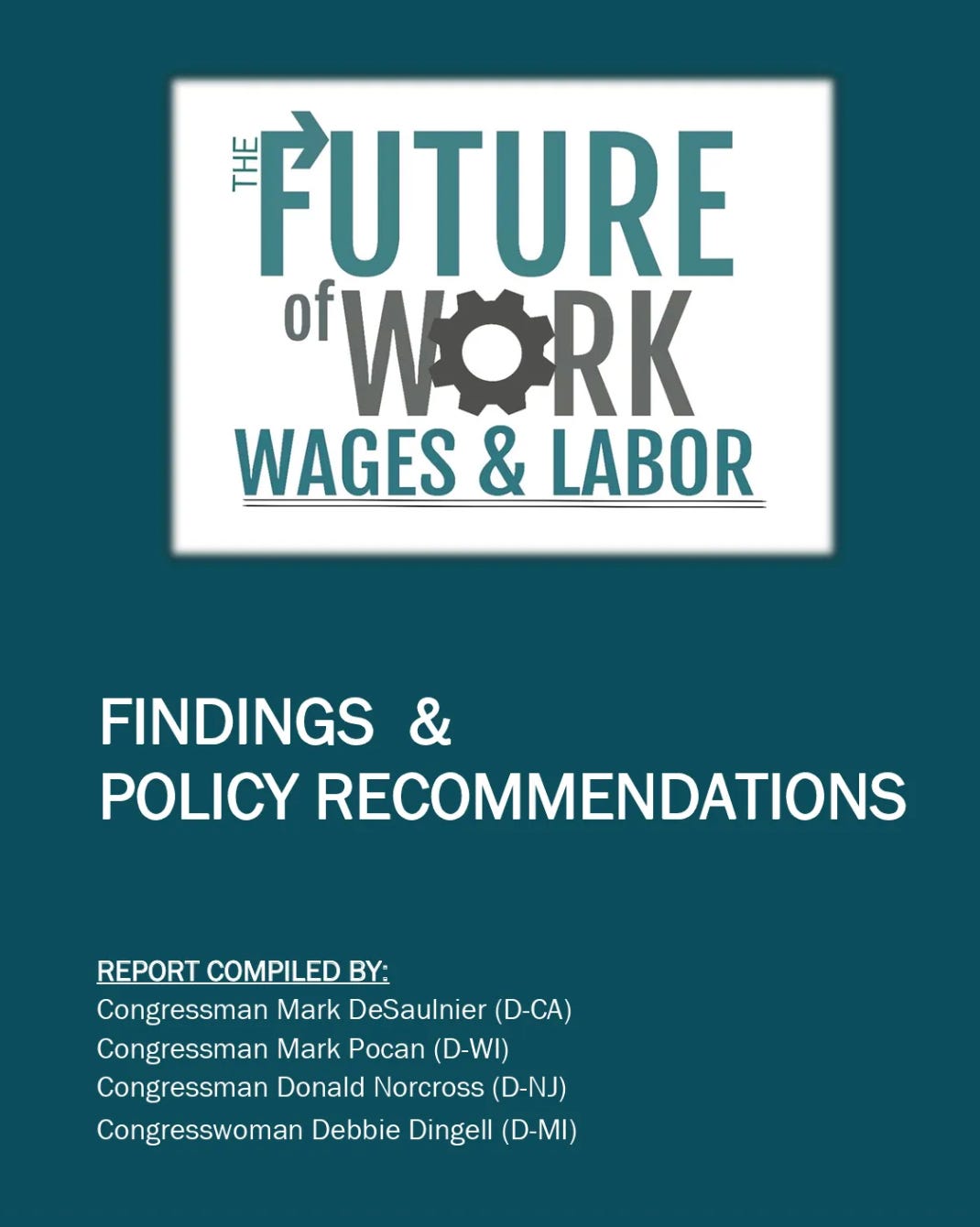
This report waxes poetic about labor unions, stating things like:
“Every person in the labor market today owes a debt of gratitude to labor unions.”
“The benefits of being represented by a labor union are also numerous.”
“Empirically, union members are in many ways better off than their non-union counterparts.”
It then goes on to channel David Weil’s thinking about making new laws and changing interpretations of existing laws so that more people would be considered unionizable employees—and it adds specific policy prescriptions.
For instance, this report talks about redefining all workers as employees, rightfully or not, across any industry “where misclassification and fissuring are endemic.” Who decides what endemic fissuring means? Ostensibly, the same people who want more of us to be reclassified as unionizable employees against our will.
This report talks about requiring companies that hire independent contractors to provide contact information for local administrative agencies, workforce development boards and legal services organizations that could help the independent contractors contest their employment status—with any companies that failed to do so being liable for damages.
This report describes ideas that the authors themselves call “admittedly radically different,” such as the government granting a union collective bargaining power across entire industries or sectors, instead of giving the employees at each workplace a vote on whether they actually wish to join a union at all.
And then, with these and other policy prescriptions laid out in detail, this band of merry unionists held meetings in select locations across the country to share their ideas with people who just might be able to turn them into real-life policy.
Look at the report’s list of who attended the August 2017 meeting in New Jersey:
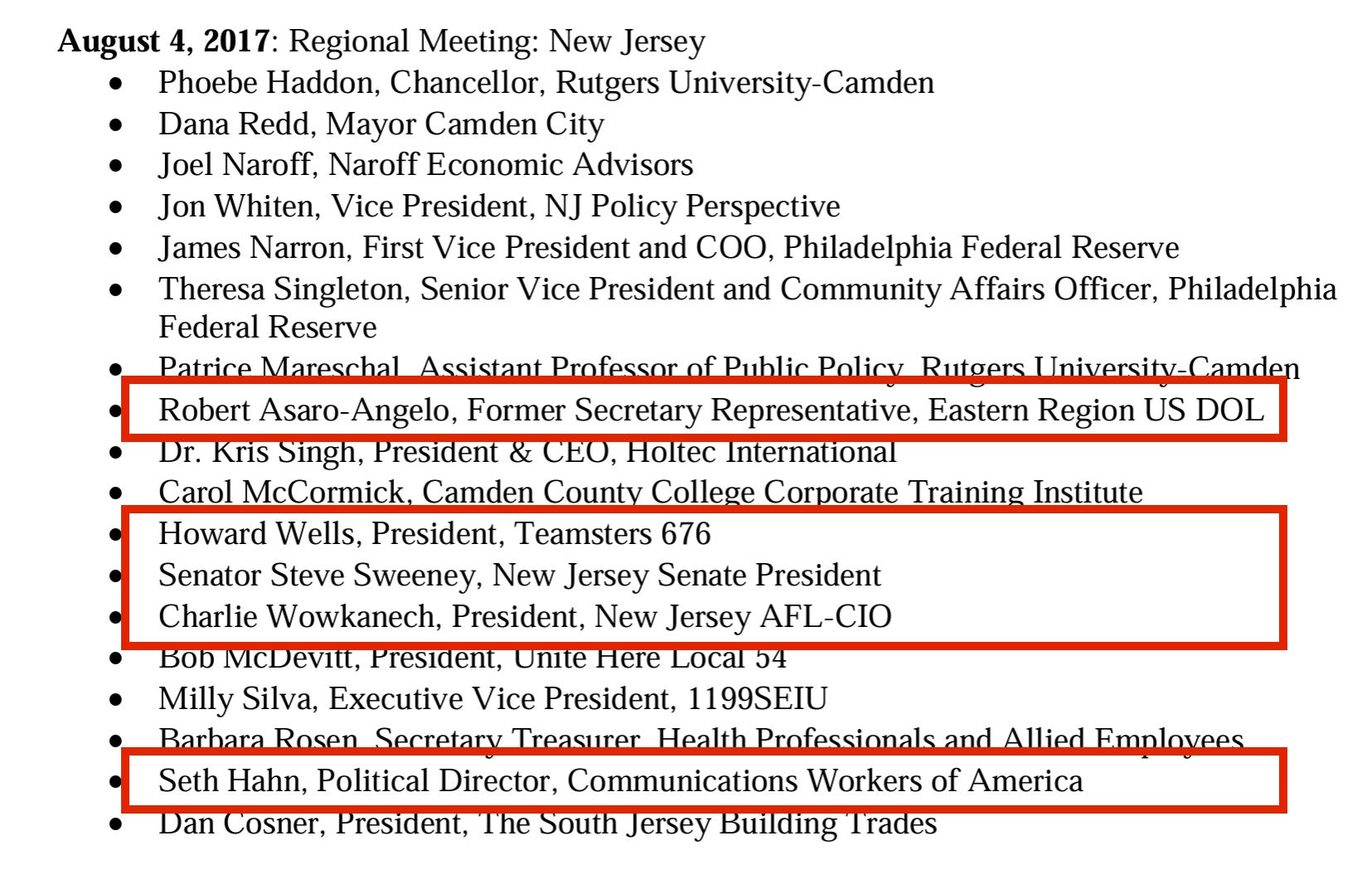
New Jersey Senate President Steve Sweeney would go on to introduce ABC Test legislation in 2019, threatening the livelihoods of independent contractors all across the state while Charlie Wowkanech of the New Jersey AFL-CIO and the Teamsters cheered him on.
Robert Asaro-Angelo would go on to become New Jersey Labor Commissioner during the administration of Governor Phil Murphy, and to propose the ABC Test independent-contractor rule that his successor, acting Labor Commissioner Kevin Jarvis—himself a former New Jersey AFL-CIO employee—is currently trying to defend, also with the AFL-CIO and the Teamsters cheering them on.
Seth Hahn would go on to become executive director of the Assembly Majority Office, giving him the ear of Assembly Speaker Craig Coughlin, who recently got an award from the New Jersey AFL-CIO and, thus far, has refused to speak out about protecting independent contractors the way numerous other members of Democratic Party leadership have done.
And what, you ask, actually happened when all of these men and their union brothers and sisters actually started to put their strategies into motion in the real world?
Total chaos, and the continuing organization of pretty much everyone—against them.
California, 2018-19
There were a couple of meetings in California to push the Weil-inspired thinking, too: in August 2016 at the University of California campus in Los Angeles, and in January 2017 in Northern California. Those meetings happened prior to April 30, 2018, which is when the California Supreme Court made a landmark ruling in a case known as Dynamex Operations West.
This court ruling was a big deal in the world of independent-contractor policy. And notably, a mention of Weil’s book The Fissured Workplace showed up in this ruling, which seemed to impose the ABC Test out of the clear blue sky to determine independent-contractor status in California.
Years later, members of the California Advisory Committee to the U.S. Commission on Civil Rights would describe what happened as a situation of judicial activism:
“In 2018, the California Supreme Court decided Dynamex v. Superior Court, a classification case. None of the Dynamex parties proposed the adoption of a brand-new test for classification when the case was briefed or in the lower courts. Long after the case had been briefed, and just weeks before oral argument, the California Supreme Court invited the parties to submit letter briefs on whether it should adopt a new test. Less than three months after oral argument, the California Supreme Court, without prompting from the litigants, unilaterally and retroactively, imposed the ‘ABC Test’…”
Now, that Dynamex decision also included a line saying that California’s Legislature, of course, retained the authority to revise any provisions by enacting new legislation. Put another way, as many people have explained in the years since, the court made clear that the California Legislature could step in and stop what was happening with the ABC Test.
But that’s not what state Assemblywoman Lorena Gonzalez, a card-carrying Teamster, went on television and told everyone across the state. Gonzalez—who today is the head of the California Federation of Labor Unions, AFL-CIO—instead made it seem as if the Legislature’s hands were tied, and as if California’s lawmakers absolutely had to pass legislation known as Assembly Bill 5, or AB5, that codified this ABC Test from the Dynamex ruling.
Pay close attention: This is the second part that’s an awful lot like what’s happening in New Jersey today:
Contrary to what she said there, Gonzalez made clear on Twitter what the ABC Test law was actually intended to achieve:
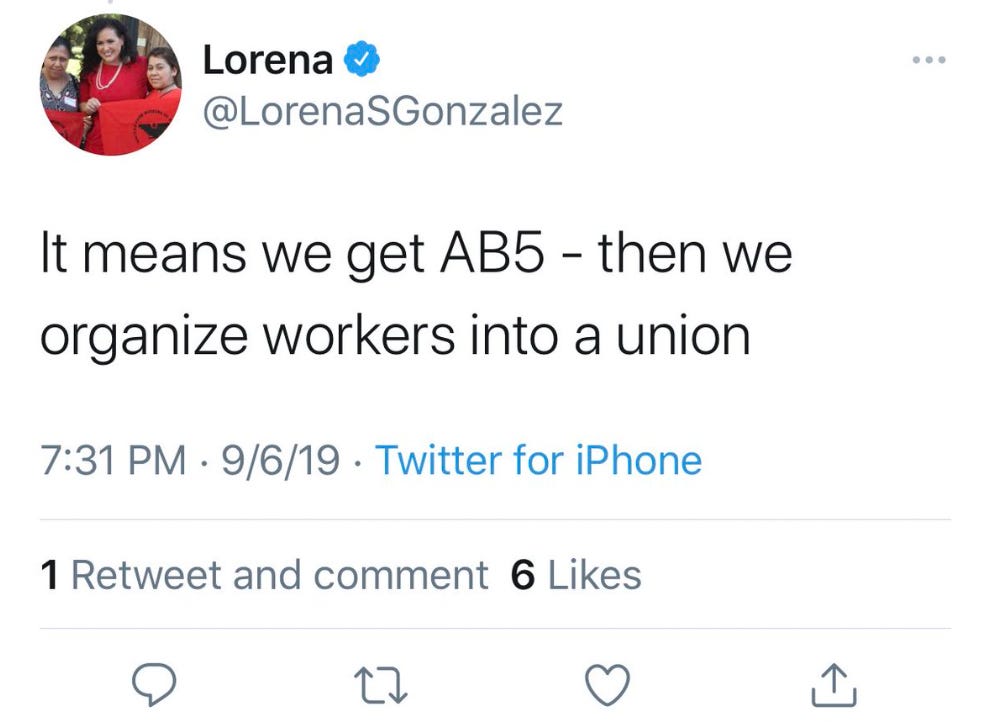
And Gonzalez didn’t seem to care how many independent contractors lost their incomes and careers as she and her unionist friends attempted to set this process in motion.
As reported in The Orange County Register:
“Freelance jobs are ‘feudalism,’ says California Assemblywoman Lorena Gonzalez. … Once the bill passed, Vox media cut hundreds of freelance writing jobs. When Gonzalez was asked if she felt bad about that, she sneered, those weren’t ‘real jobs.’”
Gonzalez also didn’t seem to have any problem with using mischaracterized research to try and convince everyone that a widespread crackdown on independent contractors was necessary.
Pay close attention: This is the third part that’s an awful lot like what’s happening in New Jersey today:
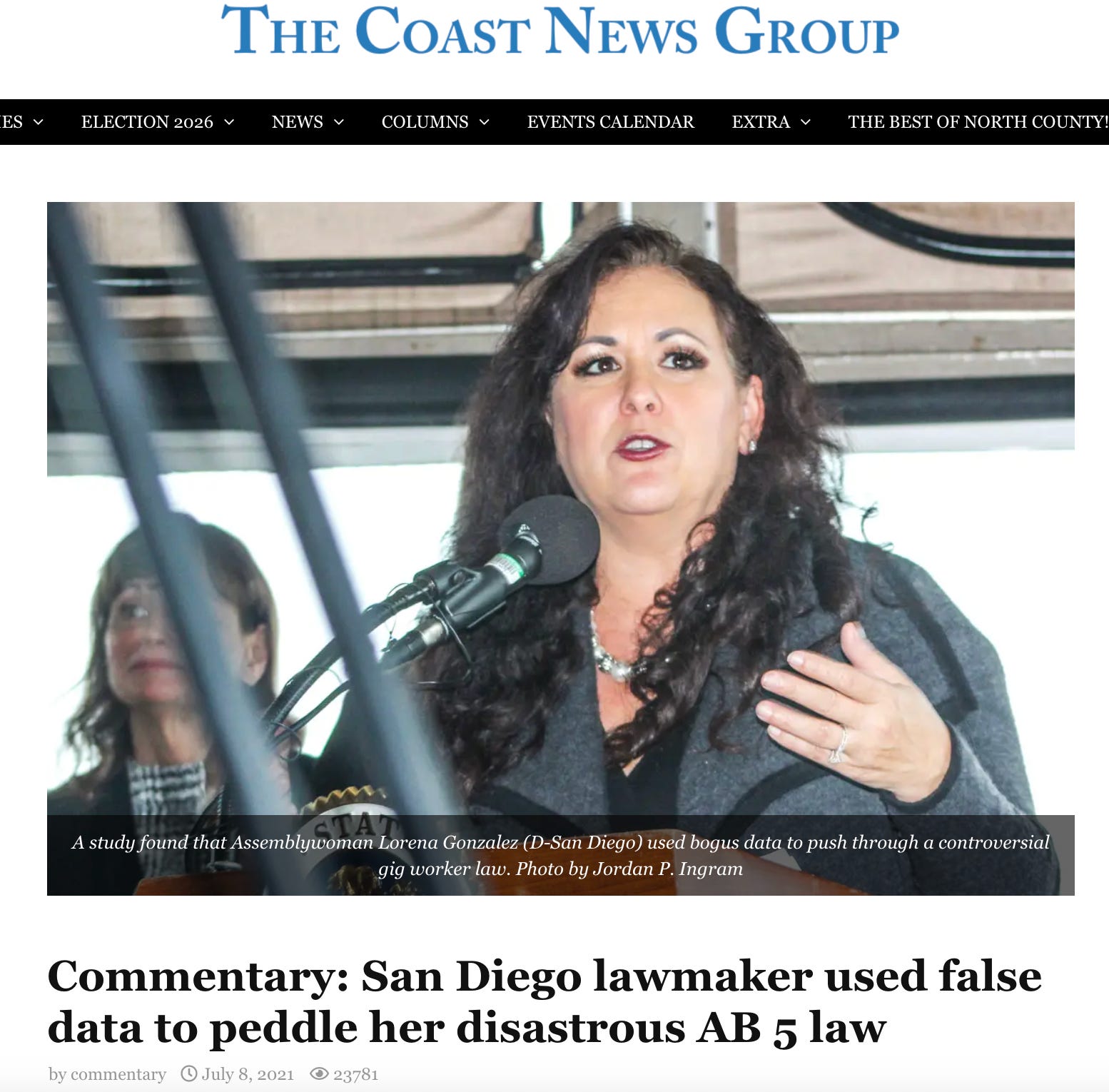
“A former union organizer turned legislator in District 80, Gonzalez has stated repeatedly that the state of California loses $7 billion a year in payroll tax revenues because of independent contractors.
“As it turns out, her claim is without evidence and has no basis in fact, according to William Hamm, managing director of Berkeley Research Group’s San Francisco Bay Area office. His team helped lead a study beginning in 2019 about the fiscal impact of independent contracting in California.
“‘Her claim is utter nonsense,’ said Hamm, former head of the non-partisan Legislative Analyst’s Office in California. ‘Anyone who cites this $7 billion number is doing so knowing full well that it is completely bogus.’”
The actual result of California’s ABC Test law, according to that same Legislative Analyst’s Office, was somewhere in the neighborhood of 1 million people being affected. Union membership, in the years that have followed, continues to be down. Economists at the Mercatus Center found that the ABC Test law in California preceded a 10.5% decrease in self-employment on average for affected occupations, as well as a 4.4% decrease in overall employment on average for affected occupations.
The economists had to write “affected occupations” because the California Legislature ultimately went back and exempted more than 100 professions from the ABC Test law so that people could try to keep earning a living as independent contractors. As one attorney wrote about what he called “a flawed piece of legislation from the very beginning”:
“… consider the fact that while the rules for who AB 5 applies to are a mere 325 words, they’re followed by almost 7,000 words worth of carveouts.”
The ABC Test injected into the Dynamex court ruling via judicial activism and then expanded through legislation was a disaster.
A disaster that the State of New Jersey—led by Senate President Steve Sweeney—immediately tried to copy.
New Jersey, 2019-20
In November 2019, just two months after California Governor Gavin Newsom signed that state’s ABC Test bill into law to limit the use of independent contractors, New Jersey Senate President Steve Sweeney introduced New Jersey Senate Bill 4204, a virtual copycat of California’s catastrophic freelance-busting language.
Now, at the time, Sweeney swore up and down to high heaven and whatever might possibly be above it that he was absolutely, positively, under no circumstances trying to copy California’s ABC Test law.
Pay close attention: This is the fourth part that’s an awful lot like what’s happening in New Jersey today.
As reported by InsiderNJ back in 2019:
“These bills will simply codify into law existing regulations so that future administrations can’t ignore, change or discard the protections already in place to protect workers against the loss of basic rights by being misclassified,” said Senator Sweeney, the sponsor of the Senate bill. “We want to put into law the current regulations to ensure their future viability. The amendments to the bill will continue to ensure the ability of legitimate independent contractors to pursue their work at the same time they safeguard against misclassification.”
The legislation is not the same as the California law.
When some of us said in testimony and wrote in op-eds that, um, this Sweeney bill absolutely was an attempt to copy California and wipe out independent contractors here in New Jersey too, Sweeney responded with an op-ed of his own, in The Asbury Park Press.
Sweeney used the word “misinformation” and compared us to “Russian operatives trying to interfere in our elections.”
Yup. Our own state Senate President actually wrote that about independent contractors like me.
And of course, Sweeney was ultimately proven to be the one spreading misinformation. His ABC Test bill later failed to advance, and years after that—amazingly, within the text of the ABC Test rule that acting Labor Commissioner Jarvis is currently trying to defend—the State of New Jersey finally acknowledged that we were the ones who were telling the truth back in 2019 about what our own government was trying to do to us:
“As to the 2019 New Jersey bill (S4204), as introduced, it would have altered New Jersey’s statutory ABC test in ways that made it virtually identical to the ABC test in California AB5.”
So, there’s that bit of actual truth. There were also repeated failures in Congress that followed as the merry band of unionists tried to pass the Protecting the Right to Organize Act, which would have injected California’s horrific ABC Test into federal law to crush independent contractors nationwide, a move that the former head of the National Labor Relations Board wrote would “substantially unravel and change large segments of the US economy.” That apparently sounded great to the AFL-CIO. Its top boss at the time even joined forces with the Democratic Socialists of America to try and make it happen.
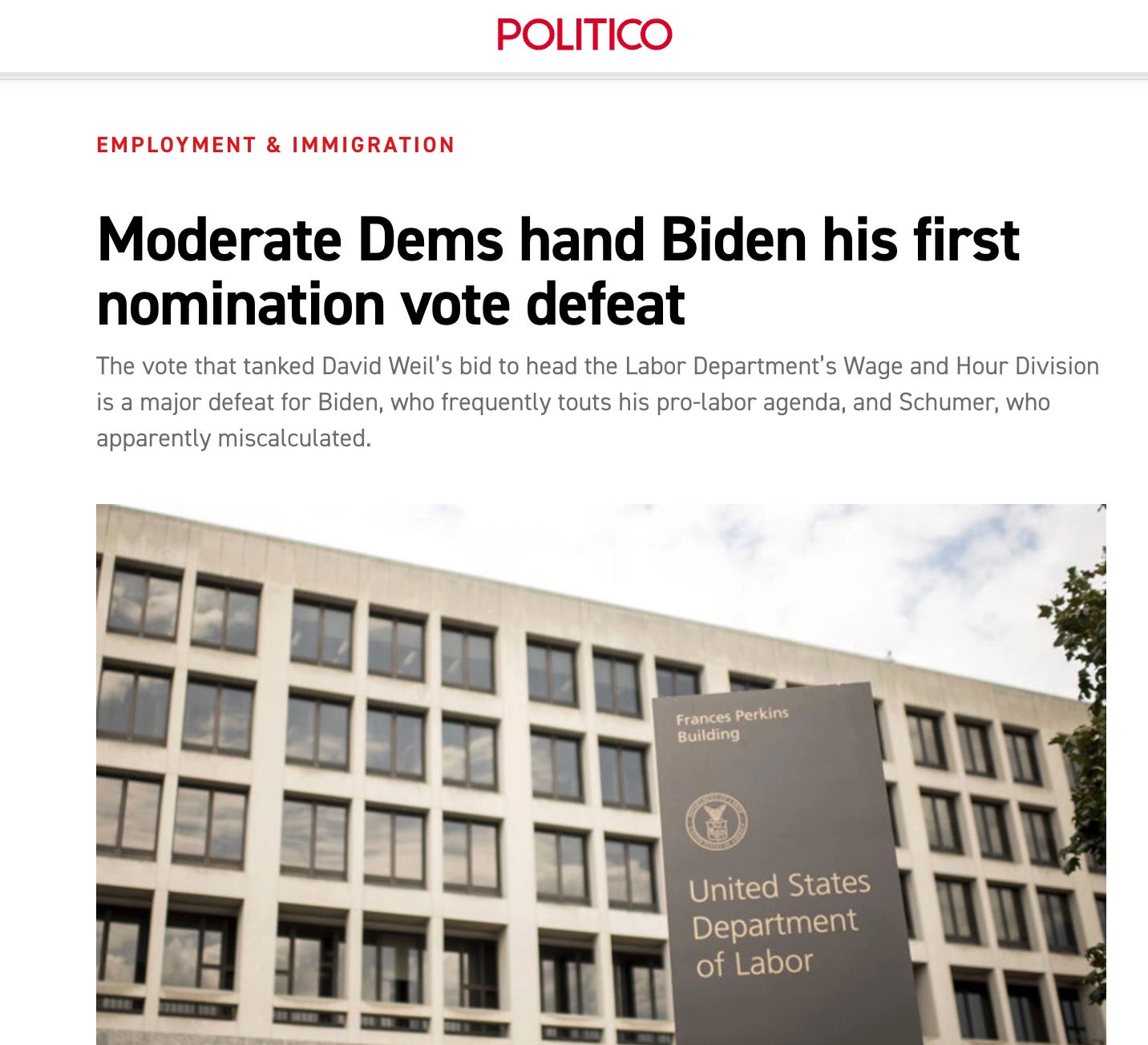
And lest we forget, there were also the moderate Democrats who stepped in to stop President Biden’s attempt in 2022 to bring back the Philosopher King of Freelance Busting, David Weil, as Wage and Hour Administrator at the U.S. Labor Department:
All of which brings us to what’s happening right now in New Jersey—and how the decidedly un-moderate administrations of Governor Phil Murphy and Governor Mikie Sherrill are still trying to spread this freelance-busting ABC Test lunacy with the strong backing of the AFL-CIO, in particular.
New Jersey, 2025-Present
When Governor Murphy’s labor commissioner, Robert Asaro-Angelo, proposed the ABC Test rulemaking in 2025, the state Labor Department’s press release repeated a lot of things that you just read about above, all of which turned out to be bunk.
There was the bit in New Jersey’s press release that’s reminiscent of what David Weil did at the U.S. Department of Labor, about how the ABC Test wasn’t changing in New Jersey, and only the state Labor Department’s interpretation of the law was being codified:
“Those new rules at N.J.A.C. 12:11 would codify the NJDOL’s interpretation of the ABC test for independent contractor status…”
There was the bit that’s reminiscent of what Lorena Gonzalez said in California, about how this rulemaking was just the New Jersey Labor Department doing what the courts had urged in a unanimous decision:
“The proposed new rules stem from the NJDOL’s interpretation of the statutory ABC test, and are informed by binding decisions of the Appellate Division of the New Jersey Superior Court and the New Jersey Supreme Court, including the New Jersey Supreme Court’s 2022 unanimous ruling in East Bay Drywall LLC v. Department of Labor and Workforce Development, in which the Court expressly suggested ‘that the Department exercise its statutory authority and expertise… to promulgate regulations…”
And as a sweet cherry on top, the New Jersey Labor Department’s press release added a nugget about how Governor Murphy’s Task Force on Misclassification had issued a “comprehensive report” about the problem of employee misclassification—a report that, also in California style, has since been shown to contain all kinds of mischaracterized data and research.
Now, if you’ve read this far, you already understand the kinds of damage that a horribly overreaching bureaucratic interpretation of existing law can do, even if that existing law is really old. A new interpretation can almost entirely eviscerate anyone’s ability to be an independent contractor—which is how attorneys described the proposed New Jersey rulemaking in 2025. They called the Labor Department’s originally proposed interpretation of the existing ABC Test an existential threat to independent work itself.
You also know at this point that when one of these unionists claims they’re just trying to codify something because of some ruling that came down in the courts, you need to dig a little deeper.
And when you do that in New Jersey, you see that the East Bay Drywall ruling in no way, shape or form said the state’s Labor Department should create an independent-contractor rule with what experts called unprecedented interpretations of the ABC Test, interpretations that numerous state Senate committee chairmen said seemed to be outside the bounds of statute and case law.
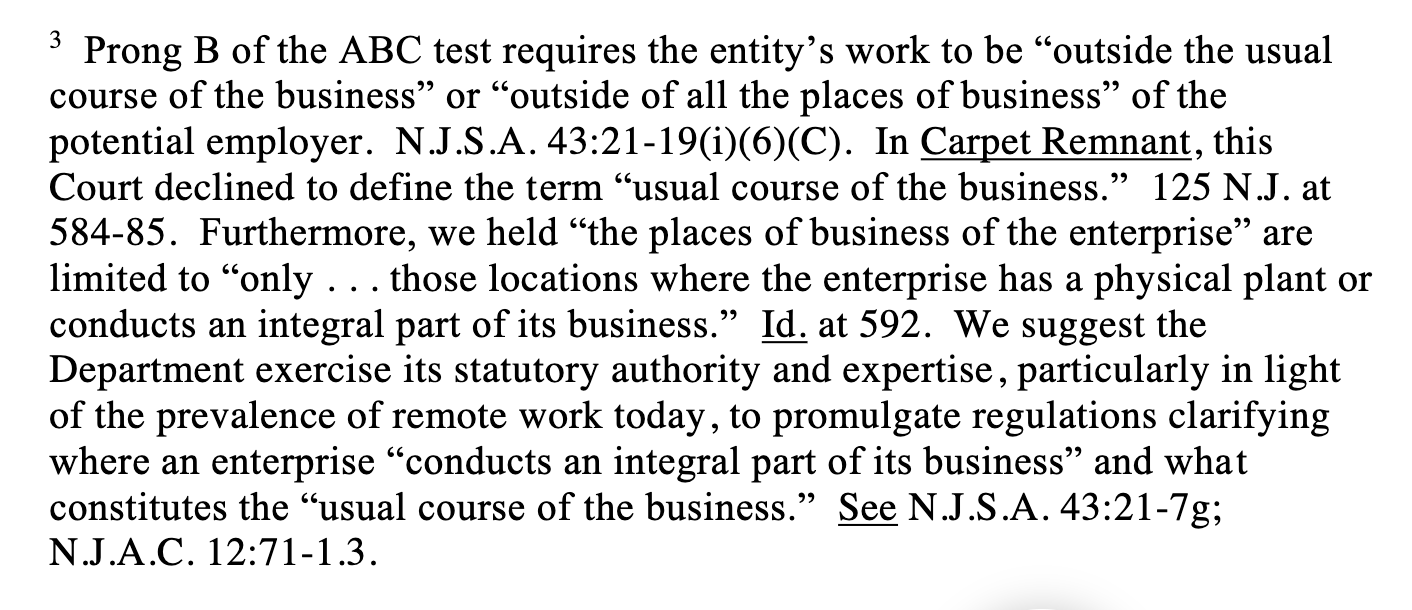
What actually exists in the East Bay Drywall ruling is a single footnote that says some kind of clarification is needed, because nobody could determine the meaning of the words in the ABC Test regulatory language anymore:
And it was on that note that the ABC Test rulemaking to determine independent-contractor status went forward in New Jersey, despite all the evidence that came before it of just how destructive it would be. This rulemaking led yet again to the AFL-CIO and the Teamsters cheering amid massive public outcry—this time including 99% opposition in written public comments, along with a couple dozen letters from lawmakers on both sides of the political aisle expressing concerns, and research from economists showing that the way New Jersey is applying the ABC Test is already causing harm, in fact, disproportionately to women.
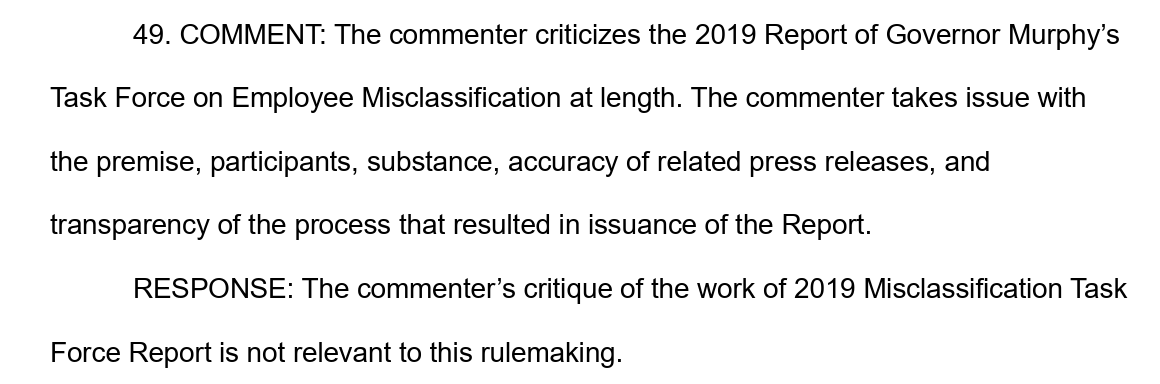
New Jersey’s Labor Department ignored virtually all of that pushback. Instead, the adopted rule states outright that the evidence about data and research being mischaracterized in the Murphy Task Force Report is irrelevant, even though the Department itself cited that very same Task Force Report as “comprehensive” when it announced the ABC Test rulemaking:
The adopted rule also states that the Labor Department will not consider any of the challenges it received with regard to the economic impact of what it’s doing with the ABC Test rulemaking:

Now, it’s true that the version of the rule that New Jersey’s Labor Department adopted—the version that’s scheduled to take effect October 1—did scale back some of the truly insane interpretations of the ABC Test that the Labor Department said it was merely trying to codify because it was already using them (apparently without the Legislature’s consent or knowledge).
But even so, there are still big problems with the adopted rule, including the fact that nobody can seem to tell us independent contractors how to pass the part of the ABC Test that says we have to prove we’re running a business.
As attorneys noted:
“Under Prong C, the final regulations still specify that holding a professional license, having multiple employers, registering a business entity, receiving a 1099 tax form, or carrying insurance are not individually sufficient to establish an independently established business.”
Think about it: If registering a business entity isn’t enough to prove that you’re doing business as a business entity, then how do you prove you’re in business?
There’s also the fact that in recent testimony at the State House involving the New Jersey AFL-CIO, it came out that there doesn’t actually seem to be widespread employee misclassification across all kinds of professions in the first place.
That’s right, it’s California-style craziness in New Jersey yet again. This whole policy mess is happening because, supposedly, we have this massive problem of employee misclassification that needs to be resolved.
And yet, in a state with an estimated 1.7 million independent contractors, testimony recently revealed that New Jersey’s Labor Department is only receiving about 700 claims a year of this nature, and almost all of them are coming from just one kind of worker: rideshare and delivery drivers.
Which is how we got to where we are now, just as with Steve Sweeney back in 2019, with acting Labor Commissioner Jarvis claiming “misinformation” in the press.
Because if people can’t win a debate on the facts, they will always attack the messenger.
And oh, what a stupendous attack yesterday’s against us was.
Yesterday’s Kevin Jarvis Quotes
Take another look at the quotes that New Jersey acting Labor Commissioner Kevin Jarvis gave to the New Jersey Monitor yesterday, and think about them again in the context of everything you just read above.
“This is not a new test.”
Yes, that’s true—the ABC Test in New Jersey is not new, in the same way that the Fair Labor Standards Act wasn’t new when David Weil decided to interpret it in a completely new way, and the same way that the ABC Test wasn’t new when California decided to use it in a new way.
Just because the language on the page isn’t changing doesn’t mean the effects of interpretation and implementation are staying the same.
“This is not a change in enforcement.”
Also likely true—and also likely an admission, not a reassurance.
As testimony and public comments keep making clear, and as New Jersey’s Labor Department itself said in its own press releases about this rulemaking, what it’s doing is codifying the Department’s interpretation of the ABC Test. It’s an interpretation the Department has apparently been using for years, an interpretation that has at various points in this process been revealed to be outside the bounds of statute and case law, and unprecedented in the nation.
That doesn’t make it right. It makes it a big problem of bureaucratic overreach that the Legislature needs to step in and correct.
“The reason the regulations were adopted is because the New Jersey Supreme Court recommended the department exercise its regulatory authority.”
True, there is a footnote in a court case saying the Labor Department should clarify what, exactly, the ABC Test means, because this test to determine independent-contractor status has become so unwieldy that nobody can tell for sure anymore—but that still doesn’t make what the agency is doing appropriate or reasonable with the ABC Test.
This entire rulemaking process has revealed that what the New Jersey Labor Department is, in fact, doing is precisely the opposite of appropriate and reasonable.
“I’ve asked on multiple occasions for someone — anyone — point to me what specific reg is different than the way it was before. I’ve yet to get an example,” he said.
Apparently, acting Commissioner Jarvis failed to actually read any of the 9,500 or so public comments that were filed. Quite a few of them were from lawyers and policy experts who went on for pages and pages about all the problems this rulemaking would create, such as limiting care for disabled toddlers, making it really hard to meet provisions of the Voting Rights Act, and crippling the entire regional supply chain. You can read excerpts from a whole bunch of New Jersey’s public comments like these in a report I released this past February, titled Extremism vs. Entrepreneurism.
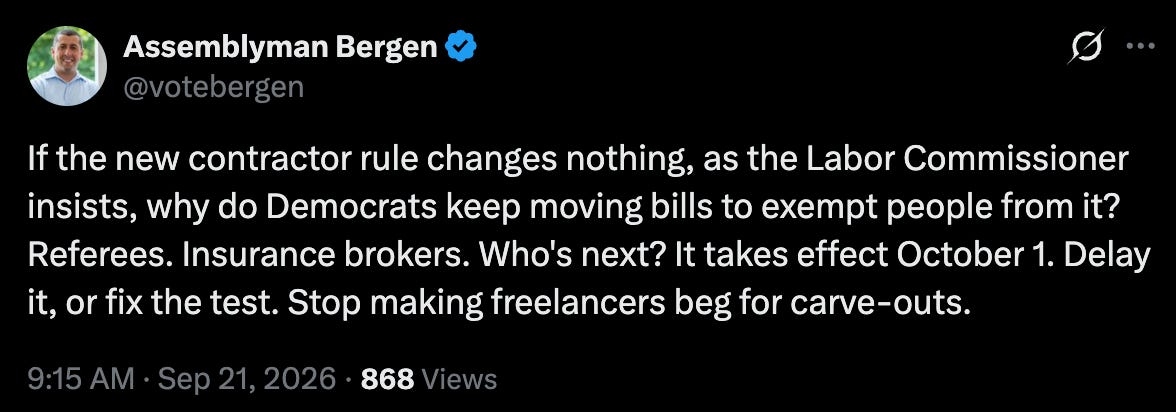
We’re talking about very real problems with the ABC Test rule that the New Jersey Legislature now also senses it must address by moving various bills to try and protect at least some kinds of independent contractors before the rule takes effect October 1.
As state Assemblyman Brian Bergen noted yesterday on X:
And let’s not forget this bit from acting Commissioner Jarvis in yesterday’s New Jersey Monitor:
Employers are not barred from giving employees flexible hours, Jarvis said, and law does not limit workers to a single job.
Well, that’s true too. Nothing in the law says a company can’t let the employees do whatever they want to do, whenever and wherever they want to do it.
There’s also nothing in the law that says companies can’t give every employee a million dollars, a Lamborghini and a pony. But I don’t expect that to happen anytime soon, either, especially if we’re all working multiple part-time jobs for multiple part-time bosses, like Jarvis says we all could be.
As if anyone would want to have multiple part-time jobs instead of being their own boss and running their own business.
And last but not least, my favorite of acting Commissioner Jarvis’ quotes from yesterday’s article:
“There’s absolutely some frustration because we’re swimming upstream against a river of misinformation.”
Sigh.
I sincerely hope that New Jersey’s Legislature will fix this ABC Test policy mess so that all of us can get back to working in the way that works best for us.
In addition to that, I also sincerely hope that our lawmakers will remember this accusation that acting Commissioner Jarvis hurled at us.
Jarvis should soon be scheduled for a confirmation hearing to determine whether he has the kind of integrity that we all want and deserve to see in our state’s appointed officials.
Our Legislature should hold him accountable.
For every single word.