

Last week, I wrote about a bill in New York City that the Teamsters are pushing alongside the Democratic Socialists of America. It’s called the Delivery Protection Act, and it would automatically turn all independent contractors who provide “core delivery services” into unionizable employees.
This bill specifically targets last-mile drivers at Amazon, a company that the Teamsters have long sought to unionize. The bill also fits beautifully into the socialists’ campaign called Unions for All.
I wrote that this “core services” concept wouldn’t be limited to New York City, and that it would not stop with delivery drivers. The unionists’ goal—just as with years’ worth of worker reclassification attempts and newer sectoral bargaining gambits—is to get a construct into the law that will allow boatloads of independent contractors to be turned into unionizable employees, all at once.
It took only one week for the freelance-busting brigade to reveal their next target city.

A City Council hearing has been scheduled September 15 for what’s being called the Chicago Delivery Protection Act. Just like the New York City bill, this one includes language about “core delivery services” and everyone who provides them needing to be an employee:
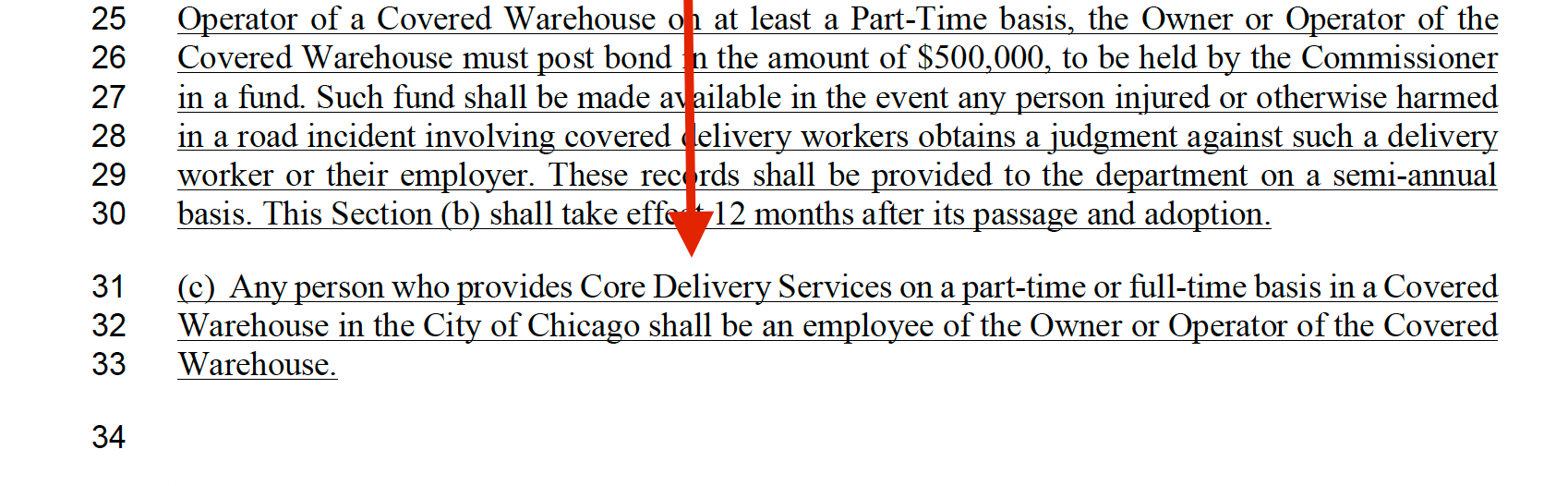
And in the Windy City, just as in New York, the Teamsters are pushing hard for the bill’s passage while trying to make sure all the headlines are about Amazon. They put out a press release yesterday in which Randy Korgan, director of the Teamsters Amazon Division, states:
“The movement to end Amazon’s dangerous DSP model is growing because workers are fed up with this company’s lies and mistreatment. Amazon Teamsters are leading the fight to hold Amazon accountable. We are calling on Chicago Alderwomen and Aldermen to defend everyday Chicagoans by passing the Delivery Protection Act.”
As I wrote last week, attempts to create a construct that will force more independent contractors into unionizable employee status always begin with Amazon or Uber in the headlines. This media narrative lulls the general public into believing this broader policy fight is between the unions and Big Tech.
But remove a single word—“delivery”—from future bills, and anything the government deemed “core services” for any kind of business or industry could only be done by unionizable employees.
Just as we saw in 2019 with California’s Assembly Bill 5 and the more than 600 professions it affected, and just as we saw last year when New Jersey put forward its independent-contractor rule that attorneys said would almost entirely eviscerate anyone’s ability to be an independent contractor, the ultimate goal is to sweep every possible worker in every conceivable profession under the union umbrella.
These “core services” bills are yet another variation on trying to achieve the goals that unionists detailed in 2018, when they called for “admittedly radically different” policies to try and shift entire industries into unionizable employee status.
You don’t have to be a genius to anticipate that more “core services” bills are about to pop up in more cities soon.
We’re also about to see if the pattern holds in Chicago of independent contractors standing shoulder to shoulder and fighting back.
They Topped Us by Three Hours
Back in 2019, when my home state of New Jersey tried to follow California’s ill-fated lead and reclassify all of us as unionizable employees through legislation, independent contractors flooded into a New Jersey Senate Labor Committee hearing to overwhelm the State House process with opposition testimony. Just as independent contractors had amassed by the thousands to fight back in California, those of us in New Jersey dominated four hours of our state’s six-hour hearing, one after the next telling lawmakers to stop what they were doing because it’s wrong.
Professional lobbyists from Trenton to Washington, D.C., still talk about that four-hour New Jersey hearing with amazement.
Well, lo and behold, New York City’s last-mile delivery drivers made their elected officials sit through a seven-hour hearing.
As Reason just reported:
“Ironically, NYC’s last-mile delivery bill is also being opposed by those it purports to help: The City Council hearing stretched to seven hours long as several hundred last-mile delivery workers unexpectedly showed up to testify against it. These workers make around $24 per hour on average and have employer-funded healthcare through the subcontracted companies.”
That same story in Reason also quotes one of my favorite attorneys, Alex MacDonald of the Littler firm, explaining exactly what’s going on here:
“As attorney Alex MacDonald has noted, this is part of a larger strategy being employed by unions in recent years: If they are unable to organize through ‘organic, boots-on-the-ground campaigns,’ they now lobby for laws like this one that ‘read like a shortcut to organizing.’ In other words, what can’t be accomplished by collective bargaining is pursued through direct regulation.”
We are seeing a variation of that unionist strategy right now once again in my home state of New Jersey, where MacDonald and I were both among the witnesses who testified this past May about the Legislature’s need to act in the face of a New Jersey Department of Labor & Workforce Development independent-contractor rule.
Far from being responsive to the will of the people—or even the will of the Legislature, which abandoned similar 2019 legislation amid widespread opposition—this New Jersey rule that’s scheduled to take effect October 1 is entirely of, by and for the union organizers:
It’s being imposed by an acting labor commissioner who used to work for the New Jersey AFL-CIO.
The only people who testified in favor of it at the Labor Department’s hearing were either on a union payroll or affiliated with organizations that have strong union ties.
The adopted rule outright states that it doesn’t matter if the research used to push it was inaccurate. It outright states that there’s not going to be any consideration of economic consequences.
It largely ignores the 99% public opposition to the rulemaking that the Department received in an estimated 9,500 written public comments.
In location after location, there are very good reasons why independent contractors keep saying “no” to all of this madness.
But union organizers keep insisting that elected officials change our answer against our will to “yes.” Chicago is just the latest hot spot on the map.
If You’re in Illinois…
I’m told that the Chicagoland Chamber of Commerce is leading the opposition in the Windy City. Give them a shout, and ask how you can help by making your voice heard.
At some point, the unionists trying ever harder to capture independent contractors against our will are going to figure out that the only thing they’re doing with these increasingly brazen actions is amassing even broader nationwide opposition—to them.
But that day is not today.
Today, it’s important for everyone to keep raising our voices and standing up for our freedom to work in whatever way works best for us.
The only silver lining I can see right now is the backlash against DSA is becoming stronger, even on the left, so if they are the new standard bearers for anti-freelance policies like these, maybe the bathwater can get thrown out with the baby.
Just like the Chicago City Council did with the city's proposed rideshare drivers unionization ordinance, look for this to be punted to Springfield for statewide legislation. Over a year ago, Chicago alderpersons were divided on rideshare drivers unionization. Petitions are currently being circulated for 2027 mayoral & city council elections, which take place in late February of next year. Chicago City Councilpersons will punt.