

The New Jersey Business and Industry Association, in partnership with the New Jersey Chamber of Commerce, has sent a letter to Governor Mikie Sherrill requesting a delay to the October 1 implementation date for the state’s independent-contractor rule that faces 99% public opposition.
You can read the letter in full here:
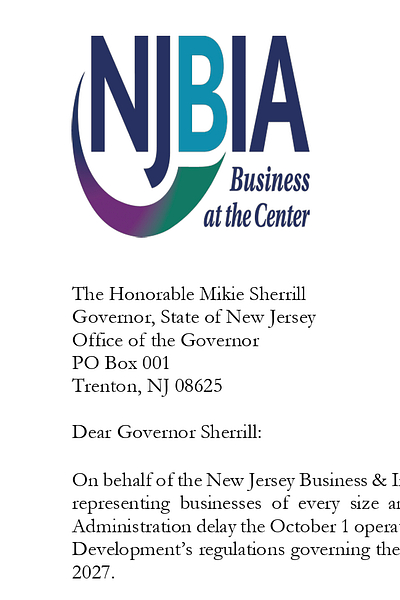
In the letter, the organizations also say they would like the Sherrill administration to work with the Legislature to create a task force—one that would include actual independent contractors—to try and fix this policy mess.
The letter states:
“We respectfully request that your Administration delay the regulations until July 1, 2027, and work with the Legislature to establish a balanced task force representing workers, organized labor, independent contractors, employers, nonprofits, and other affected stakeholders. Nine additional months would allow New Jersey to examine the experiences of other states, evaluate the economic evidence, hear directly from affected workers and businesses, and develop a framework that targets genuine misclassification without jeopardizing legitimate independent work.”
That’s a very good idea. The task force that Governor Phil Murphy created to kick off this entire policy nightmare almost a decade ago issued a report that’s filled with mischaracterized data and research. And since that report came out, claiming that we need all kinds of new laws and policies to address a “growing problem” of employee misclassification, Sherrill’s own acting Labor Commissioner has confirmed that the Department of Labor and Workforce Development is only receiving about 700 claims a year from independent contractors—in a state with an estimated 1.7 million independent contractors.
We are enduring some of the most extreme independent-contractor policymaking in the nation, all of it being done based on claims that are iffy at best, and all of it happening without any leadership or meaningful input from the actual independent contractors whose livelihoods are on the line.
It’s long past time for that to change. A real task force that actually includes our voices, and that bases its recommendations on properly vetted data and research, would be a big step in the right direction.
‘Of Greater Concern…”
Also speaking out—again—against this independent-contractor rulemaking in my home state is the New Jersey Bar Association, which sent a letter to Governor Sherrill on September 22, joining the chorus of voices urging the administration to stop this rule from taking effect October 1.
You can read that letter in full here:
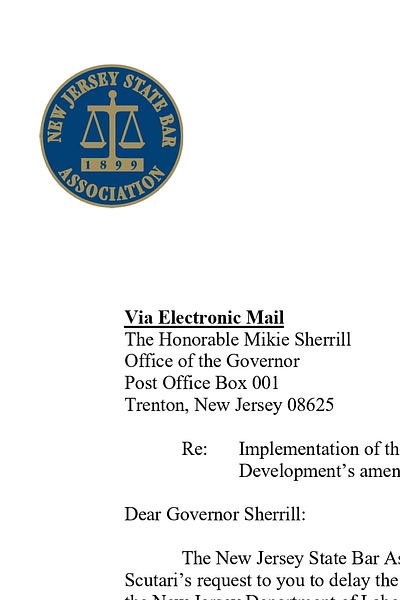
This letter states:
“The Association remains concerned about the impact of these revised regulations on attorneys – especially solo and small firms practitioners – which make up the large majority of attorneys in this state. Solo and small firms often use the services of per diem counsel as the need arises. The ABC test – in particular the revision to Prong C – risks the misclassification of these per diem attorneys for simply lacking formal business trappings, despite functioning as bona fide independent businesses.
“Of greater concern is the open question of the impact of these modified regulations on the use by these smaller firms of limited-scope assistance in addition to per diem attorneys, namely paralegals, accountants, investigators, and the like.”
These concerns, too, are not new. In an August 2025 public comment, the bar association detailed similar problems with the independent-contractor rulemaking.
As you’ll see if you click through on that link, the state’s own Office of the Public Defender issued a public comment at that time too, stating that the “the proposed rules risk undermining access to justice.”
‘Uncertainty over Intellectual Property’
I was particularly happy to read this op-ed that BINJE published by Adam Perle, the CEO of ArtPride, who detailed smart concerns about this independent-contractor rulemaking for the arts community—including a concern about intellectual property that parallels what I wrote about copyright-law concerns for writers like me when I testified before Congress about freelance busting in 2025.
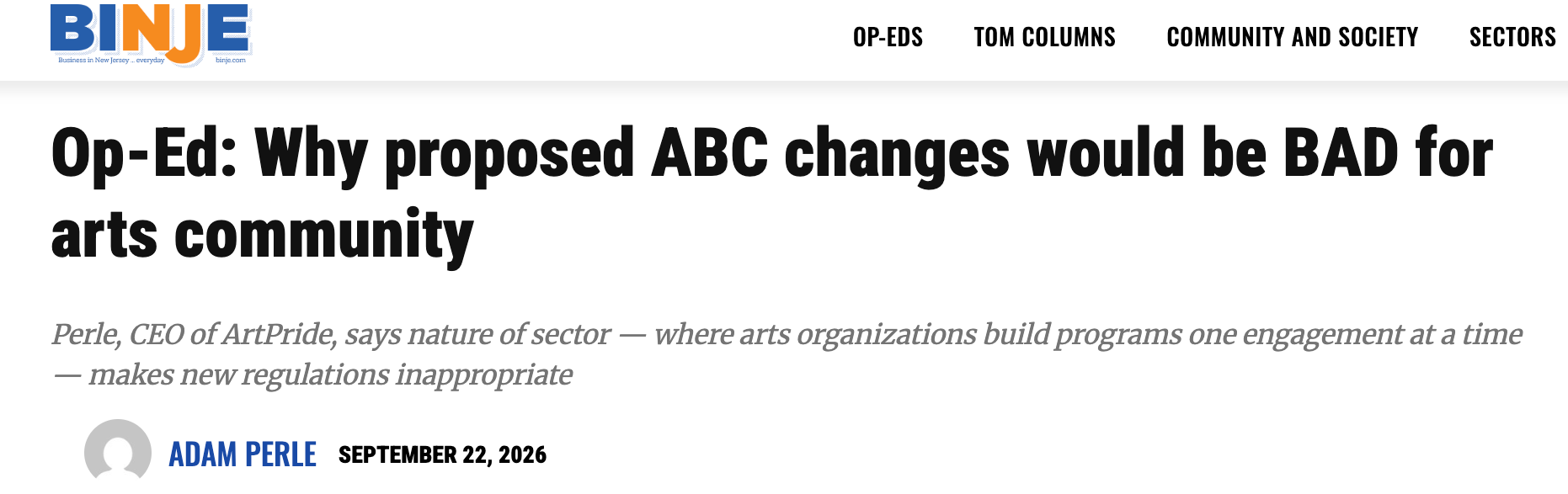
Perle wrote:
“Classification may also create uncertainty over intellectual property. A teaching artist’s curriculum, a choreographer’s work, a designer’s concepts, or a musician’s original material may be used across many engagements. Artists should not risk losing control of work they created simply because a short-term project is treated as employment.”
That’s eerily similar to what I wrote when I testified about freelance busting before the U.S. Senate HELP Committee in 2025:
“Under U.S. copyright law—which dates all the way back to the Copyright Act of 1790—the minute we put pen to paper as writers and authors in this great nation, we own the copyright to whatever we create. That means we also have the right to sell it, to slice it and dice it, and to sell it again and again. It means we get the financial upside if we write something the public loves.
“By comparison, if we are forced into employee status, then the employer owns the copyright. The corporations get all the financial upside, and we are forced to accept whatever crumbs they give us.
“Some 66% of writers and authors in America are self-employed, according to the U.S. Bureau of Labor Statistics. Any lawmaker who wants to protect us needs to stand up for our freedom to be independent contractors, too.”
Perle, in his recent op-ed, also laid out specific examples of how this independent-contractor rulemaking is problematic for the arts community, examples that I cannot fathom anyone failing to understand.
He wrote:
“Consider a national touring act booked to perform for one night at a New Jersey performing arts center. The artists arrive with their own program, work at venues throughout the country, and have no continuing relationship with the presenter.
“But the performing arts center is in the business of presenting performances, and the engagement takes place on its stage.
“Should the center be required to treat those touring artists as its employees for that one performance?”
Of course not. That’s the answer to the question Perle asks here, in the minds of any reasonable, rational people.
‘Nationwide Implications’
Also in recent days, attorney Richard Reibstein—a long-established expert on independent-contractor law—published this article about the national implications of the deeply misguided policymaking that Governor Sherrill’s Labor Department is embracing.
Reibstein wrote:
“The new regulation still carries out one of the most business-unfriendly tests for IC status in the country and, as noted below, interprets that test in a particularly unhelpful manner. While some companies may mistakenly regard this New Jersey regulation as only governing businesses located or operating a facility in New Jersey, it also impacts companies operating on a nationwide basis that engage any New Jersey workers who perform services from their home offices or other business locations in New Jersey.”
He also writes:
“… the new IC regulation in that state, soon to become effective, will give many companies that engage any workers in New Jersey even greater concern than they had prior to the time the NJDOL began its administrative process.
“As noted above, the new regulation applies not only to companies physically located and operating in New Jersey but also to businesses operating in New Jersey on a ‘virtual’ basis from their headquarters in other states when they use remote workers from across the U.S. including New Jersey. For this reason, some companies operating remotely may choose to curb their use of ICs that live or work in New Jersey, thereby curtailing opportunities for ICs and other freelancers that reside in the Garden State.”
October 1 is this coming Thursday. All of us in New Jersey who earn some or all of our income as independent contractors—an estimated 1.7 million people—need our elected officials to stop this ABC Test madness.
We then need meaningful guardrails put in place to ensure that this kind of attack on our fundamental freedom to earn a living can never, ever happen again.