

My favorite economist (yes, I have a favorite economist) is Liya Palagashvili. I met her in 2023, the first time I testified before Congress about independent-contractor policy. She was a witness on the same panel, also fighting to try and protect everyone’s freedom to be our own bosses.
Since then, Palagashvili and her team have documented the harms of overly restrictive independent-contractor policy in California, New Jersey and beyond. Her work in this area, specific to ABC Test regulatory language, is groundbreaking. She’s a math-brain superhero to freelance writers like me.
Last week, Palagashvili published an article titled “AI, Transaction Costs, and a Quiet Shift Toward Self‑Employment.” It raises some interesting questions about whether the rise of artificial intelligence might affect independent-contractor policymaking going forward.
She writes:
“Something that strikes me in much of the AI‑and‑work debate is how narrowly it is framed. The dominant question tends to be whether AI will replace workers in existing jobs, and if so, in which ones. Even the more nuanced task-based approaches focus primarily on which tasks AI can perform. What gets far less attention is whether AI changes how work is organized in the first place.
“From an economic perspective, that omission matters. Technological change doesn’t just substitute capital for labor—it also reshapes the boundary between firms and markets. And on that margin, AI may be exerting a transaction‑cost shock that quietly expands self‑employment and contract‑based work across a much wider set of occupations than we usually associate with the ‘gig economy.’”
Think about that idea for a hot minute. Palagashvili is writing about the concept of expanding self-employment even further at a time when we are already experiencing a years-long policymaking clash that’s rooted in the expansion of self-employment.
On one side of this policy clash are unionists who are desperate to prop up their dying business model—which depends on keeping as much of the workforce as possible in traditional, unionizable jobs. These unionists have been attempting to use government force to change policy in ways so extreme that attorneys say the ideas now pose an existential threat to self-employment itself.
On the other side of this policy clash are independent contractors, the vast majority of whom prefer to remain self-employed. Our numbers only keep rising in a nation where most people would prefer to be our own bosses, and where a growing number of people are working for ourselves with tools such as laptop computers, smartphones, Wi-Fi and increasingly sophisticated software.
Understanding the existing policy fight in that technological context makes it easy to see how AI’s acceleration might also accelerate the current policy clash.
I never thought about AI this way until I read Palagashvili’s article last week, but it is indeed possible that the advancement of artificial intelligence could help advance the fight to stop freelance busting.
How Quaint
Liya Palagashvili and I were both back before the U.S. House of Representatives last year. We testified together again on the side of independent contractors, at a hearing where we sat across from Democratic Representative Mark Takano of California.
Instead of internalizing what we were testifying about, Takano clung to his beliefs about the good, unionized manufacturing jobs of the 1950s. He also made sure to throw in a reference to Uber, which, as noted yet again in an article that I published last week, has precious little to do with most independent contractors.
Watch for yourself as this sitting member of Congress takes a long-winded road through rideshare to try and justify his beliefs that most independent contractors would rather be unionizable employees:
Takano’s statements are demonstrably false—nobody is saying that everyone will be forced to become an independent contractor in the United States—and his claims are going to seem as quaint as a crocheted blanket if AI technology does, in fact, allow more Americans to follow their dreams and become their own bosses.
Many of the things Representative Takano described as being, in his mind, tied to unionizable employee status—good income, safe working conditions—are already things independent contractors achieve every single day. Millions of self-employed people now earn more than $100,000 a year, and it doesn’t get much safer than working from wherever you want, whenever you please.
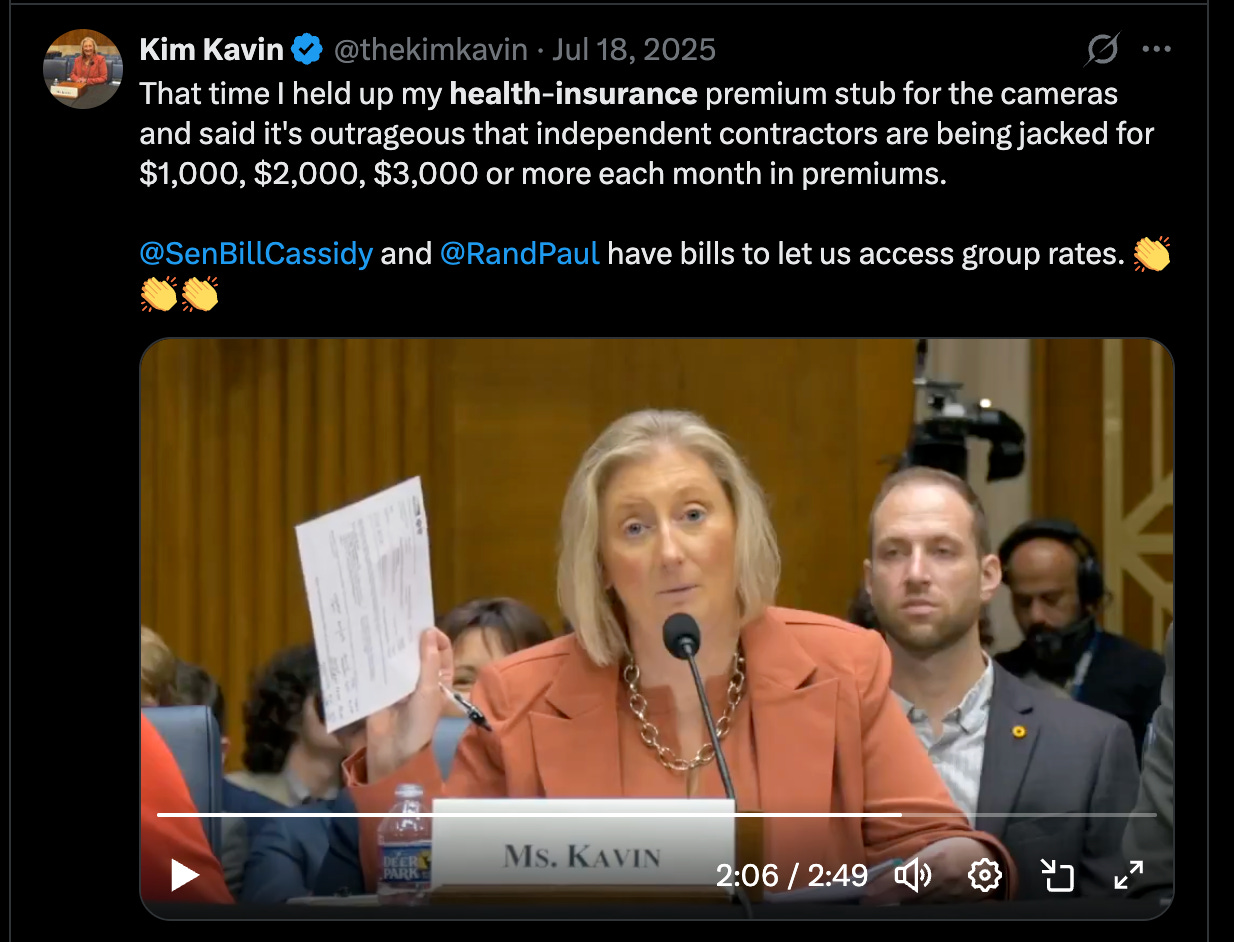
By contrast, one benefit of having a traditional job—easier access to group-rate health insurance—does remain problematic for independent contractors. But that’s a health-insurance policy problem, not a worker-classification policy problem. As I testified before the U.S. Senate last year, a lot of us who are getting soaked with high premiums and deductibles are eager for Congress to pass legislation that would correct that equal-access problem:
Palagashvili, who has also been a leader in trying to move the needle on this health-insurance policy problem, wrote about this very point in her article last week, adding the wrinkle of how AI acceleration could become a factor in those policy discussions as well:
“The portable benefits conversation has moved from think tank papers to actual pilots and federal proposals. That momentum reflects a growing recognition: safety nets built around W-2 employment don’t work well when work happens across multiple clients and projects. If this AI-driven reorganization accelerates, the mismatch between how we organize social insurance and how work actually gets done will only widen.”
If you think about it, Takano and Palagashvili are essentially saying the same thing: Far too many of our labor and employment policies are built for the workforce of the 1950s, and something has to change.
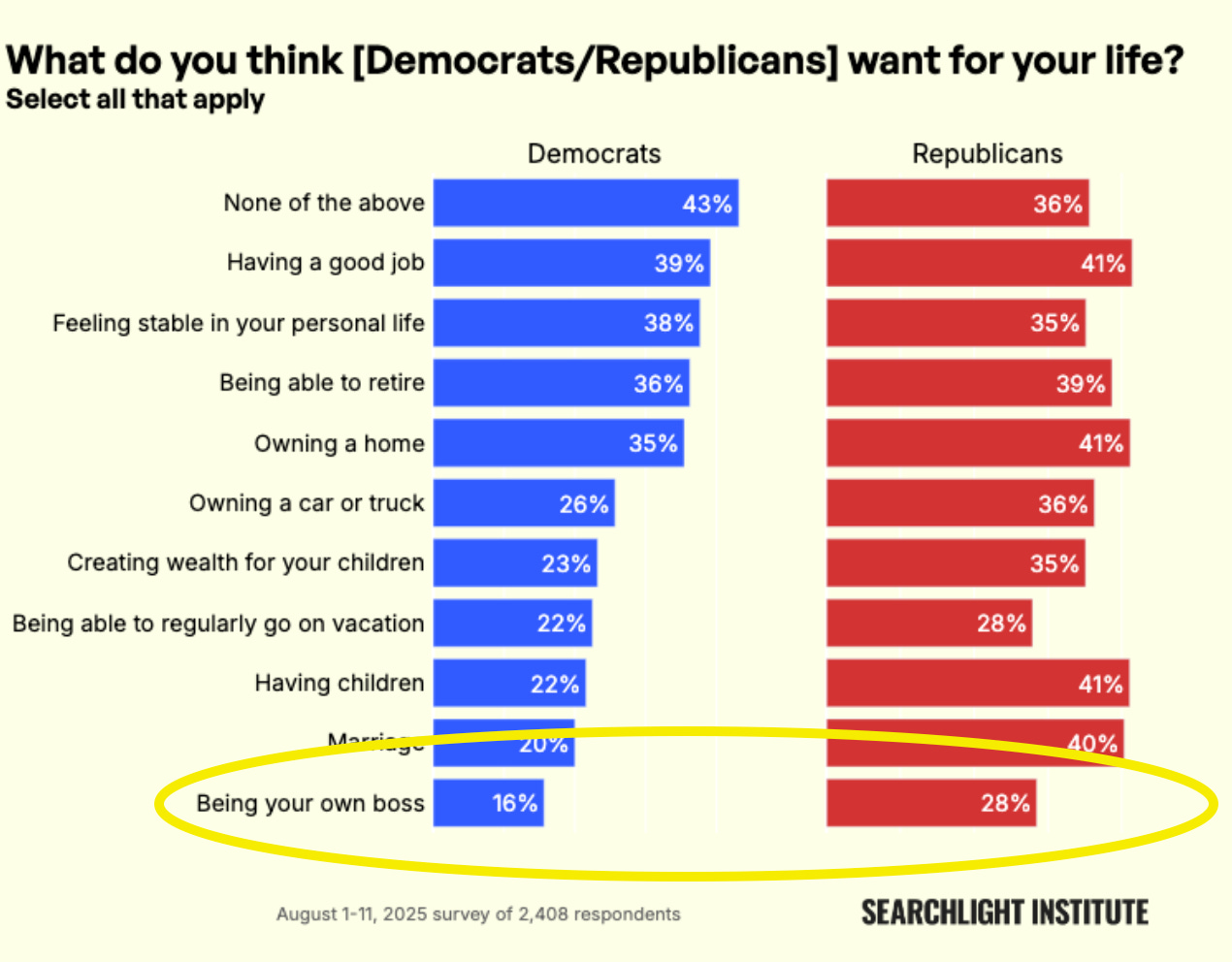
But only Palagashvili is saying it in the same way that the vast majority of Americans—Democrats and Republicans alike—are saying it. While Takano is arguing that we have to force people back into the kinds of traditional union jobs that existed in the 1950s, most Americans today are instead saying that lawmakers in both political parties could be doing a whole lot more to support for our desire to be our own bosses.
A Final Thought
Palagashvili’s thought-provoking article from last week ends with this:
“The conversation needs to expand beyond ‘will AI take my job?’ to ‘how will AI reorganize how we work?’ That question will shape not just labor markets but social insurance, labor regulation, and economic measurement for the economy we’re building.”
I’ve been a freelance writer and editor, by choice, since 2003. For the past 23 years, my available freelance work and opportunities have only expanded as the Internet and technology have advanced—because I have made an effort to learn everything from basic HTML code to search-engine optimization and social-media techniques, to ensure that my fundamental writing and editing skills remain marketable in the changing media landscape.
Yes, like just about every freelancer I know in publishing, I have clients right now who are trying to cut overhead by increasing the use of AI. However, these clients are quickly realizing that you need smart humans in the loop if you want your content to stand out amid all the AI-generated junk. If past is prologue, then those of us who naturally think about using technology to do things more creatively and efficiently are going to survive the rise of AI, too.
Palagashvili’s ideas, once again, seem to be in alignment with my lived experience. She writes about AI making it possible for freelancers to provide even better services to our clients. She’s correct about this:
“An independent consultant can now produce client-ready reports with AI assistance for data visualization, editing, and formatting, which previously required support staff at a consulting firm. A policy researcher who once needed a think tank’s editorial review, design staff, and institutional publication channels can now use AI tools for editing and professional formatting, while publishing directly through Substack or personal websites reaches audiences without institutional backing.”
The Substack you’re reading right now—not to mention the Substack where she published her article—are proof that this is all true. So is the image at the top of this article. I created it using Substack’s built-in AI image generator. And I distributed it to you by pressing a button, without institutional backing of any kind.
Think for yourself about whether someone pining for the manufacturing jobs of the 1950s is more likely to succeed than someone who thinks like Palagashvili and I do, as our society barrels technologically toward the year 2050.
In the end, policymakers trying to force all of us back to the past may have no choice but to accept reality and fully support our freedom to choose independent contracting.