

Every year for the Labor Day holiday, Gallup does a survey related to unions. This year’s headline was a talking point on the news all weekend long:
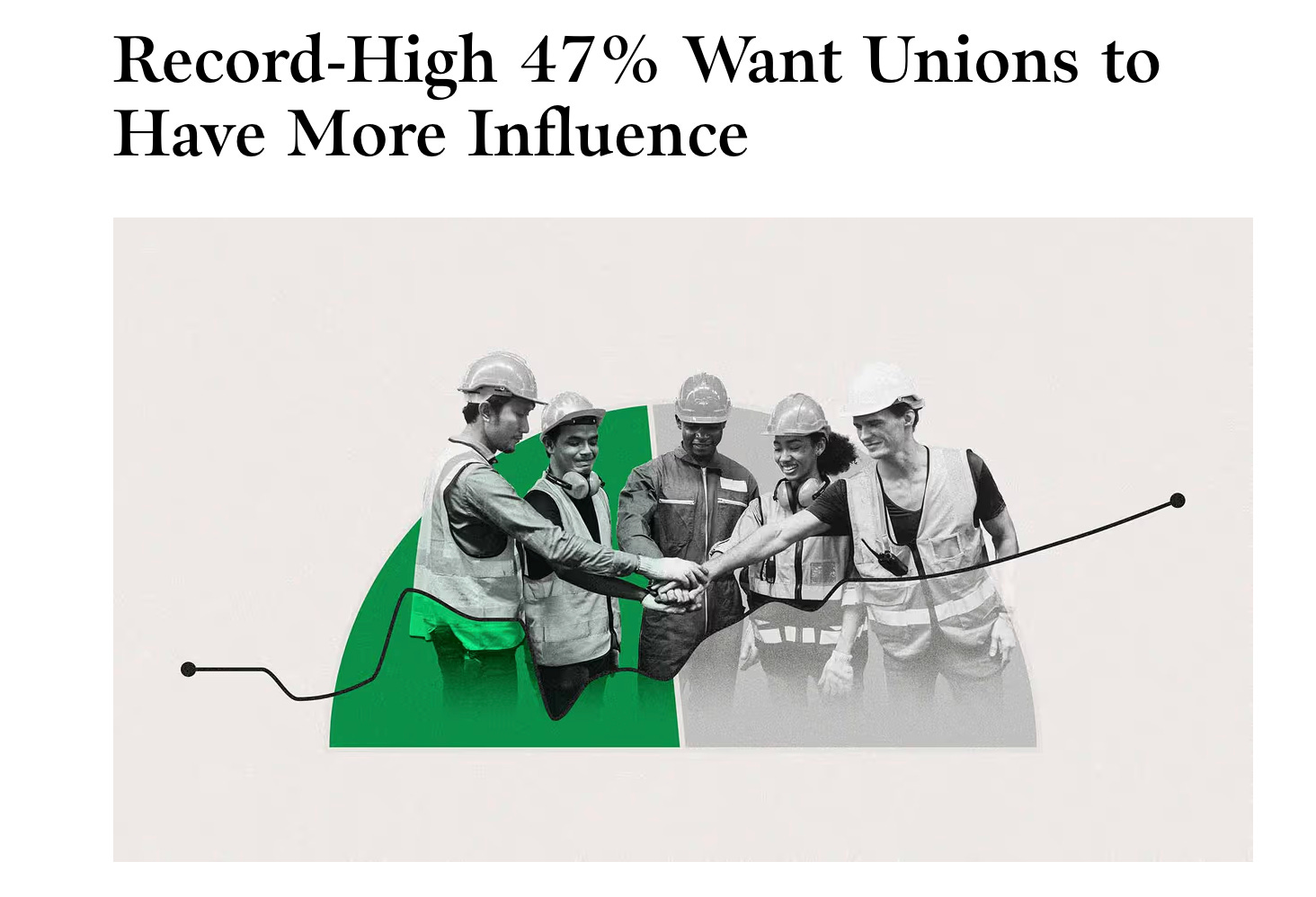
Notably, according to Gallup, that record-high figure is because of just one group of respondents:
“Democrats account for the entire increase since 2023 in Americans’ desire for unions to have more influence. Currently, 73% of Democrats hold this view, up 12 points from 61% and the highest Gallup has measured for the group. By contrast, this preference is unchanged among independents and Republicans, at 45% and 19%, respectively.”
Also notable in this year’s survey is that an important question is missing. It has actually been missing for several years now. The last time I saw it asked was in 2022, when Gallup found that while about 70% of Americans support labor unions (similar to this year’s 71%), a full 80% of nonunion employees either had no interest in joining a union or were at best neutral on the subject:
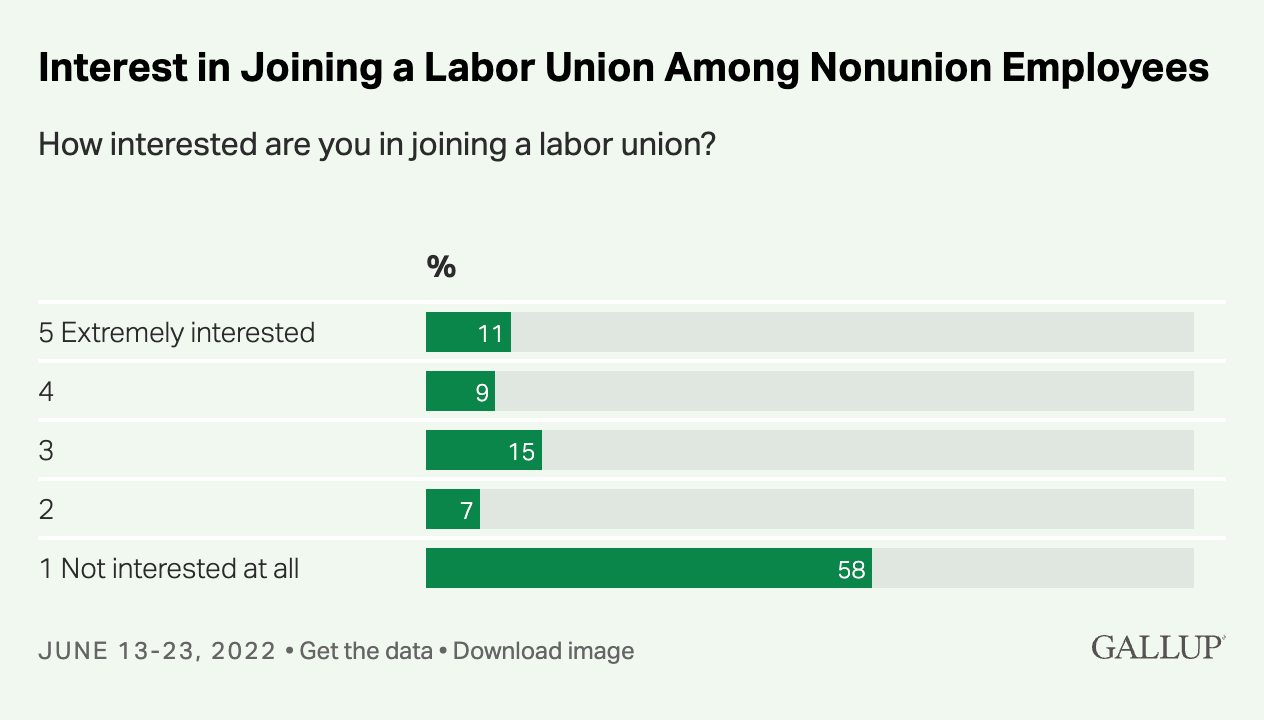
The omission of this additional question sure skews the overall narrative of Gallup’s findings, eh?
Without that additional question, we end up with politicians suggesting that because most people approve of labor unions, we need to change our laws so that more people can join labor unions. Even though most people already eligible to join clearly don’t wish to do so.
Alas, this year’s Gallup survey is what it is. And in addition to promoting Gallup’s survey, labor union leaders were all over TV this weekend reporting the AFL-CIO’s research showing that more people trust unions than trust Democrats or Republicans.
Per the AFL-CIO:
Trust in unions exceeds trust in the Democratic Party by 20 points (52% to 32%), and workers are twice as likely to trust unions than to trust the Republican Party (52% to 26%).
Young workers ages 18–30 trust labor unions (61%) more than twice as much as they trust the Democratic Party (28%) or the Republican Party (22%). Among young men, the trust gap is 40 points between unions and Democrats (63% to 23%) and 43 points between unions and Republicans (63% to 20%).
The only group workers trust more than unions is their own neighbors (75%).
I found the AFL-CIO’s talking point to be a bit odd, given that surveys have also found Americans like zombies, hemorrhoids and dog poop more than they like Congress. People like traffic jams, lice and root canals more than they like Congress. Even the federal immigration agency ICE is more popular than Congress.
Which means that if the questions were posed differently, trust in unions might match or fall below most people’s feelings about dog poop, root canals and ICE.
That got me to thinking. Of course, I’d like to see Gallup bring back its question about whether non-union employees actually wish to join unions. And yes, by all means, I’m for Gallup asking how people’s feelings about unions compare to their feelings about zombies and dog poop.
But drilling down deeper, the following five additional questions would also help to shed a lot of light on what people really believe about unions, not just based on what people think unions are doing, but instead in the context of how some unions are actually behaving today.
Question 1
Do you believe the government should change regulatory language to reclassify entrepreneurial people—such as independent contractors who choose to work as financial advisers, real-estate agents and freelance writers—as unionizable employees?
This question is important because the union-led push to reclassify as many independent contractors as possible has been underway for years. Right now, there’s a bill in Congress called the Protecting the Right to Organize Act that would expand a version of California’s failed reclassification experiment nationwide. It has the support of pretty much the entire Democratic Party, while the former chairman of the National Labor Relations Board says it would unravel large segments of the economy.
Question 2
Do you believe that every person involved should get to vote on whether to join a union? Or do you believe the government should give a union control over a whole sector, such as all rideshare drivers in a state, even if only 25 percent of the drivers actually vote to join?
This question matters because that’s the exact percent required under a new Massachusetts sectoral-bargaining scheme that’s already being copied in California, Illinois and Minnesota, and that union leaders say they plan to bring to other states as well.
Question 3
Do you believe it’s OK for city officials to mandate that all people doing a certain kind of work must automatically be unionizable employees, and can no longer earn even a side income as independent contractors?
This question is in play right now in New York City and Chicago, where bills have been introduced with strong backing from the Teamsters union to automatically make certain Amazon workers, in particular, unionizable employees.
Question 4
Do you believe that union organizers should work with the Democratic Socialists of America to weaken or end capitalism? Or do you believe that unions should exist as they always have in the United States, within the system of capitalism?
This question is important because a lot of people don’t realize that for several years now, the AFL-CIO and the Teamsters, in particular, have been working hand-in-glove with the Democratic Socialists of America to try and grow union membership. This past weekend, at the Socialism 2026 conference—#TrySocialism—a DSA member on one of the panels talked about how the group is already working on “radical militant democratic unionism” right now.
Question 5
Do you believe that unions should use members’ dues to pay for political campaigns, such as the New Jersey Education Association spending $40 million in a failed election campaign that attempted to make the union president the state’s governor?
Really, $40 million is a drop in the bucket. Most people would be stunned to learn that, as recently reported in The Hill, labor unions directed more than $1.8 billion into Democratic Party campaigns and political causes during the 2024 election cycle alone.
ICYMI The Washington Post editorial cited the 2022 Gallup findings this year:
https://www.washingtonpost.com/opinions/2026/09/06/unions-high-approval-rating-doesnt-mean-americans-want-join/