

This past weekend—with New Jersey’s independent-contractor rule now less than two months away from taking effect October 1—the New Jersey Business & Industry Association published an article that challenges the need for the rulemaking at all.
The article focuses on a settlement in a case about employee misclassification that the administration of Governor Mikie Sherrill just announced with regard to a trucking company—and makes the point that the state already had the tools it needed to resolve the issue without the looming independent-contractor rule being in place.
NJBIA Policy Analyst Jack Kelly is quoted:
“Misclassification is a serious offense that we don’t condone in any way, shape or form. And the Sherrill administration just showed there are serious methods already in place to address it.”
That is correct.
Also correct are the points that Kelly makes at the end of the article—points that many of us here in New Jersey have been making at public hearings going back the better part of a decade now, and that many of us made in page after page of the estimated 9,500 public comments that demonstrated 99% public opposition to this independent-contractor rule.
Kelly hits the bullseye with this passage:
“You could make the case that the enforcement mechanisms are already in place. You can also contend that this whole debate, at its core, is not really about protecting workers who were truly misclassified.
“If it was, a comprehensive study should have first been conducted examining whether the IRS test used before the ABC test was actually failing to detect and address unlawful misclassification at the scale being alleged.
“Instead, we are moving directly toward one of the strictest independent contractor standards in the nation at our own peril.”

He’s right.
And what most people don’t realize is that when Kelly suggests that an examination should have been done to determine whether the IRS Test is effective in addressing employee misclassification, he’s actually highlighting a trick the freelance-busting brigade has been using for more than 25 years now to hide the truth of that matter.
The Test that Worked
Back in February 2000, a Maryland-based firm called Planmatics, Inc. prepared a nearly 200-page report for the U.S. Department of Labor about independent contractors.
This report, now known colloquially in labor-policy circles as the “Planmatics report” or the “Planmatics study,” tried to determine the prevalence of employee misclassification. The Planmatics report became the source of a figure that the freelance busters still widely quote today: that 10% to 30% of employers misclassify at least one employee. The administration of Governor Phil Murphy cited this figure in New Jersey in 2019 to help justify an unprecedented series of laws and crackdowns that targeted businesses working with independent contractors.
But here’s the thing: The Planmatics report is filled with undocumented, anecdotal claims, especially as they pertain to New Jersey.
And in trying to pass off that information as something it’s not, the Planmatics report intentionally buries a key detail: The State of New Jersey, even back then, was successfully using the IRS Test to address the problem of employee misclassification.
Read it for yourself and make your own judgment.
Below is the section of the Planmatics report that focuses on New Jersey. It’s pretty short, not even filling two whole pages, and it takes as gospel the unsubstantiated claims of unnamed people who are affiliated with unions and union-adjacent groups:
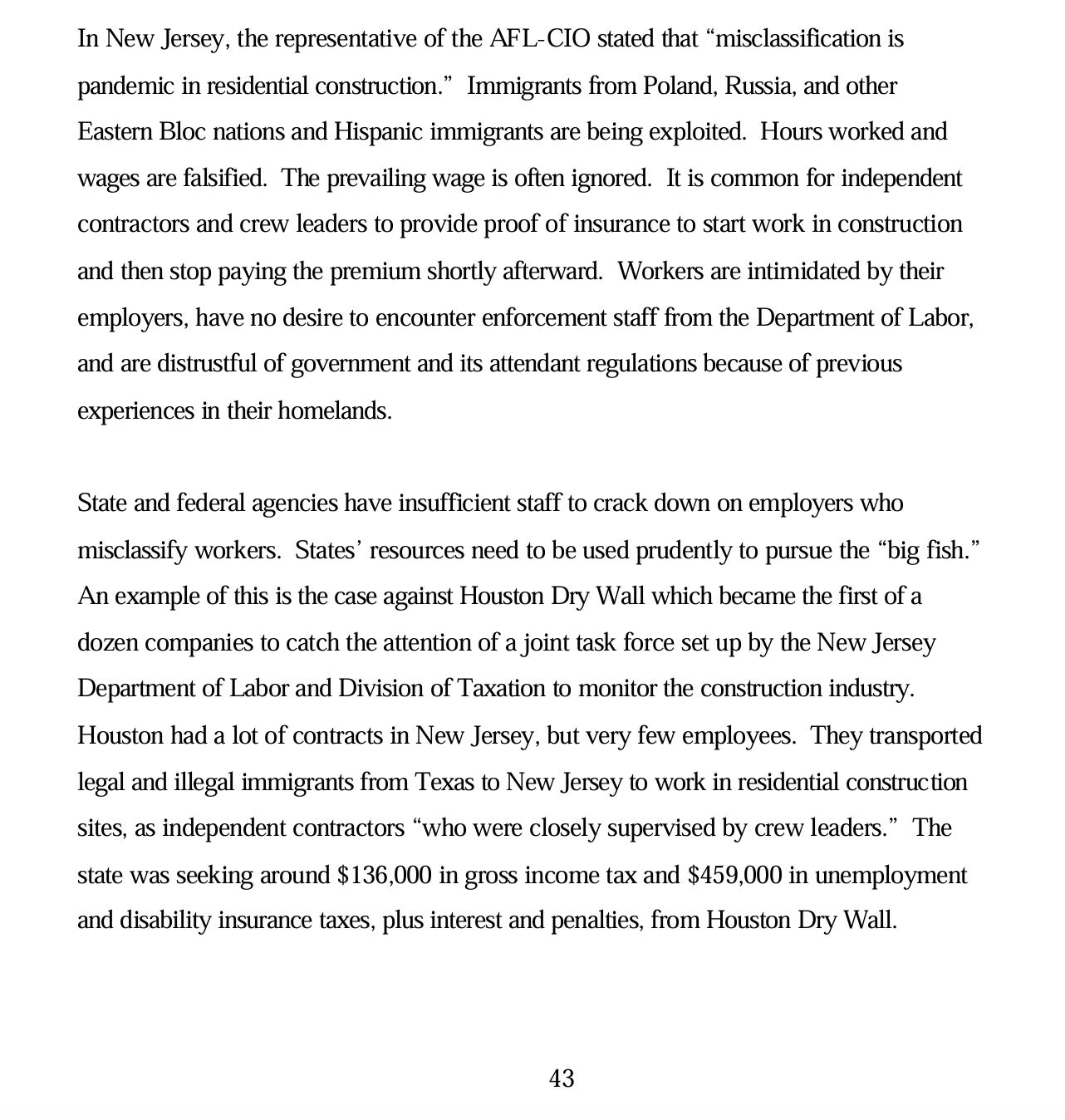
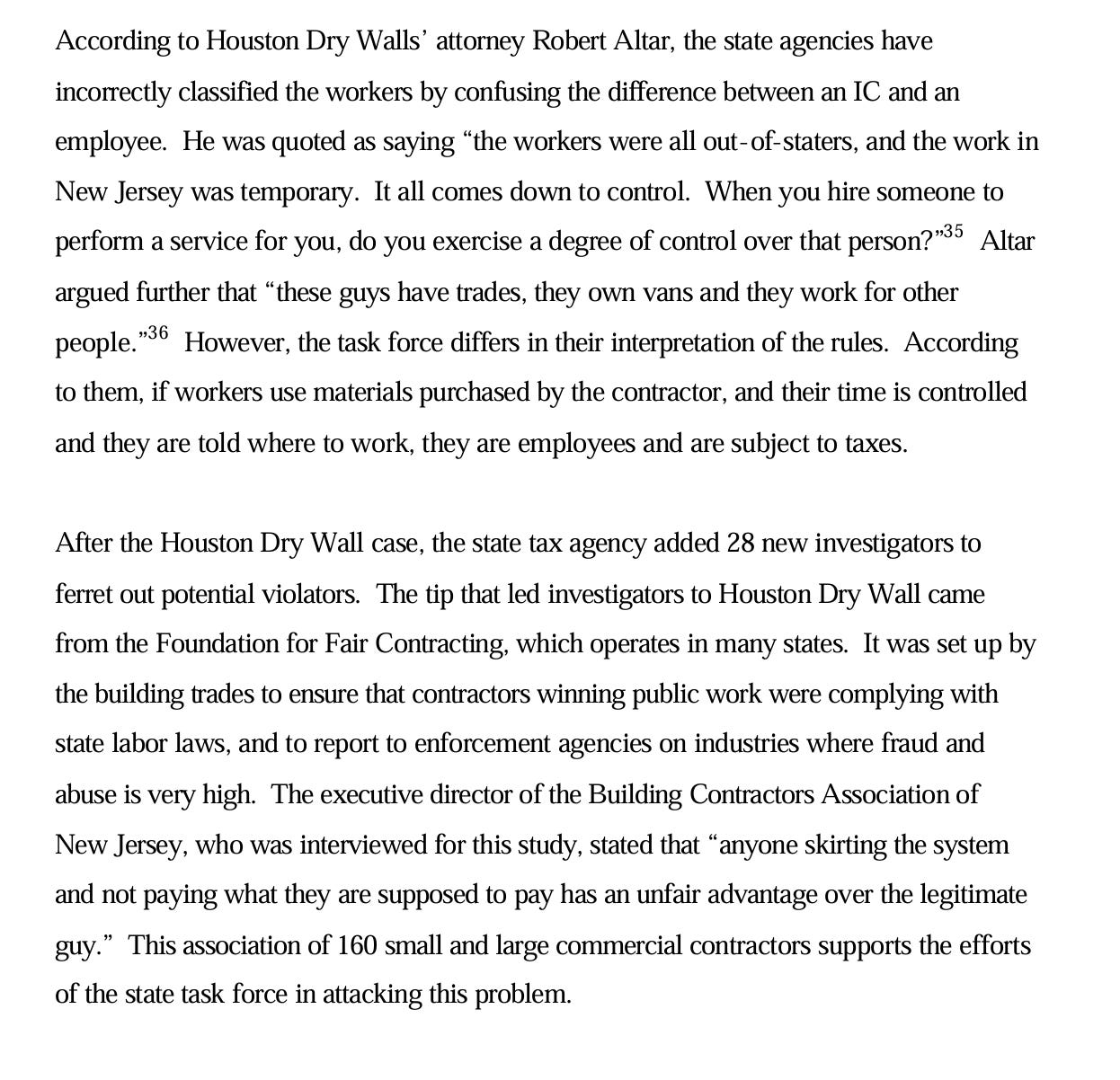
Note the way that the Planmatics report—while fluffing up the union and union-friendly sources—totally omits any information about how the State of New Jersey actually succeeded in targeting the practice of employee misclassification at the Houston Dry Wall company.
To figure that out, you have to read the footnote that relates to this section:

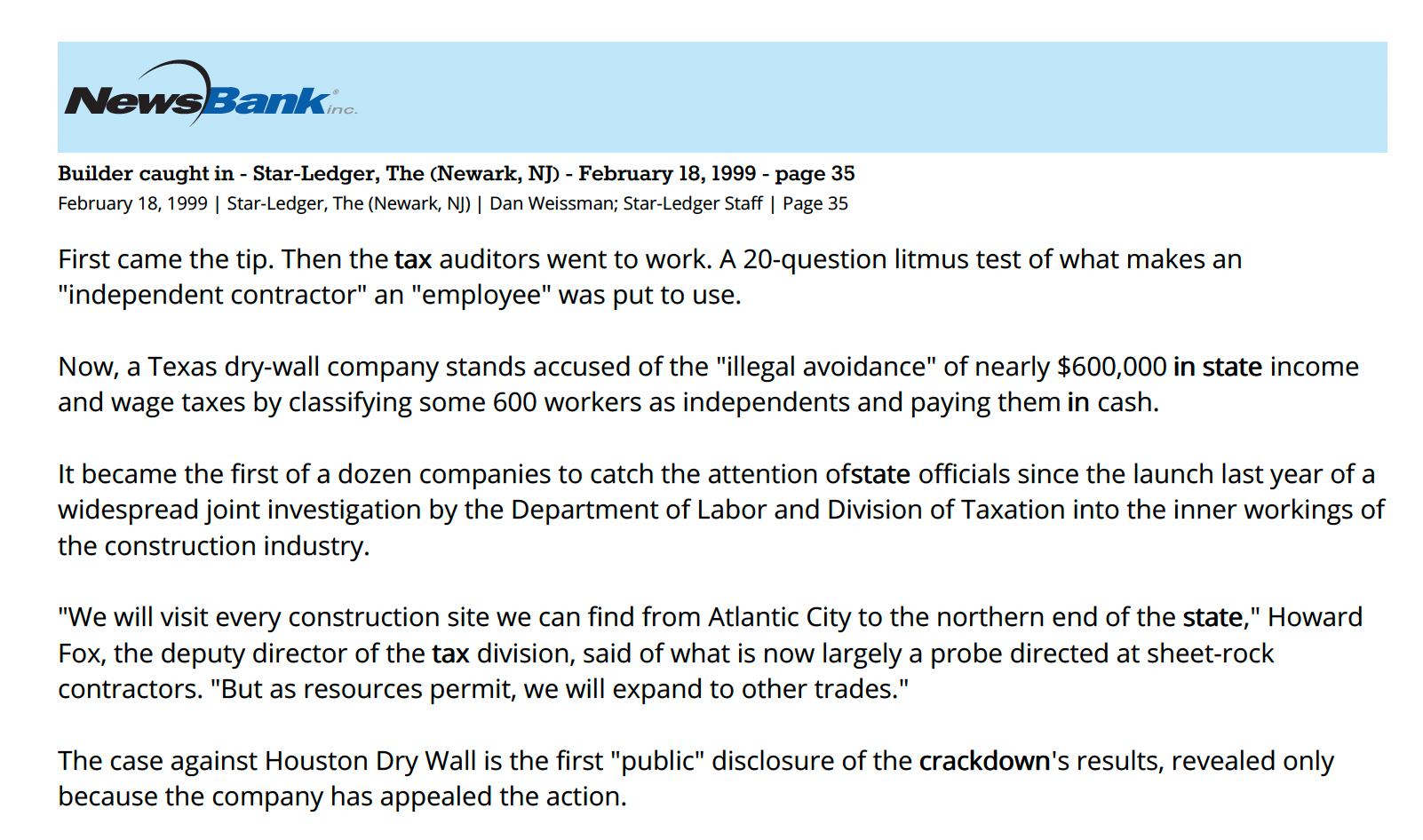
This article isn’t accessible online, so I accessed it using my handy-dandy library card here in Morris County, New Jersey.
And lo and behold, when I read that 1999 article from the Star-Ledger, the reality could not have been any clearer about what the Planmatics report had left out: The state had used IRS Test regulatory language to address this case of misclassification.
That fact is right in the first paragraph of the article. The term “20-question test,” at the time the Star-Ledger article was written, was a synonym for the IRS Test:
The NJBIA’s Jack Kelly is right on the money to suggest that, before powering forward with the ABC Test, a study should have been done to examine whether the IRS Test was actually failing to detect and address unlawful misclassification at the scale being alleged here in my home state of New Jersey.
But we all know why that didn’t happen.
Convening a real, unbiased task force or doing any kind of a deep dive in this policy area would have revealed that there is no persuasive evidence of unlawful misclassification at the scale it’s being alleged—and that there is, in fact, quite a lot of evidence about how the Murphy administration mischaracterized research and data, and buried key information, in ways similar to the Planmatics report.
Let Us Count the Ways
Regular readers of this Substack have been aware of the disconnect between misclassification claims from the freelance-busting brigade and most other people’s understanding of reality for a long time now:
There’s the 2019 Report of Gov. Murphy’s Task Force on Employee Misclassification that says the problem has increased by 40% since 2009, but then cites research that says no such thing. This Murphy report also cites a nonexistent “2000 U.S. Department of Labor study of misclassification in construction in New Jersey,” saying it shows millions of dollars in taxes failing to be paid. In reality, the source of that information is a 2016 report that unionists commissioned at Stockton University—a report whose own authors say there’s no reliable way to accurately measure misclassification. (You can see all of that broken down with screen shots and links here.)
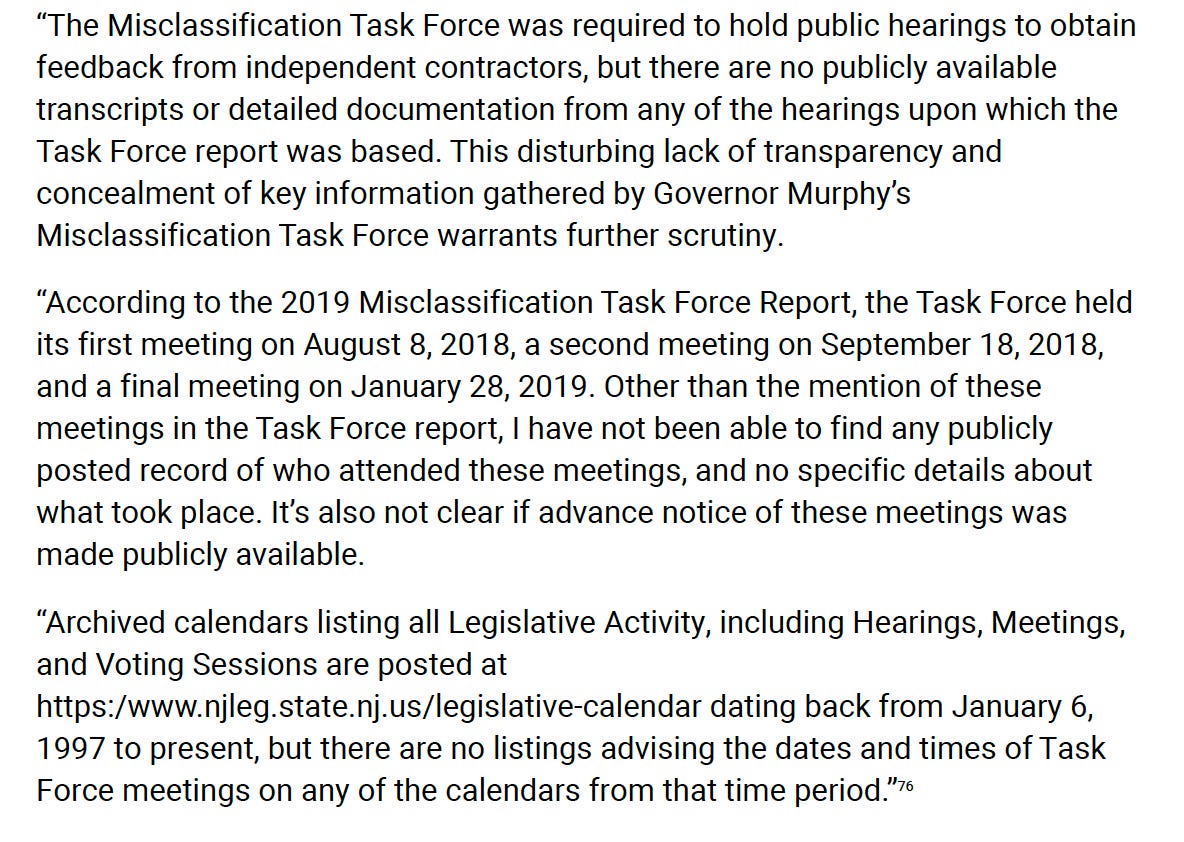
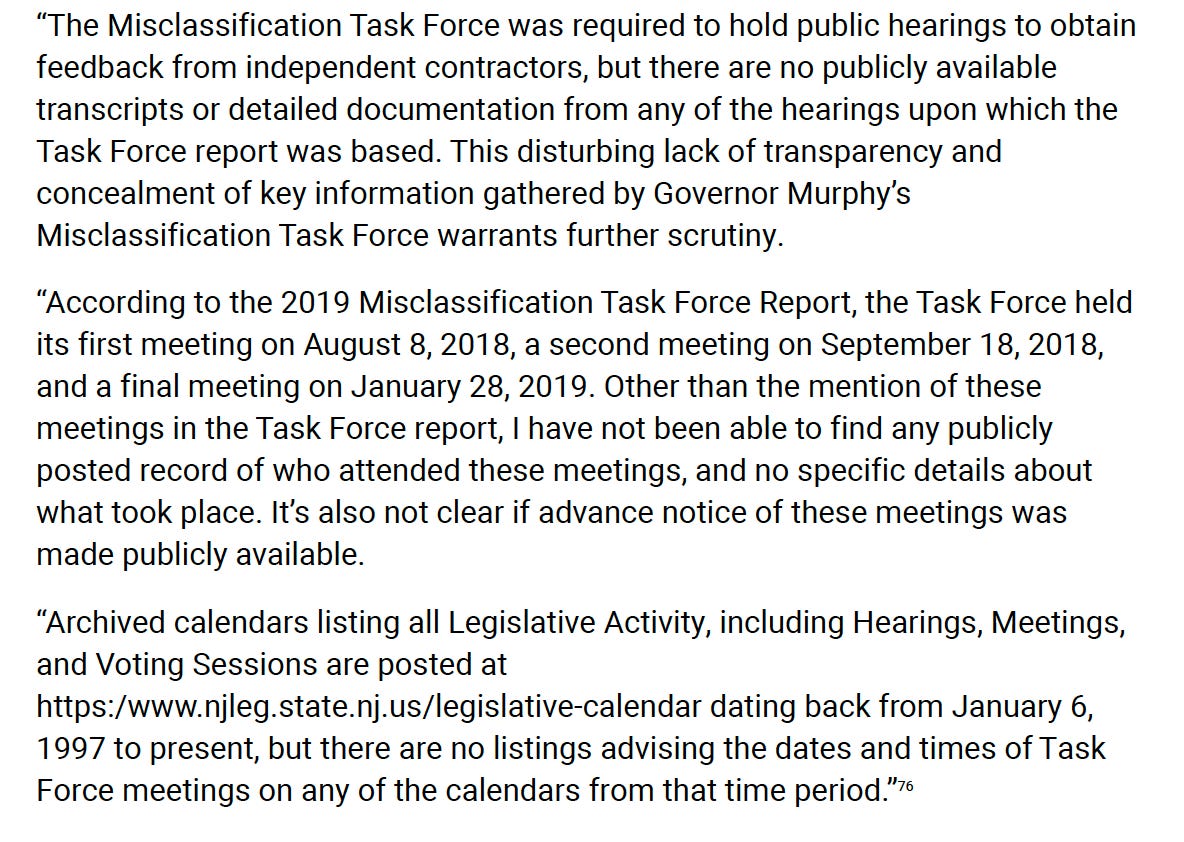
To this day, those of us trying to stop New Jersey’s freelance busting can’t find any list of who actually served on Governor Murphy’s Task Force on Employee Misclassification, and we don’t know who wrote that report. We also have a lot of questions about the public hearings this Murphy report cites—questions that Lisa Yakomin, president of the Association of Bi-State Motor Carriers, raised in the group’s public comment filed in opposition to the independent-contractor rule. I quoted a section from her public comment in my report “Extremism vs. Entrepreneurism”:
We also now know that despite the Murphy administration’s claims about misclassification costing the state hundreds of millions or even billions of dollars, there is no evidence of that being true based on the results of the Murphy-era independent-contractor crackdown after all these years.
And we know, from recent testimony by the Sherrill administration’s acting Labor Commissioner, Kevin Jarvis, that the state Department of Labor and Workforce Development is receiving only about 700 claims each year from independent contractors. In a state with an estimated 1.7 million independent contractors—and where if 10% of a million or so companies were misclassifying workers, there would be at least 100,000 people misclassified statewide—that testimony is yet more evidence that the problem of misclassification is not widespread at all.
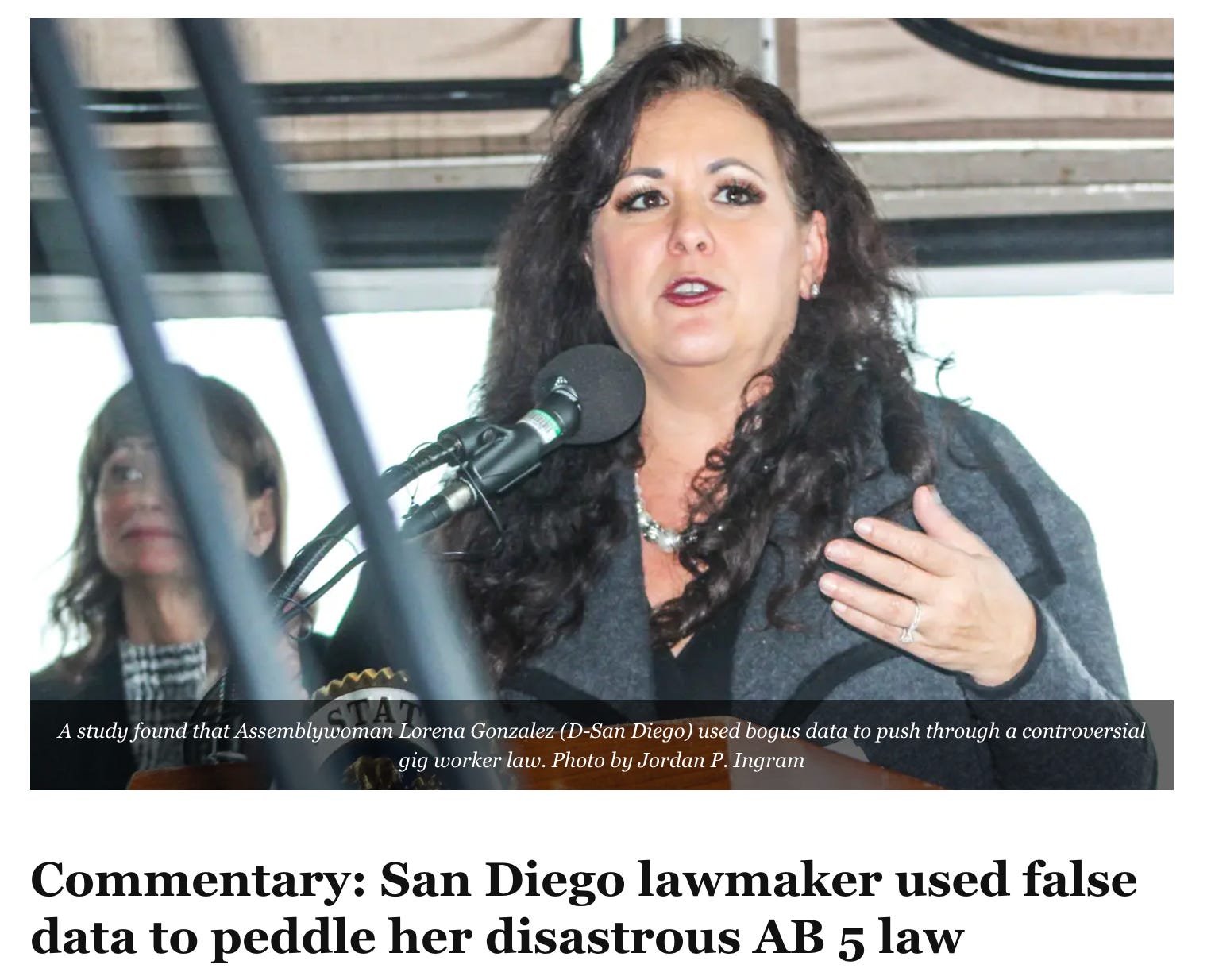
And that’s all from New Jersey alone. Californians fighting a similar ABC Test push, via that state’s Assembly Bill 5 law, have documented similar shenanigans, particularly with regard to a lawmaker who later went on to lead the California Federation of Labor Unions, AFL-CIO:
Like I wrote at the top, the NJBIA’s Jack Kelly hit the bullseye when he said this:
“You could make the case that the enforcement mechanisms are already in place. You can also contend that this whole debate, at its core, is not really about protecting workers who were truly misclassified.”
The evidence is overwhelming that this is true. Especially when you factor in a report the unionists themselves put out in 2018, a report that specifically names many of the people involved in this New Jersey ABC Test push, laying out their plan to reclassify entire all workers across entire industries as unionizable employees—whether the independent contractors were misclassified or not.
At last summer’s public hearing about the New Jersey rulemaking, the only people who testified in support were on union payrolls or with groups that have strong associations to unions.
Out of the estimated 9,500 written public comments the state received, only 26 were in support—and 16 of the 26 came from unions or groups with strong affiliations to unions.
Freelance busting isn’t about protecting workers who are misclassified. It’s Big Labor attacking the smallest of small-business owners. It’s about precisely what lawyers described in their initial evaluation of New Jersey’s rule proposal: nearly eviscerating the ability to be an independent contractor at all.
New Jersey Lawmakers Must Act
New Jersey’s independent-contractor rule is scheduled to take effect October 1. Legislators should pass the concurrent resolution that would invalidate the rule and protect us all from this freelance-busting madness that is rooted in false claims, mischaracterized data and research, and obfuscated facts.
Members of the New Jersey Legislature can stop this rule on their own. The concurrent resolution does not require the governor’s signature to take effect. Legislators simply have to pass the resolutions in the Assembly and Senate.
The Murphy administration took legislators for a ride on this policy issue. Passing the concurrent resolution would acknowledge the seriousness of what has already happened that is so clearly wrong, and would stop what’s about to happen next before matters become even worse.