

Back in 2018, unionists in Congress issued a report packed with ideas for how to try and grow unions all across the nation. One of those ideas was to bring sectoral bargaining to the United States—an idea that the report’s authors noted is “admittedly radically different” from what Americans have long known union organizing to be.
Well, folks, as of yesterday in Massachusetts, we are officially living in the age of radically different union organizing.
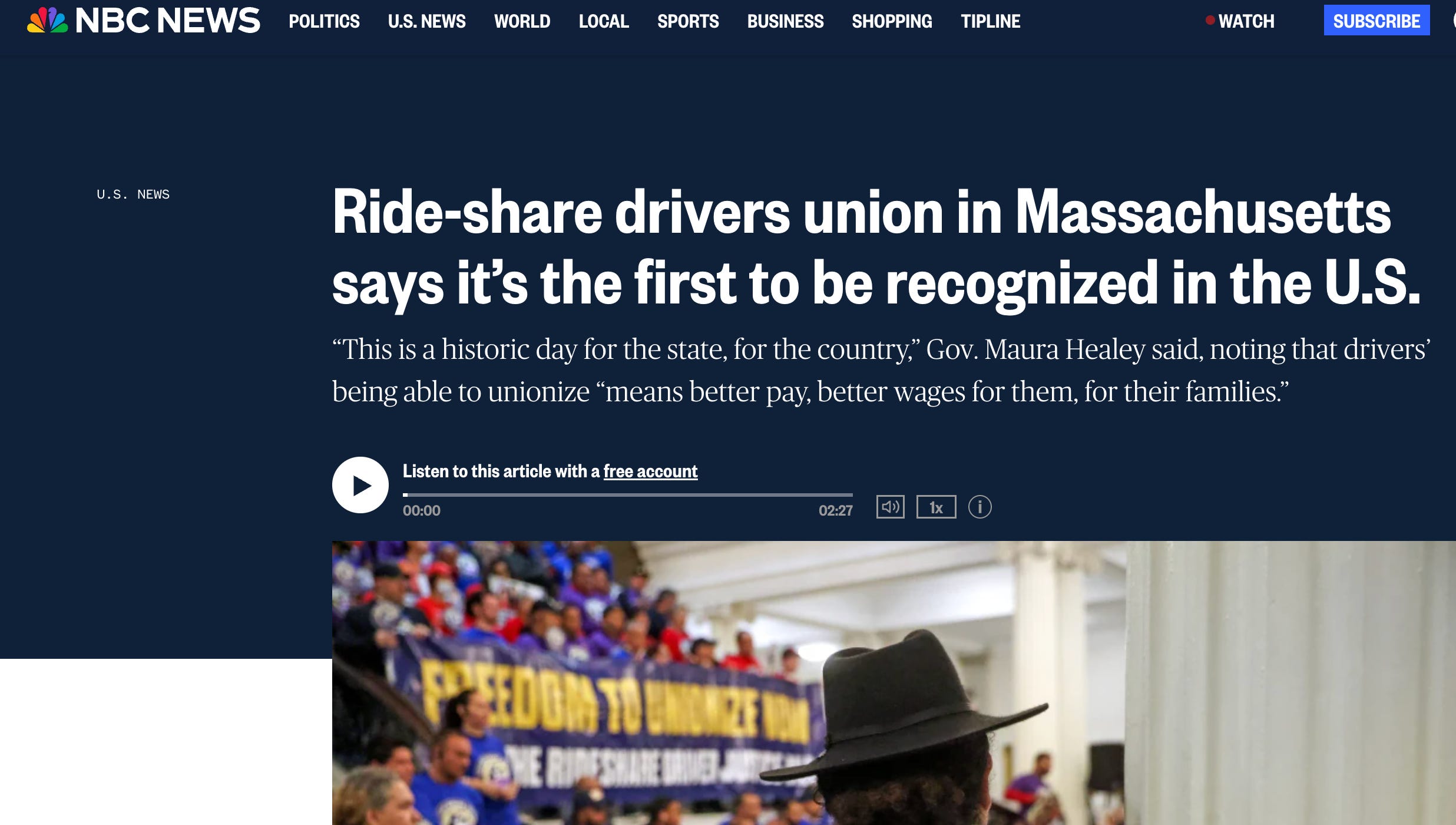
App Drivers Union, an affiliate of 32BJ SEIU and the International Association of Machinists and Aerospace Workers, won recognition from the commonwealth's Department of Labor Relations to represent nearly 70,000 rideshare drivers all across Massachusetts.
It’s the first union of rideshare drivers to be certified in the United States. And not a single one of those drivers was reclassified as a unionizable employee first. The union is now positioned over the independent contractors, whether they like it or not.
To better understand what just happened in Massachusetts, and what is likely to happen next, I reached out to Alex MacDonald, an attorney with the Littler Mendelson law firm who is also co-chair of the Workplace Policy Institute. He wrote this paper a couple years ago about the perils of sectoral bargaining for rideshare drivers in Massachusetts, a situation that he described at the time as “legally dubious” and “economically disastrous.”
Here’s his take on what just happened in the Bay State, and what it could mean for all kinds of industries nationwide next.
Q&A with Alex MacDonald
Let’s start by giving readers a basic understanding of what sectoral bargaining is, since most people have never heard of it. Even the unionists who support the idea of sectoral bargaining have called it “admittedly radically different” from how union organizing has always been done in the United States. Would you agree with that characterization?
Yes, that’s the right way to put it. In the United States today, we have what’s called “enterprise” bargaining. That basically means workers decide whether to join a union workplace by workplace. If they do decide to join a union, they bargain with the employer only for their own workplace. (This is sometimes called the “bargaining unit.”) The employer and the union can agree to bargain at a higher level—say, for multiple plants at the same time. But they don’t have to do that. The default rule is that bargaining is local and affects only a single workplace.
Sectoral bargaining is different. Instead of organizing workplace by workplace, the union organizes an entire industry at once. It negotiates a single agreement with all employers in the industry. That agreement then applies to every workplace. You can think of it as collective bargaining at a higher level of remove: It means that the same terms apply in every workplace.
That’s why unions like sectoral bargaining. For them, it’s efficient. They don’t have to organize hundreds of workplaces and negotiate dozens of agreements. They can organize all the workers at once and negotiate a single contract. It gives them more power for less work.
So the union organizers like sectoral bargaining because it makes their lives easier. What’s the flip side of that equation?
There are downsides for everyone else. For one, it means that employees cannot choose to work in a nonunion firm. They can’t go work for a different employer because that employer is covered by the same agreement. They’re stuck with a Hobson’s choice: the union’s contract or nothing at all.
There are also downsides for consumers. Unions raise labor costs; economists used to peg the cost premium at about 14%. That premium has come down over the years, in part because unions represent a smaller slice of the workplace and so have less bargaining power. But in a sectoral-bargaining system, they represent everyone. So they have more leverage to extract higher costs. And because every employer has to pay those costs, each individual employer is less worried about passing the costs on. The result is that consumers pay more across the board.
Consumers also may have less choice. Some economists think that sectoral bargaining slows innovation. The sectoral terms are usually written by big, entrenched businesses with a lot of power at the bargaining table. These businesses have an interest in getting terms that work well for them and not necessarily their smaller rivals. They’re OK with complicated seniority, benefit and grievance provisions because they have sophisticated human resources and labor relations departments. They can spread the cost. But small businesses can’t do that so easily. They grow slower or get driven out altogether. The result is less diversity, less competition and, ultimately, less innovation.
Unionists figuring out how to get sectoral bargaining into U.S. law sort of began in California with the fast food industry back in 2022, right?
Kind of. The California Fast Food Council was labor’s first big sectoral win. The council is essentially a quasi-sectoral forum, where employers and unions jointly set terms with government officials. At the time, it was the closest thing we’d seen to sectoral bargaining in the pure private sector.
But even before that, unions had been experimenting with sectoral systems in public-supported industries. For example, the SEIU had been active in the home-care industry. Home-care workers are often private employees, but their pay is supported by state money. The SEIU pushed for (and got) laws that allow it to represent these workers on a statewide level. It now represents these workers in California, Washington State, Illinois and elsewhere. It used these laws to add hundreds of thousands of new members—a huge success in an era of otherwise declining union membership.
And what it took from that success is that it can organize without really organizing: It just needs a friendly state to pass a friendly law.
And then in November 2024, while the whole country’s attention was on President Trump versus Vice President Harris, unionists in Massachusetts managed to expand this sectoral bargaining idea in a way that specifically targeted the rideshare industry, correct?
That’s right. The Massachusetts sectoral law was based on a ballot initiative, which was sponsored and funded by the SEIU. It passed with about 54% of the vote. It was pitched just as a way to give rideshare drivers the same right to join a union that employees have.
But during the campaign, there wasn’t much talk about how this law differed from normal collective bargaining. The press coverage was muted at best.
After that ballot measure passed in Massachusetts in November 2024, what needed to happen for a union to gain control over all the rideshare drivers in the state?
First, the union had to get signatures from 5% of all “active” drivers. Those signatures got it access to contact information for the rest of the drivers.
It then had two options: It could demand an election, or it could keep collecting signatures. If it collected signatures from at least 25% of active drivers, it could be automatically certified as the bargaining representative of every driver in the state. It seems to have taken the second option.
The term “active driver” is misleading. It includes only drivers who have completed at least the median number of rides in the last six months. In other words, it includes only half of all drivers.
The other half don’t count. Their signatures are unnecessary, and they never vote. They basically have no voice.

This unionization effort has the full backing of Massachusetts Governor Maura Healey. She called Monday’s news a “historic day for the state, for the country.”
Am I right to be frightened when I hear that kind of language? It reminds me of September 2019, when California Governor Gavin Newsom called Assembly Bill 5 “landmark legislation”—right before AB5 smashed the incomes and careers of all kinds of independent contractors in that state.
The comparison to AB5 is interesting. AB5’s all-but-acknowledged purpose was to convert a lot of app-based workers from contractors into employees. It didn’t work: Even while AB5 affected a whole lot of other workers, app-based workers were carved out by a ballot initiative.
The Massachusetts law seems to have learned from that experience; it takes a different tack. It acknowledges that these workers are still independent contractors. But even so, it covers them with a system of unionization that gives them less voice than if they were employees.
By some measures, it is the worst of all worlds for these workers.
Is there any way for an individual rideshare driver in Massachusetts to opt out of union representation? Or is it accurate now that if you are a rideshare driver in Massachusetts, you are represented by this union whether you like it or not?
No, there is no way to opt out. Once the union is certified, it is the exclusive bargaining representative of every driver—even the ones who couldn’t vote.

What is the likelihood of lawsuits being filed over this sectoral-bargaining arrangement in general, and on what grounds could those cases be brought?
Some lawsuits have already been filed to challenge similar schemes. For example, a few months ago, a coalition representing nursing homes challenged a Minnesota law establishing a quasi-sectoral board for the nursing-home industry. (Full disclosure: I am part of a team representing that coalition.)
The lawsuit argues that the board violates the First Amendment, the Due Process Clause, the Sherman Antitrust Act and the National Labor Relations Act. Similar arguments could be made against the Massachusetts law.
I’m trying to wrap my mind around the enormity of what might come next, both for rideshare drivers all across America and for all kinds of other industries. Where do you think things will go from here?
In the short term, these laws will likely spread. One has already been adopted in California. Others have been proposed in Minnesota and Illinois. Whether they spread any further may depend on what happens on the ground. If costs shoot up and work opportunities disappear, other states may hesitate before going down this road. But that will depend on whether consumers, workers and voters reject the system.
What else do you think it’s important for readers to know about what just happened in Massachusetts?
People should understand that this isn’t just about the rideshare industry. It’s about a new way of organizing. Unions see this kind of law as a road back to their former influence in the workplace.
They aren’t going to stop with rideshare. This system will come to other sectors.
For updates on this and other labor and employment issues, follow Alex MacDonald on LinkedIn.
Excellent article, Kim. The Q & A format is especially helpful with this issue.