

I spent a bit of time last week in Trenton, N.J., and Washington, D.C. In both capitals, at least in the circles of people I know, the hot topic is what’s happening with proposed independent-contractor rulemaking at the New Jersey Department of Labor & Workforce Development.
A lot of experts on labor and employment law told me that my home state’s proposed rule—which attorneys say “almost entirely eviscerates” any chance of establishing independent-contractor status, and is “an existential threat to flexible, independent work”—is just way too extreme. Not even California went this far, and the results there were a disaster. New Jersey’s Legislature rejected a version of this years ago, with good reason.
Several people went so far as to pose a theory: that New Jersey’s Labor Commissioner must be going rogue because there’s simply no good reason to be doing this.
Those are all very rational arguments.
But they fail to account for the strategy.

I’m with the majority of people I spoke with—none of whom see what’s happening at New Jersey’s Labor Department as a rogue move. To us, this rule proposal seems very much part of a big-picture strategy.
This strategy, which we’ve seen play out for years now, has nothing to do with respecting the vast majority of independent contractors who prefer to be self-employed. It’s not intended to arrive at reasonable policy language that can tell the difference between a properly classified independent contractor and a misclassified employee.
In fact, this strategy doesn’t even allow for the idea of independent contractors being happily self-employed at all.
Instead, a clearly stated goal of this strategy—as documented in a 2018 report co-written by New Jersey Congressman Donald Norcross—is to use a concept known as the “fissured workplace” and claims of widespread misclassification as justification to “define workers as employees of whatever firms purchase their labor.”
This 2018 report is rooted in the beliefs of the man it names on page one: David Weil, an academic that I think of as the philosopher king of freelance busting. Weil wrote The Fissured Workplace: Why Work Became So Bad for So Many and What Can Be Done to Improve It. His book is 424 pages that describe a blown-apart mid-1900s system of employees in traditional office spaces and factories. It frames the way tens of millions of us work today—wherever, whenever and however we want—as a problem. The workplace, he writes, is “fissured” and needs to be put back together again. He describes traditional employment with unionization as the ideal.
During his tenure as U.S. Wage and Hour administrator during the Obama administration, Weil used his authority to declare that most independent contractors should be treated as employees, in what attorneys at the time called “an unapologetic effort to restrict the use of independent contractors.” Attorneys wrote: “The result that the Administrator seeks is to severely restrict the use of independent contractors and to require businesses to reclassify those workers as employees…”
Weil’s extreme beliefs about independent contractors are a foundational element of the 2018 report that New Jersey’s Congressman Norcross co-wrote. It outlines a strategy that is so far-reaching, it includes a suggestion to automatically classify individuals as employees if a company fails to disclose contact information for legal organizations that contest employment status.
This 2018 report also names some of the key figures and organizations we’ve seen try, for years now, to reclassify New Jersey’s independent contractors as employees. It details how, on August 4, 2017, a meeting was held in New Jersey to discuss, among other things, independent-contractor reclassification.
The report says attendees included:
Then-New Jersey Senate President Steve Sweeney (who, in 2019, was the primary sponsor of New Jersey legislation based on California’s freelance-busting law)
Robert Asaro-Angelo (the current New Jersey Labor Commissioner pushing for the proposed Labor Department rulemaking)
Charles Wowkanech, president of the New Jersey AFL-CIO (a vocal proponent of the Sweeney bill and the Asaro-Angelo rulemaking)
Howard Wells, president of Teamsters 676 (the Teamsters in general have been vocal proponents of the Sweeney bill and the Asaro-Angelo rulemaking)
Barbara Rosen, secretary treasurer of Health Professionals and Allied Employees (the current president of this union testified in support of the Asaro-Angelo rulemaking at June’s public hearing)
I understand why some people think New Jersey’s Labor Commissioner is going rogue. The Labor Department has proposed what one of the public comments describes as “the nation’s most extreme approach to date with respect to worker classification policy.” To a lot of people, what’s happening seems like madness.
But this 2018 report provides a reason the Labor Department may be stubbornly hell-bent on ignoring the public’s overwhelming 99% opposition to the proposed independent-contractor rule. It offers a reason why the Department seems to be ignoring the two dozen sitting Senate and Assembly members who have raised their voices with concerns.
I don’t agree with this reason, but it is logical, at least from the perspective of the unionists in that 2018 report.
Their goal is to advance the strategy.
Big Labor vs. the Smallest of Small Business
We live in a nation where most people who are currently eligible to join unions have no desire to join one. Gallup made this nifty chart so everyone could understand the actual reality of how Americans feel:
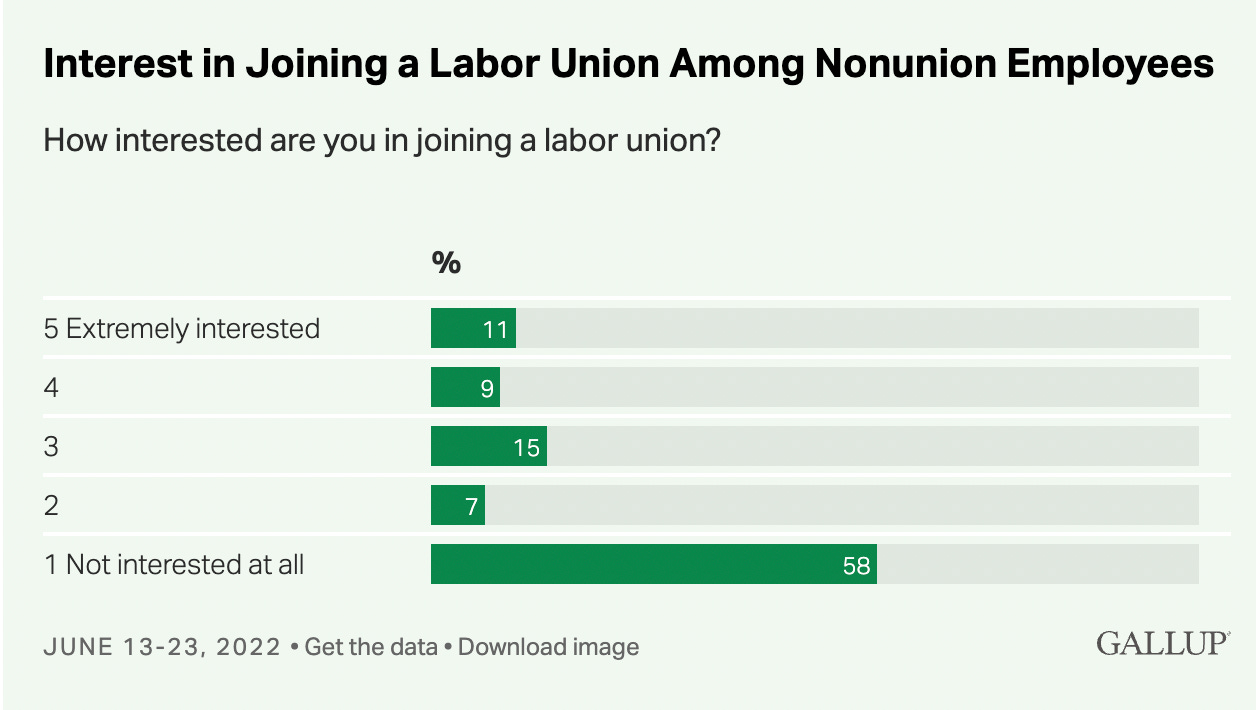
But the way most people feel is not relevant to the strategy. The 2018 report minces no words about what its authors believe: that unionized employees are quite simply better off than everyone else.
They write:
“Every person in the labor market today owes a debt of gratitude to labor unions. Without them, many of the policies we take for granted would not exist or would be severely diminished. Among them are: the 40-hour work week, paid sick leave, child labor laws, Social Security, minimum wage, paid family leave, employer-based health coverage, workplace safety laws.
“The benefits of being represented by a labor union are also numerous. The relative decline of union membership over the last 35 years has coincided with a decline in the middle class’ share of national income. It is also true that during the height of labor union membership, in the 1940s and 50s, income inequality was at its lowest point in American history.
“Empirically, union members are in many ways better off than their non-union counterparts.”
The big-picture vision of this report is not to make policy based on what most Americans want, but instead to make policy that supports unionization—which can’t be achieved with people happily earning a living as independent contractors. Union organizers, by law, have to leave independent contractors alone. They can only unionize employees. And as Gallup demonstrated above, most of that available target audience for unionization wants nothing to do with unions.
So, this 2018 report lays out a version of what David Weil has been describing in his writings for decades now: ideas for giving union organizers ways to target independent contractors.
It’s a big swing to take. In the United States of America, most people think of being your own boss as a good thing. About two-thirds of Americans tell Gallup it’s what we would prefer to be. And it’s what most independent contractors are—the smallest of small-business owners. There’s actually a lot more of us “nonemployer” firms than there are businesses that have employees, according to the U.S. Census Bureau:
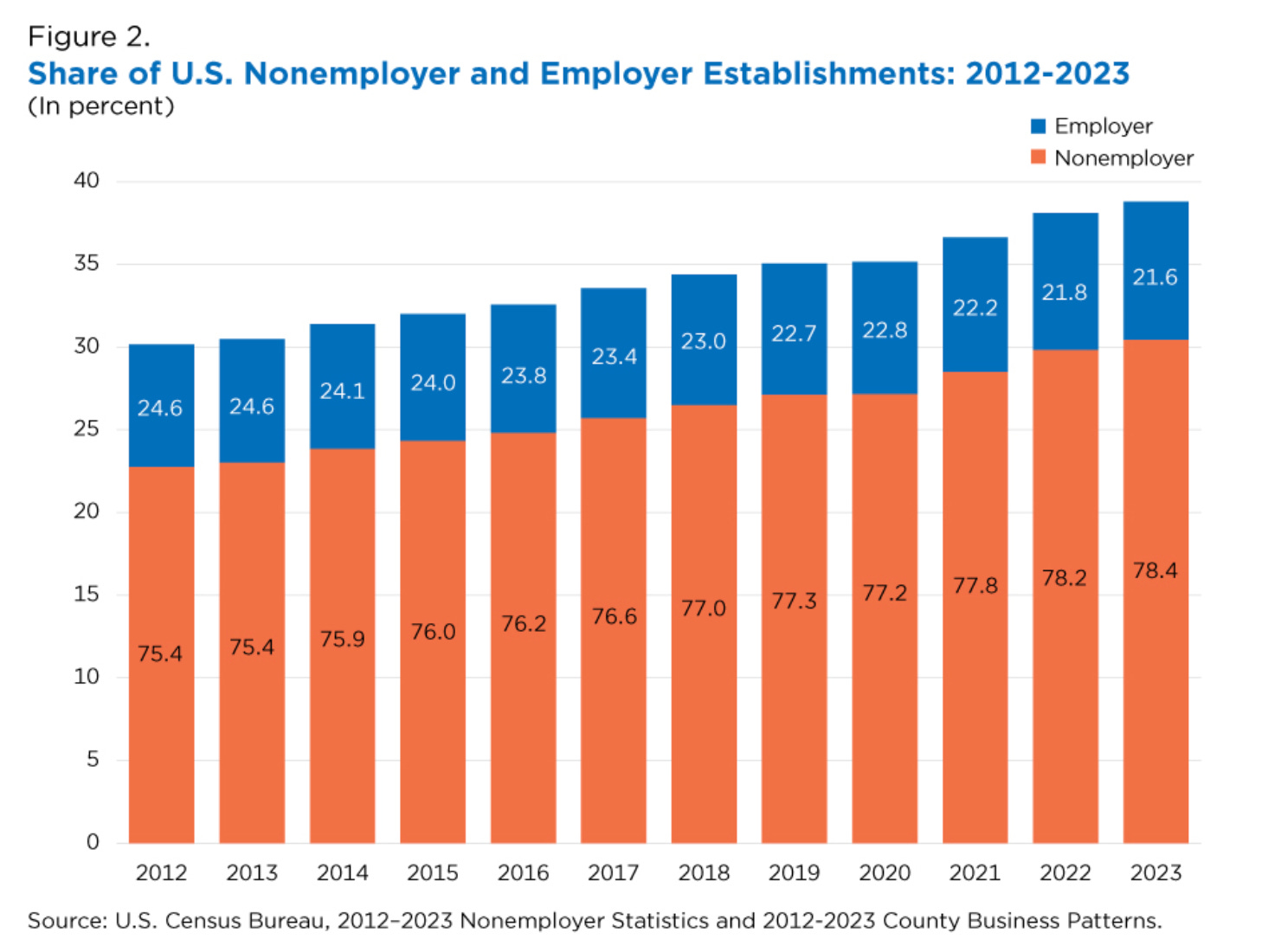
The unionists’ 2018 report describes that big orange bull’s-eye they want to unionize not as self-employed people choosing an entrepreneurial pathway to achieve the American Dream, but instead as victims. The report establishes a narrative that it’s imperative to stop the “misuse and abuse of independent contractors.”
Here’s how the 2018 report explains what its authors believe needs to be done:
“In industries where misclassification and fissuring are endemic, define workers as employees of whatever firms purchase their labor.”
Go back and read that sentence again.
It doesn’t say that in industries where regulators suspect misclassification is occurring, there should be a crackdown on the bad-actor companies that are misclassifying their employees.
Instead, it calls for a wholesale reclassification of every worker in those industries as employees.
And as extreme as that thinking may seem, the administration of Governor Phil Murphy has long been pushing it even farther in New Jersey.
In 2019, New Jerseyans received the Report of Gov. Murphy’s Task Force on Employee Misclassification. It cites David Weil and his “fissured” theory in its very first paragraph, creating a narrative that misclassification is out of control not merely in certain industries, but everywhere:
“Misclassification is the practice of illegally and improperly classifying workers as independent contractors, rather than employees. This practice has increased by approximately 40% in the last ten years, and is a growing problem in New Jersey (and other states).”
Now, that 40% figure is mischaracterized data, as I explain here. The actual data does not support that claim.
What the mischaracterized data does establish, though, is a narrative about independent contractors being victims who need to be saved.
And getting people to believe that narrative is the whole tamale in this policy debate.
‘Admittedly Radically Different’
I’ve said it before, and I’ll say it again: There are misclassified employees who need help. The companies that misclassify their employees should be held accountable.
But that is not the same as what most of us are experiencing. What’s happening, from our perspective, is Big Labor attacking the smallest of small-business owners.
Framing independent contractors as victims is the only way these unionists can advance the strategy. It explains the language in the 2018 Norcross report. It explains the language in the 2019 Murphy Task Force Report. And it explains the following quote from the press release that New Jersey’s Labor Department issued when it announced the proposed independent-contractor rulemaking:
“The work being done in New Jersey to combat worker misclassification is a testament to our state’s commitment to justice and fairness in the workplace,” said Labor Commissioner Robert Asaro-Angelo. “This rule proposal is a critical step in providing clear, reliable guidance to employers to help them comply with the law and prevent the illegal misclassification of employees.”
I’m pretty sure I speak for all of us among the 99% opposition to the Labor Department’s plan when I say that absolutely nothing about what’s happening seems related to justice or fairness.
In fact, both of those words show up in the public comments that opponents of the Department’s plan filed. There’s a public comment from the State of New Jersey Office of the Public Defender that says the proposed rules “risk undermining access to justice.”
And there’s a comment from a lifelong Democrat who wrote about fairness, as well as about how this proposed rulemaking does not fit that description:
“I believe in the important role that the government plays in ensuring fair treatment for all workers. However, the proposed ABC test is not the right solution. The ABC test, unconstrained without exemptions, represents a blunt instrument that will cause significant collateral damage to legitimate independent contractors and small businesses.”
If only such written public comments—among the 9,500 or so of them that New Jerseyans submitted in opposition to the proposed rulemaking—mattered when it comes to the strategy of restricting independent contractors overall.
Need more convincing? Read the full 2018 report. It doesn’t just talk about the idea of reclassifying independent contractors. It also suggests implementing sectoral bargaining, which is a whole other way of giving unionists more power.
“This method of organizing is admittedly radically different than the one we currently rely on in the United States,” the report’s authors wrote.
They then suggested getting the ball rolling in that radical direction with an “incremental approach, such as authorizing sectoral bargaining in one sector as a pilot program.”
California just did this with a new law two months ago, specific to rideshare drivers.
Yes, California, whose Assembly Bill 5 kicked off the current wave of attempts to reclassify independent contractors all across the country.
Fun fact from the 2018 report: Before that meeting in New Jersey to discuss the strategy, the acolytes of David Weil held two meetings in California.