

In April 2023, former U.S. Wage and Hour Administrator Tammy McCutchen testified before Congress the even she could not make sense of all the regulatory language that affects the business model of independent contracting:
“I am here today because I believe that compliance with independent contractor standards in this country is nearly impossible. I am an expert. I know the [Fair Labor Standards Act]. I have reviewed every state independent contractor standard in the country. I have written an app that uses predictive analytics to provide a risk assessment of classifying a worker as an independent contractor. Believe me when I admit, even I cannot always tell you who is an employee and who is an independent contractor with certainty.”
McCutchen’s pointed testimony went on, a few paragraphs later, to add this section about what she says is required to fix a problem so significant that it opens the door to tyranny:
“The war on the independent workforce is perpetuated by the chaos of the legal standards for determining who is an employee and who is an independent contractor. By my last count, there are no less than 100 different federal and state statutes regulating independent contracting under at least six different types of employment and tax laws: wage and hour, workers’ compensation, equal employment opportunity, workplace safety, unemployment tax, and income tax. Not all the laws are totally different, but most have some differences, small or large. Also, both the federal government and many state governments have different standards in different statutes.
“Yes, a single person can be an employee under wage and hours law but an independent contractor under workers’ compensation law. A single person can be an employee in one state and an independent contractor in another.
“This chaos opens the door to abuse—even tyranny. Regulators can choose at will from a menu of different definitions, some broad, some narrow. This reduces predictability and opens the door to favoritism, ideological enmity, or even whimsy. The war will continue until that chaos is ended. Only Congress can do that.”
If you think things have gotten better since the day in April 2023 when McCutchen gave that testimony, think again.
There have been several hearings in Congress about the Modern Worker Empowerment Act, which Congressman Kevin Kiley, R-California, and Senator Tim Scott, R-South Carolina, sponsored to try and protect independent contractors nationwide from the kinds of chaos and income destruction we’ve seen with the enactment of California’s Assembly Bill 5. The Modern Worker Empowerment Act made it through committee and is awaiting a vote of the full U.S. House of Representatives, but it remains stalled in the U.S. Senate HELP Committee, where Chairman Bill Cassidy, R-Louisiana, has tried to be a voice of reason with a detailed white paper about why policy must ensure “that independent workers have access to critical benefits and the freedom to pursue a living in ways that work for them.”
Meanwhile, over at the White House, the U.S. Department of Labor—which faced five federal lawsuits over its last attempt to change independent-contractor rules—just proposed a new rule for determining independent-contractor status. Public comments are being filed about this rule proposal as we speak. Attorneys wrote pretty bluntly about the situation: “If you’re having a bit of déjà vu, we are too. This marks the third regulation on independent contractor status since 2021, and you might be dizzy from the back-and-forth changes.”
And at the state level, as if California’s freelance-busting debacle wasn’t already bad enough, regulators where I live in New Jersey have proposed what experts say would be the most extreme independent-contractor policy in the nation—so extreme that they say it poses an “existential threat” to independent work itself and would almost entirely eviscerate anyone’s ability to be an independent contractor at all.
To the many thousands of us who comprise New Jersey’s 99% public opposition to this proposed state-level rulemaking, the situation sure does feel like exactly the kind of “ideological enmity” that McCutchen described in her testimony before Congress.
Now, all of that recent history has become prologue to the press release that U.S. Senator Mike Lee, R-Utah, issued last week announcing the 21st Century Worker Act.
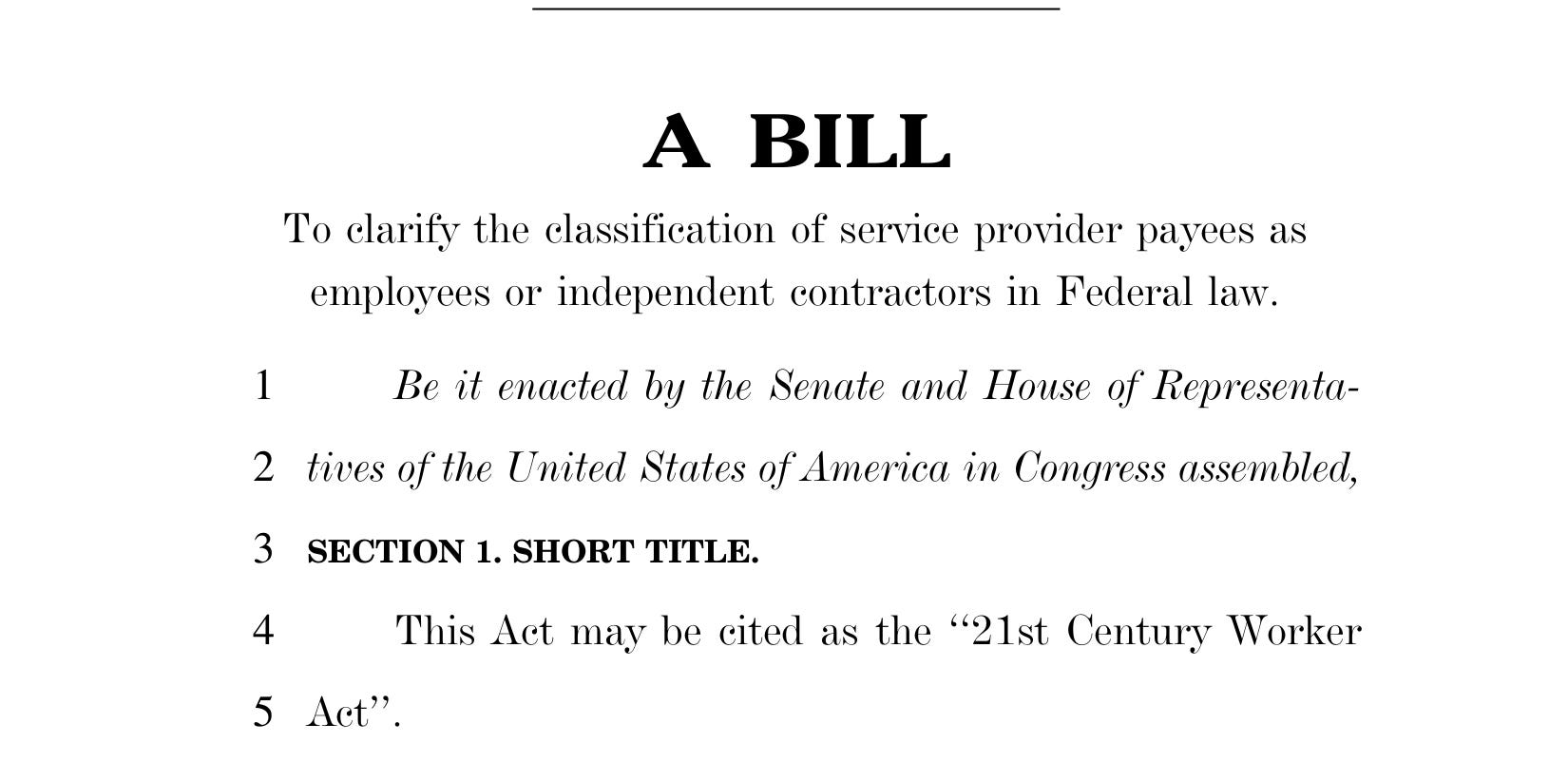
This isn’t the first attempt to pass this bill. Senator Lee also introduced the 21st Century Worker Act in the 2023-24 session of Congress, which failed to advance the legislation.
Here’s how Senator Lee described his intent with the bill being introduced last week:
“Gig workers and independent contractors face too much red tape when starting a job. Employers are so scared of misclassifying their employees that they often give up altogether, leaving workers out of a job and our economy worse off. The 21st Century Worker Act cuts through the red tape to give workers and employers flexibility instead of a bureaucratic headache.”
Senator Lee’s press release left no doubt about where he stands on this policy issue, adding: “Current federal labor policy is complex and openly hostile to flexible work arrangements.”
It’s hard to say whether the 21st Century Worker Act will be the winning idea among the various federal attempts to fix the policy madness that independent contractors and the broader business community are being forced to endure.
But if nothing else, it’s nice to see yet another effort to stop the freelance busting that never should have been allowed to begin in the first place.
‘Freedom to Mutually Elect Worker Status’
The Competitive Enterprise Institute, which advocates for limited government, was among the organizations promoting the 21st Century Worker Act right out of the gate last week.
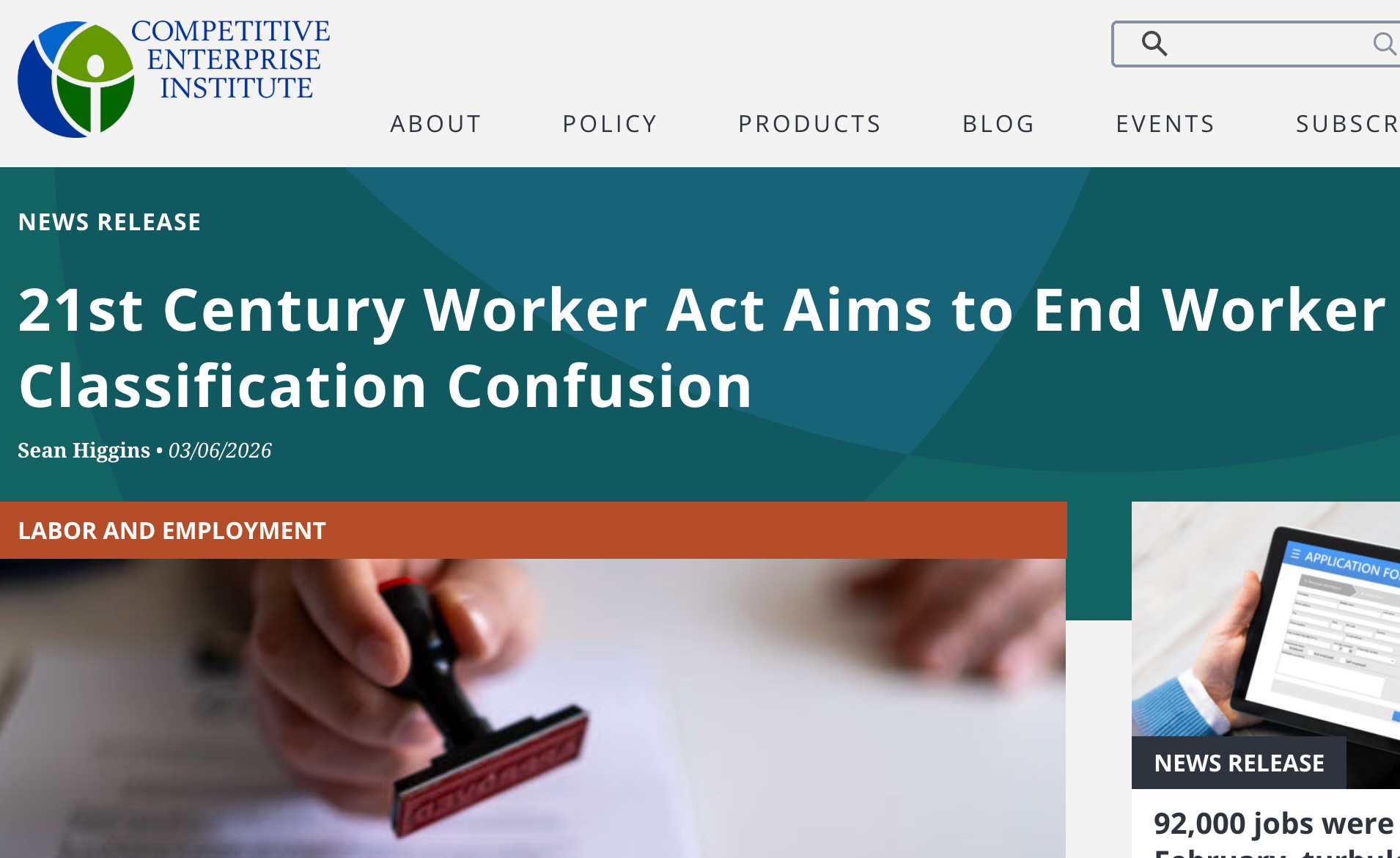
I’m sure that attorneys can, and will, debate endlessly about whether this legislation’s proposed language would be better or worse than other proposed language to determine independent-contractor status. But one part of what CEI Research Fellow Sean Higgins wrote stands out to me by comparison with other options that are on the table:
“The bill would replace the current patchwork of conflicting standards under the Fair Labor Standards Act, National Labor Relations Act, and Internal Revenue Code with a single, clear bright line test for determining independent contractor status across federal labor and tax statutes. It also directs the Government Accountability Office (GAO) to assess the impact of these new standards and allows workers and businesses freedom to mutually elect worker status in cases where conventional classifications do not apply clearly.”
Senator Lee’s press release described that last bit—about the freedom to elect worker status separate from employee or independent-contractor designation—like this:
“Creates a third category for workers who do not cleanly meet the definition of an independent contractor or employee. It is impossible for the government to conceive of every possible work arrangement. This bill outlines a process for workers and businesses to mutually elect worker status in instances when a worker cannot be cleanly classified as either an independent contractor or an employee.
“If the business and its employee cannot agree on status, the worker will be classified as an independent contractor by default.”
If nothing else, that idea alone demonstrates a willingness to be rational about the changing nature of work, especially as artificial intelligence advances and threatens traditional jobs. This line of thinking is a whole lot better than what we’re enduring in states like California and New Jersey, which seem intent on restricting the independent-contracting pathway right out of existence.
The Great Recession taught us all that when conditions nosedive in the traditional job market, independent contracting skyrockets. People need flexibility to navigate whatever the world is throwing at us, to put food on our tables, to exercise our can-do instincts.
We are living through just such a time right now. It has never been more important for the pathway of independent contracting to be protected and preserved.
I fully agree with this part of what Karen Kerrigan, president and CEO of the Small Business & Entrepreneurship Council, stated in Senator Lee’s press release last week:
“For years, SBE Council has raised concerns about inconsistent and expansive federal interpretations that create confusion and expose small businesses and independent contractors to legal risk. These heavy-handed classification standards discourage legitimate contracting relationships and threaten the flexibility and autonomy that millions of Americans actively choose.”
The regulatory problem could not be any clearer. Ideas to solve it are plentiful.
What we need now is a path for Congress to pass legislation—ideally, in a way that protects the option of independent contracting at the state and federal levels alike.
Elected officials need to understand that tax payer rights is the objective for both small businesses and independent contractors. Yes, WE in America have a right to work and file taxes. The same as an elected official. It’s almost “as if” elected government officials want to stop people from paying taxes. Why would a government want people to stop working? We, as a Nation; need to make good financial decisions for our Families to thrive. Is the government going to stop the schools from having Tricky Trays donation events? Think about it! Again, thank you Kim Kavin.