

Yesterday, the U.S. Bureau of Labor Statistics released new data showing the union membership rate was 10% in 2025, little changed from the prior year. The number of wage and salary workers belonging to unions was 14.7 million.
To understand how far union membership has fallen in recent decades, the Bureau of Labor Statistics also noted that in 1983, the first year for which comparable data are available, the union membership rate was 20.1% and there were 17.7 million union members.

This drop in union membership is the biggest driver of freelance busting. It’s why unionists keep urging policymakers at the state and federal levels to try everything and anything they can think of to boost union membership. There is a real feeling of desperation among unionists right now, plain and simple.
Here’s what unionist Hamilton Nolan wrote yesterday after the new data dropped:
“Turning around this decades-long decline of union density is the labor movement’s most important task. If we do not do it, we will quite literally shrink down into utter irrelevance. We will fail at our central job: building power for working people. Giving workers unions—the tool that they can use to wield power on their own, without asking permission from anyone else—is the first job of all of us who consider ourselves a part of the labor movement. Union density under ten percent is a collective failure.”
Ideas that unionists are trying to turn around this collective failure include targeting independent contracting through all kinds of freelance busting. And yes, that includes attempts to reclassify huge swaths of independent contractors as unionizable employees, as unionists in Congress described in detail several years ago.
The nearly two-thirds of Americans who would prefer to be our own bosses need protection from this encroachment on our freedom to choose self-employment. So do the vast majority of us who are already independent contractors and wish to remain so.
It’s beyond frustrating that the help we need may be a long time coming, especially at the federal level. Experts recently gathered to discuss the reality of the situation in Congress during an hourlong Federalist Society panel, where they minced no words about why the challenges in Washington, D.C., persist.
Tribes Won’t Give an Inch
The whole hour of this new Federalist Society panel is well worth watching, in my opinion, but I think the following three short clips really put into perspective what we are all up against as we try to get independent-contractor policy to advance in Congress right now.
In this first clip, moderator Alex MacDonald of Littler Mendelson P.C. and panelist G. Roger King of CHRO Association talk about the big-picture reasons why Congress is struggling to pass labor legislation. King describes what’s happening in the House of Representatives and in the U.S. Senate as an “absolute stalemate”:
I can say, based on the three times that I’ve testified before Congress about independent-contractor policy since 2023, King’s description of a “stalemate” is spot on. It’s practically a given, heading into every hearing, that Republicans will almost all be on one side of the issue while Democrats will almost all be on the other side. The entire exercise of having hearings about independent-contractor policy simply exposes this deep divide again and again.
In this second clip from the Federalist Society panel, Thomas Beck of Littler Mendelson P.C. says he believes labor policy has now become as controversial as abortion or transgender policy in Washington, D.C.:
The bit where he talked about having to go through multiple cycles of Congress—meaning a multiyear effort—before the situation changes is also something I’ve heard on Capitol Hill with regard to independent-contractor policy specifically. I’ve heard it not only from lobbyists and attorneys, but also from top aides to committee chairmen who are just as frustrated as all the rest of us about the current state of affairs.
In this final clip, F. Vincent Vernuccio of the Institute for the American Worker talks about how hard it is to get even simple labor bills through Congress right now—including bills where there seems to be agreement on both sides of the political aisle:
Put all of this expert analysis together, and it’s evident that independent-contractor policy isn’t getting resolved anytime soon. Ours is not a simple policy issue with largely bipartisan agreement. It’s a complex policy issue that’s fully immersed in the tribal swamp.
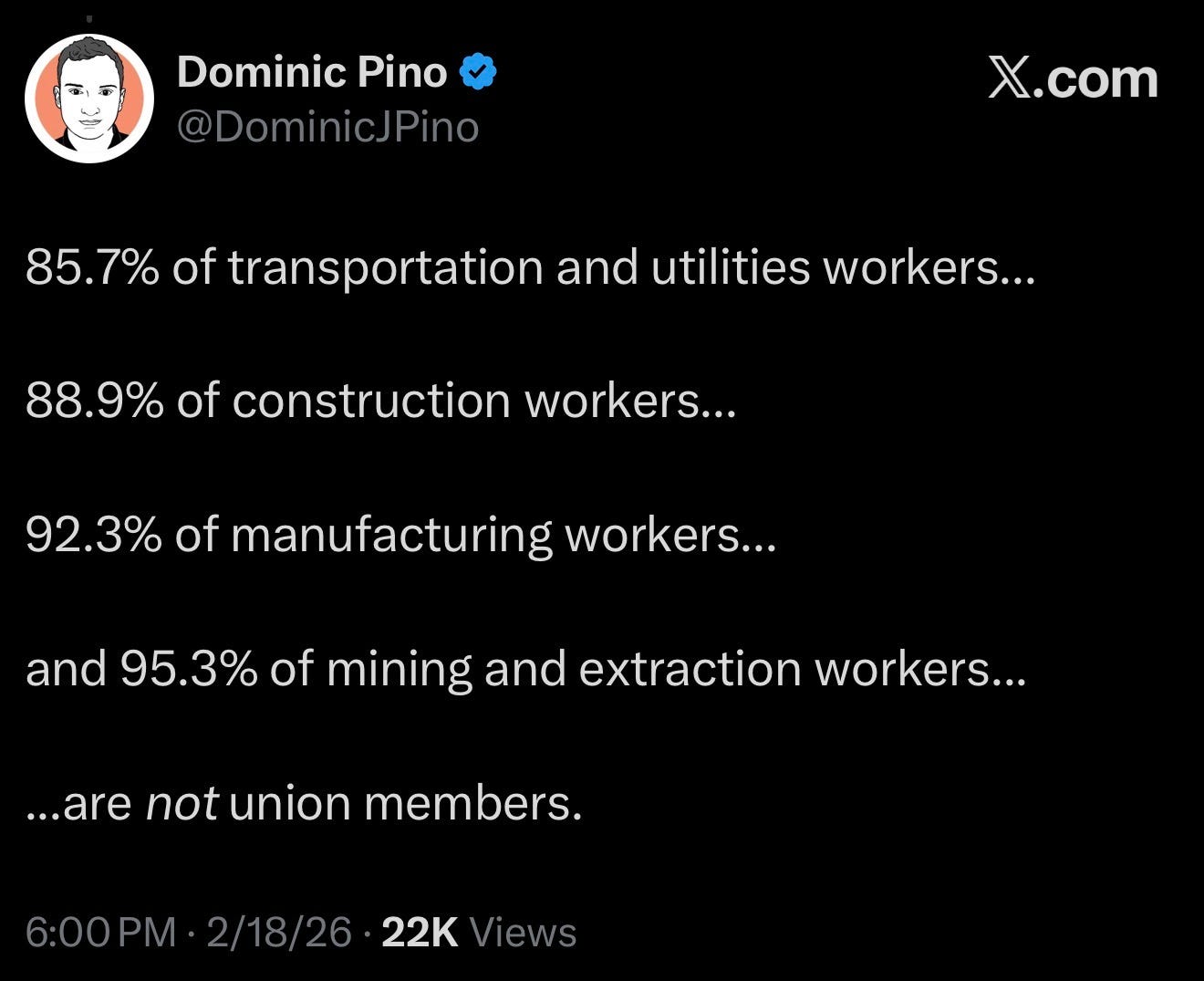
That’s even truer today than it was yesterday, with the Bureau of Labor Statistics releasing the latest union-membership figures. Dominic Pino, a Washington Post opinion writer, broke down the new data last night in a thread over on X.
Try to imagine the level of desperation that unionists feel as they, too, look at figures like these:
Actually, we don’t have to imagine how the unionists feel. Nolan stated it vividly in his Substack yesterday:
“We are in a fight. And we are losing. … We can either do things differently, or continue to get our asses kicked.”
The AFL-CIO used the occasion of the data drop to yet again urge lawmakers to pass legislation that would spread California’s disastrous freelance-busting language nationwide:
“We call on Congress to pass the Protecting the Right to Organize (PRO) Act…”
This is what the Federalist Society panelists meant when they talked about tribes being dug in for the long haul. And it’s nothing new: Quite a few unionists have been howling for a while now that their membership numbers have dropped so low, the unions themselves are facing an existential threat unless something significant changes.
‘Deeply Undesirable’
Unionists have been writing for years about how the current system of unionization that worked for them after the Great Depression is no longer working. Here’s how labor organizer Stephen Lerner put it about a year ago, writing for In These Times:
“Our goal can’t be to just limit the damage, slow the hemorrhaging and hope the Democrats get elected in 2026 so we can return to the slow and steady decline that labor has long faced under both parties. After all, labor continued to lose density under Biden with the most aggressively pro-union labor board in recent history. Returning to the status quo is both impossible and deeply undesirable. We can’t fall into the trap of defending a failed system; we need to articulate a vision of a country and world worth fighting for.”
The problem with that last bit is that this vision coming from the unionists now includes proposing legislation and regulations that target independent contractors in ways that experts say would “substantially unravel and change large segments of the U.S. economy” and that pose an “existential threat” to the idea of independent work itself.
Which, of course, is such an extreme approach to policy that it forces independent contractors and the business community to dig in our heels against the unionists. It is quite the heavy lift to try and find common ground with people who are so desperate to save their own skins, they’re willing to destroy yours.
Like the man said, “absolute stalemate.”
The upshot of all this is that the powerful forces driving freelance busting are unfortunately not going away anytime soon. That’s the bad news that yesterday’s Bureau of Labor Statistics data amplified.
But the good news is that our widespread resistance to freelance busting isn’t going anywhere either—and it’s only growing with every year that this policy mess remains.