

The top two Republicans in New Jersey’s Legislature sent a letter to Governor Mikie Sherrill today, adding their names publicly to the deafening chorus of bipartisan legislators who have expressed concerns about the Labor Department’s independent-contractor rule that’s scheduled to take effect tomorrow.
This letter from Senate Republican Leader Anthony Bucco and Assembly Republican Leader John DiMaio comes amid 99% public opposition to the Labor Department rulemaking, as well as continuing widespread opposition from across the broader business community.
With the addition of Senator Bucco and Assemblyman DiMaio’s letter today, three out of four leaders of the Legislature have now publicly requested a delay in this rule’s implementation. Senate President Nick Scutari, a Democrat, asked for the same delay back in August.
The only holdout among top brass in the Legislature who has not spoken out about the need to protect independent contractors is Assembly Speaker Craig Coughlin, a Democrat.
Here is the three-page letter that Republican leadership sent to Governor Sherrill today:
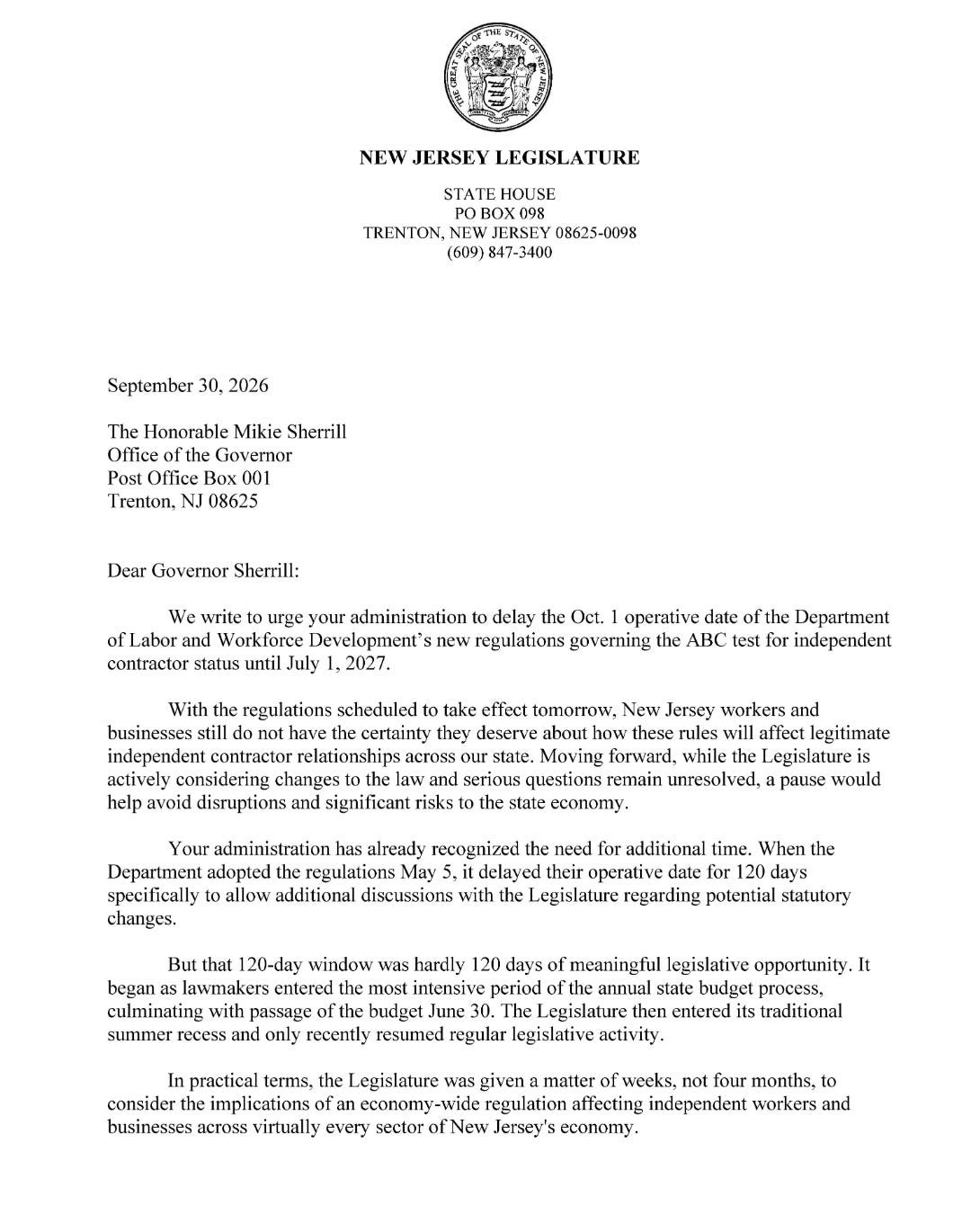
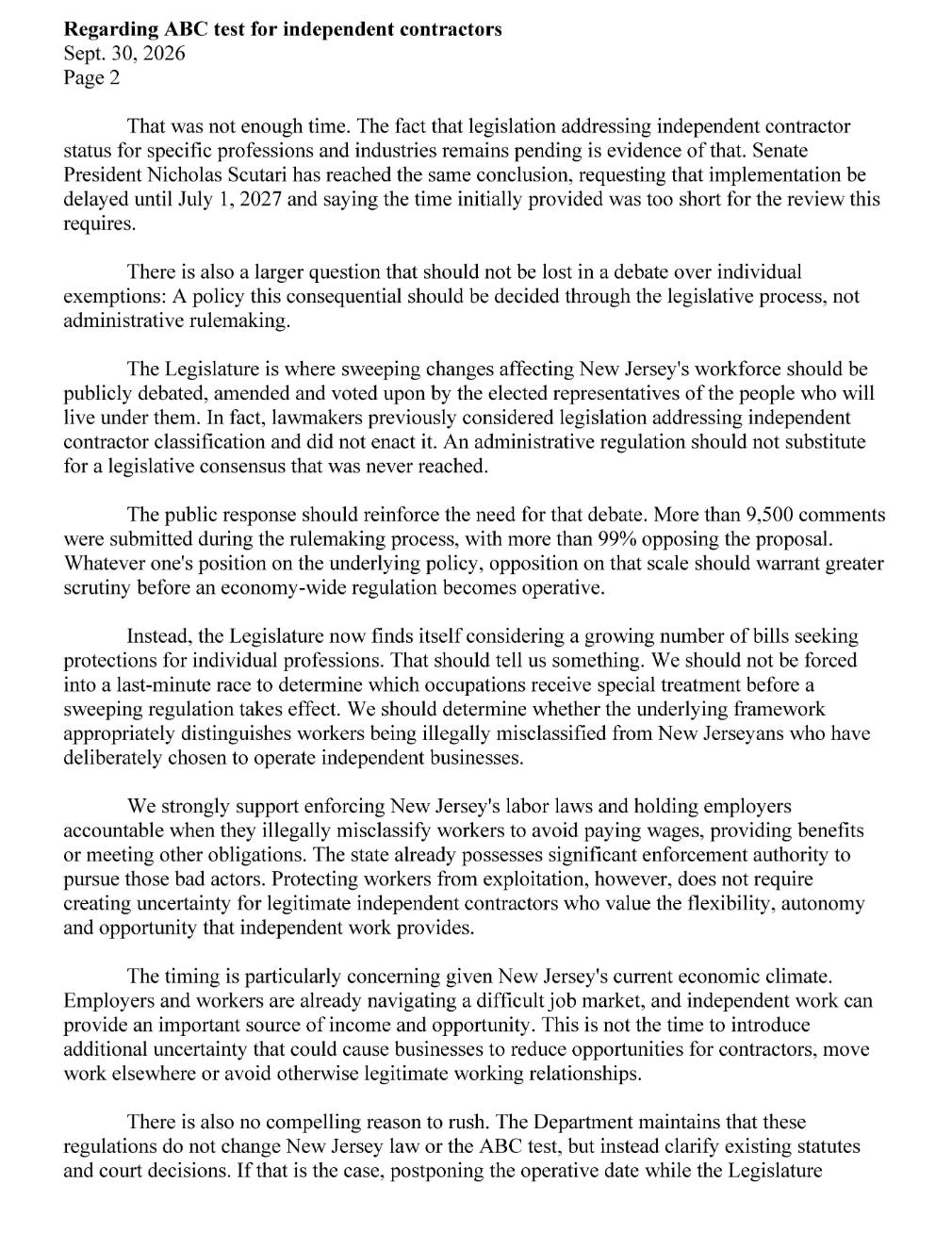
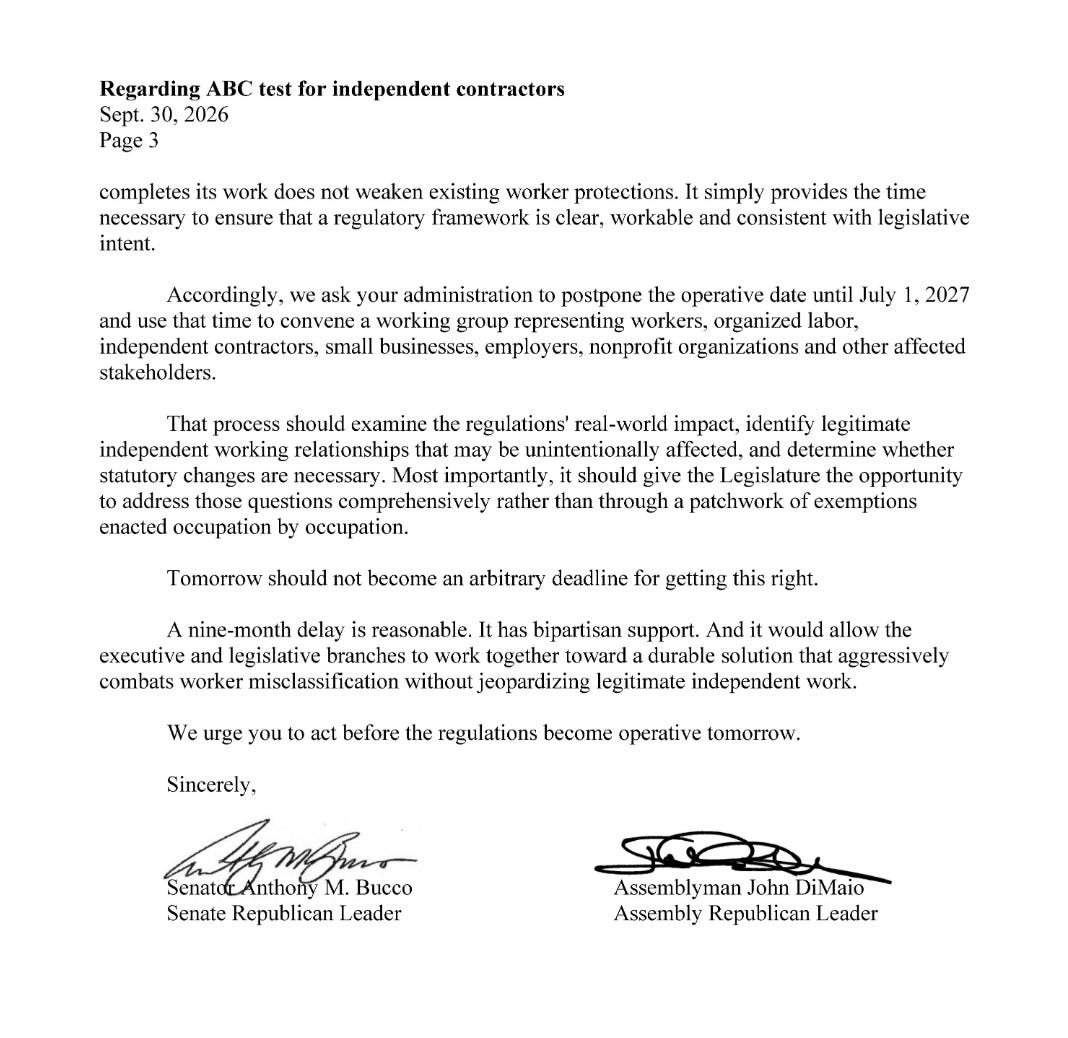
Senator Bucco used to be my state representative prior to redistricting, and I can personally attest that he has stood shoulder to shoulder with independent contractors ever since this policy mess began in our state back in 2019.
Assemblyman DiMaio is from the town next door to mine, and I can also personally attest that he understands this policy problem through his work in the construction industry. We spoke about this most recently over the summer, and he is fully on board with supporting the freedom to be our own bosses, too.
These leaders could not be more correct in writing this letter, and this part of it in particular:
"A policy this consequential should be decided through the legislative process, not administrative rulemaking."
Their letter also notes that the last time this policy question came before the Legislature, in 2019, lawmakers declined to pass the bill.
That ABC Test bill faced widespread public opposition, too.
Trenton’s Phone Lines are Flooded
Based on my own calls a couple hours ago to the offices of Governor Sherrill, Senator Scutari and Assemblyman Coughlin, angry independent contractors from all kinds of professions are pounding their phone lines today.
Some of the staffers sounded deeply frustrated when I called. Governor Sherrill’s staffer told me that office alone had received hundreds of calls by about lunchtime. When I asked if I could leave my name, she hung up on me.
Governor Sherrill is expected to appear tonight on News12’s “Ask the Governor” segment. Quite a few independent contractors I know have sent in questions, trying to get some kind of a meaningful response.
Hopefully, the show’s host will ask one of our questions, which you may recall happening with Sherrill’s predecessor, Phil Murphy—whose Labor Department is the one that began this deeply misguided rulemaking process, and who laughed out loud at our concerns on live TV.
My email to the Governor, number 10 but whose counting : )
Dear Governor Sherrill:
I am writing to urge you to delay—or withdraw—the Department of Labor’s independent-contractor rule before it causes lasting harm to New Jersey’s small businesses, independent professionals, and economy.
The opposition to this rule is overwhelming. Independent contractors, business organizations, and bipartisan legislative leaders have raised serious concerns, yet the administration continues moving forward without resolving them. A policy with consequences this significant should be considered through the legislative process, with meaningful participation from the people and businesses it will directly affect.
As Chief Operating Officer of The Language Center, I see firsthand how important independent professionals are to the language-services industry. Interpreters choose their availability, accept or decline assignments, work with multiple agencies, and decide where and how they provide services. They are not asking the State to take away their independence.
Forcing specialized industries into a traditional employment model could make many small businesses financially unsustainable. It could lead to reduced services, higher prices, lost work opportunities, business closures, and companies relocating to more business-friendly states. In our industry, it could also limit access to qualified interpreters in schools, hospitals, courts, and government agencies.
Why would New Jersey adopt a policy that risks driving away the very businesses and professionals that contribute to its economy? The State should be encouraging responsible businesses to remain, invest, and grow—not placing additional burdens on them until they have no choice but to reduce operations or leave. How much can a camel take before it's back is broken?
I respectfully ask you to look beyond the demands of unions and other special-interest groups and listen to the independent contractors, small-business owners, and residents who will live with the consequences. Genuine worker misclassification should be addressed directly, but legitimate independent contracting should not be dismantled in the process.
Please delay implementation and work with the Legislature to develop a fair, transparent solution. Better yet, withdraw this rule and begin again with the voices of independent contractors and small businesses fully represented.
Governor, you still have an opportunity to prevent unnecessary economic harm and demonstrate that New Jersey listens to its people and not only Unions and Special Interests. Please do the right thing.
Sincerely,
Marcin Rogalski
Chief Operating Officer
The Language Center
www.thelanguagectr.com
Thank you, Kim, for continuing to stand up for independent contractors and small businesses. When leaders from both parties, business organizations, and 99% of public commenters are calling for a delay, the administration should listen.
As a language-service provider, we depend on professional interpreters who choose their availability, assignments, and the COMPANIES (NOT ONE, MANY) they work with. This rule threatens that independence and could reduce access to essential interpreting services in schools, hospitals, courts, and government agencies.
A policy with consequences this serious should be addressed through the legislative process—not imposed through administrative rule making. Thank you for keeping attention on this important issue.
I guess we are down to the final hours to see how friendly or not the Garden State is to their businesses.