

A sign hangs in my kitchen with a quote that’s attributed to the late, great Andy Rooney: “The average dog is a nicer person than the average person.”
And boy, ain’t that especially true in the workplace. When I was still a staff employee more than two decades ago, I was forced to tolerate every conceivable kind of jerk. There was the boss who only spoke to me on days when I wore miniskirts. The boss who bellowed at the top of his lungs for me to come to his office like a trained circus animal. The guys from the office who thought it was OK to put their hands on me when they were drunk at work functions I was required to attend.
One of my favorite things about being an independent contractor has always been the ability to choose who gets to be on my client roster, and who receives the reply email that says: “I’m sorry, but my schedule is full.” I choose the clients, eliminating the kinds of obnoxious behavior I was forced to endure as a staff employee.
That ability to choose who gets to be part of my day is a huge part of why I love being a freelancer. Being an independent contractor is the best way in the world to avoid horrible people at work.
So, I was happy to see this research from MBO Partners get a push over on X earlier this week. It says 92% of independent contractors report having either a lot of choice (53%) or some choice (39%) about the organizations they work with. This is up from 2019.
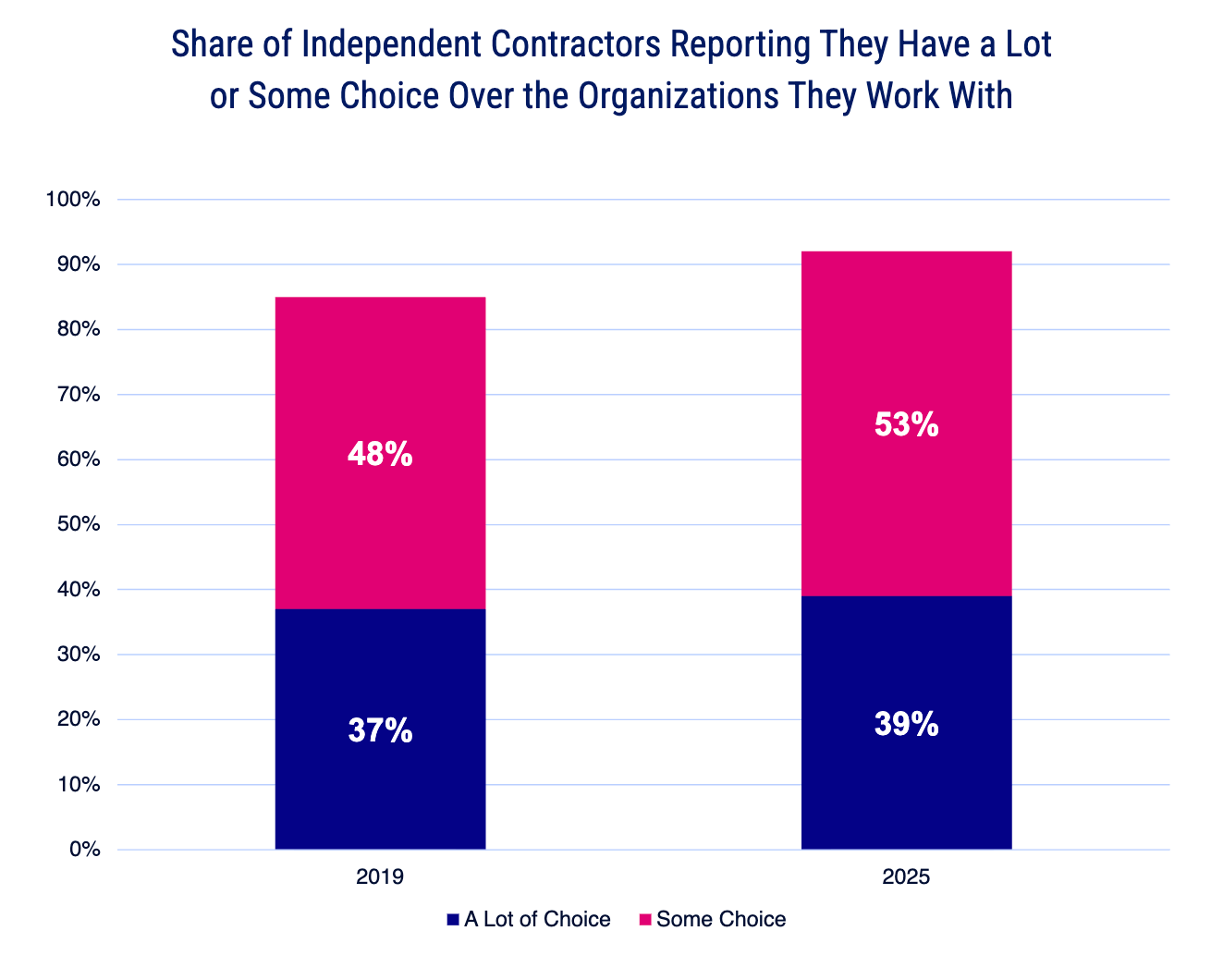
High-earning independent contractors (those with annual revenues of $100,000 or more) report even higher levels of choice, with 99% saying they have a lot of choice (58%) or some choice (41%) in clients.
Perhaps most important, the research also shows that 98% of independent contractors are either very satisfied (44%) or satisfied (54%) with their client relationships.
Compare that with how employees are feeling these days, according to Harvard Business Review:
“Everywhere you look, the data points in the same direction: People are miserable at work. One in five employees say their job hurts their mental health. Nearly a third of employees describe their workplace as isolated or impersonal, and over 40% report significant stress.”
It’s almost as if the nearly two-thirds of Americans who tell Gallup we’d prefer to be our own bosses actually mean it—and that most of us feel better when we actually make the leap and do it.
Add It to the List
The research from MBO Partners suggests a core reason why so many people report feeling happier and healthier as independent contractors.
A fair bit of other research also exists about the health benefits of being your own boss. There’s research into how, especially for women, it’s good for your heart health. And how it allows for a healthier work-life balance. And how it helps you feel more optimistic as well as more in control of your life. And how—again, especially for women—self-employment correlates to a lower risk of developing high blood pressure, obesity and diabetes compared to women who have a salary or work for wages.
Mental health improves with self-employment too, according to this research as well as this research about women, in particular, feeling less stress when we’re self-employed. And there’s this research about self-employed men and women alike saying their mental wellbeing improved.
I guess someone, somewhere needed all this research to understand that when you have the ability to kick jerks out of your life, you feel better.

Which leads me to one more notable finding in the MBO Partners research—a key insight that is important to understand when government agencies are developing regulatory language to determine who is a legal independent contractor, and who is not.
‘Strategic, Lasting Relationships’
One of the challenges with freelance busting is that the people pushing this awful concept seem to think that having a lucrative business relationship with a client should equate to employee status.
I don’t know any independent contractors who believe this is true. When we find good clients—people who are easy to work with, people we get along with, people who respect us as much as we respect them, people who pay on time and pay well—we want to engage in repeat business with them. This desire is as natural as wanting to avoid jerks at work. It’s common sense. When we find people we like to work with, we want to keep working with them.
In the MBO Partners research, that sentiment showed up in this finding:
“Independent contractors prefer long-term partnerships with clients who offer career growth and ongoing opportunities. They also value firms that help them develop new skills: 88% consider learning opportunities either significant (49%) or important (39%), and 62% seek strategic, lasting relationships over one-time projects.”
Back in the old days, freelance writers used to call these kinds of strategic, lasting relationships “anchor clients.” You’d get on the radar of a few great magazines you really enjoyed working with, take on work from those same clients again and again, and have them as anchors for your freelancing business while you added other, smaller clients around them.
None of this has anything to do with being treated as an employee. You’re not under their control, and you’re free to work simultaneously with anyone else. It’s about developing long-term, mutually beneficial business relationships with good people.
But some regulators nowadays are trying to twist that kind of relationship into evidence that we’re not independent contractors at all.
Take the currently proposed (and widely opposed) independent-contractor rule in New Jersey, which says an independent contractor can be deemed an employee based on (among other things):
The number of customers we have and the volume of business from each of those customers
The amount of money we receive from the customer compared to the amount of money we receive from other customers in the same industry
Think about that. It could mean that if you’re a freelancer with a strong anchor client, then you could be deemed an employee because of a lucrative, strategic relationship.
Now, compare that kind of thinking to what the U.S. Department of Labor just proposed as a federal rule, focusing on these two core factors:
The nature and degree of control over the work
The worker’s opportunity for profit or loss based on initiative and/or investment
In simple layman’s terms, the federal rule proposal is suggesting that what matters most are things like who controls when, how and where we do the work, and whether we have the opportunity to take on other work from other clients.
There’s a lot more to these two rule proposals than these bits I shared above—I have oversimplified things to make a point. And that point is that when we think about these kinds of regulatory factors, philosophy matters. It should take into account what a lot of successful independent contractors are saying in the research.
Our regulations around independent contracting should be designed to stop actual cases of employee misclassification, not to reclassify independent contractors who have built mutually beneficial, lucrative business relationships with good clients.
At the end of the day, I’m with Andy Rooney: “The average dog is a nicer person than the average person.” My favorite clients are the ones who think it’s fantastic that I head out in the middle of every afternoon to walk my dog in the park. They know what I know: that when I feel better, I work better.
And that benefits us all.
I'd be willing to bet that a vast, vast majority of legislators and regulators making anti-independent contractor policy have never worked as anything but a W-2 employee.
As a result, they can't comprehend "mutually beneficial business relationships"—everything looks like some form of exploitation or oppression, when it's the opposite.