

A friend got hold of the AFL-CIO’s 2026 congressional candidate questionnaire and gave me the green light to share it here. It’s a 16-page document with paragraph after paragraph that shows how these politically powerful unionists are framing all kinds of issues behind closed doors with lawmakers.
There’s a lot of interesting stuff in this questionnaire, and of course, the lines about independent contractors caught my attention. The way the AFL-CIO is framing this issue for legislators is more twisted than a ballpark pretzel. A lawmaker would need to have in-depth policy background to realize the questions are dishonest at their core.
For instance, the AFL-CIO asks this:
“Would you support efforts to require corporations to accurately designate workers as contractors or employees?”
Well of course! Who wouldn’t? Being accurate is a good thing, right?
The problem with this question is that the ABC Test regulatory language the AFL-CIO champions doesn’t accurately classify anyone. It instead seeks to reclassify huge swaths of independent contractors into the status of unionizable employees against our will. It completely ignores years’ worth of research that shows 80% of us wish to remain our own bosses.
We’ve already seen the economic fallout from this kind of weaponized ABC Test policymaking in California, where the biggest result of a law that went into effect in 2020 was legitimate independent contractors losing their incomes and careers.
And make no mistake about widespread reclassification being the goal. The unionists demonstrated as much with the way they proposed an ABC Test rule to “accurately” classify us all in New Jersey last year. Their proposed interpretation of the regulatory language, according to attorneys, created an existential threat to self-employment and almost entirely eviscerated the ability of anyone in the state to be an independent contractor at all.
The AFL-CIO telling congressional candidates there’s a need to “accurately designate workers as contractors or employees” is like a drug dealer telling lawmakers there’s a need to “accurately” designate meth and coke as health foods.
And that’s just the start of the false premises that are all throughout this questionnaire the AFL-CIO is sending to congressional candidates nationwide.
Magical Misclassification Thinking
A little farther down in this AFL-CIO questionnaire, there’s a tidy half-page sermon about the glories of the Protecting the Right to Organize Act, which would inject weaponized ABC Test regulatory language into federal law.
The PRO Act would, in reality, subject independent contractors all across the country to California-style freelance busting, forcing millions of us into unionizable-employee status or out of work altogether. This bill would create such a big policy shift that the former head of the National Labor Relations Board wrote that it would “substantially unravel and change large segments of the US economy.”
Yeah. That would be bad.
But here’s the way the AFL-CIO describes it in the questionnaire:
“... the PRO Act guarantees bargaining rights for employees who are misclassified as independent contractors ...”
That’s some magical misclassification thinking right there. The AFL-CIO is suggesting that regulatory language proven to restrict all kinds of independent contractors would only affect the wrongly classified ones. And it would guarantee their ability to join a union, which Gallup research tells us most non-union employees don’t wish to do.
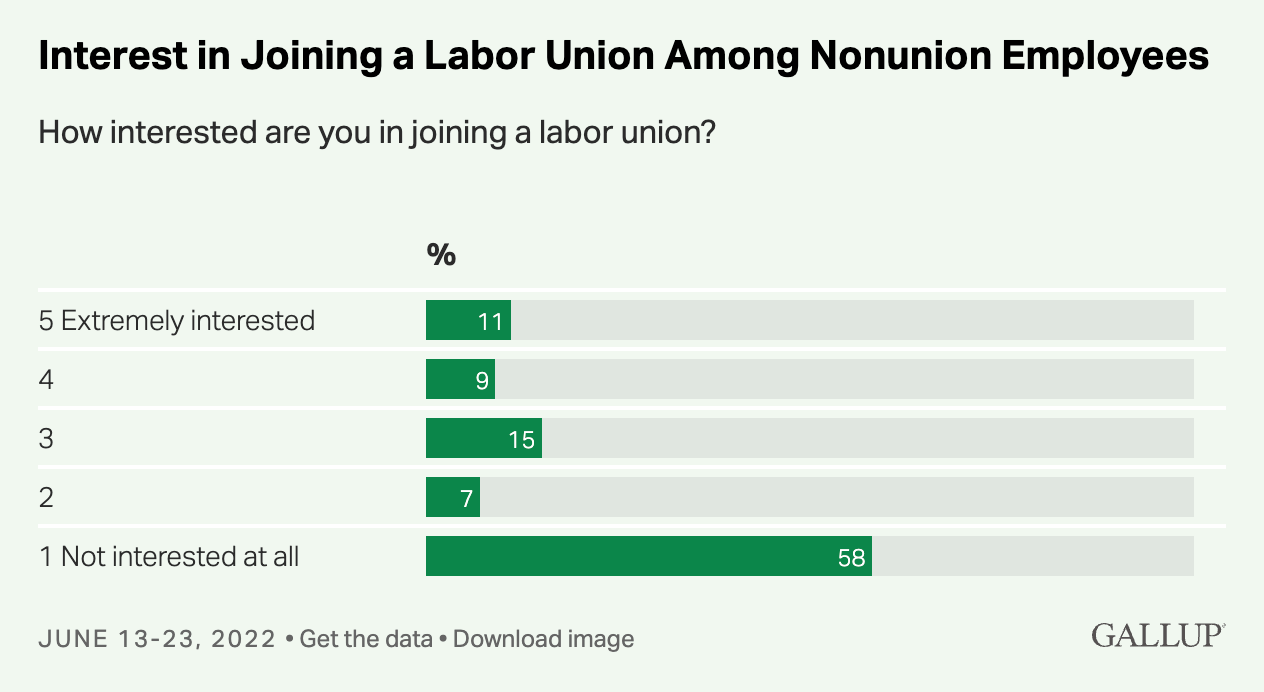
Put another way, the AFL-CIO is asking congressional candidates if they would vote to guarantee something that almost nobody wants, by reclassifying all kinds of people who aren’t misclassified in the first place.
This detachment from reality is similar to how the AFL-CIO continues to claim that misclassification is a widespread and rampant problem across all kinds of industries, when in reality, claims about its scope in California turned out to be totally bogus, and testimony in New Jersey just made clear it’s an issue that the state Labor Department is hearing about from only 0.04% of independent contractors—with most of them limited to just a single industry, rideshare and delivery drivers.
And Last, There’s This Gem
My absolute favorite line in this AFL-CIO questionnaire is in the section about artificial intelligence.
This is the question the AFL-CIO asks congressional candidates:
“Do you support copyright and intellectual property protections that safeguard the livelihoods of union professionals who rely more than ever on effective intellectual property rights to earn compensation and benefits, as well as to ensure future career opportunities in today’s digital era?”
This question barely even makes sense if you understand how copyright works.
The minute an employee creates anything, the copyright typically becomes the property of the person’s employer. This means the employer can do anything it wants with the work. If an employee’s work becomes really popular—say, a software developer who works for a tech company creates the next big app that everyone is downloading—then the employer is free to make millions of dollars off the creation without ever having to give the employee another thin dime.
By contrast, independent contractors retain the copyrights to our work unless we choose to sell them in a negotiated deal. This is important: It’s why authors are able to negotiate cash paydays for their books, as opposed to the book publishers keeping the bulk of the money. It’s why those same authors can then negotiate film or TV rights to those same books and make even more money. And so on. It’s all about who owns the copyright.
This ability to own a copyright is so important to the livelihoods of creative people that it has its own section in the U.S. Constitution. It’s not something that is specific to “union professionals” in any way, shape or form, the way the AFL-CIO’s questionnaire suggests. Copyright law has always been for everyone, ever since the day George Washington signed the first copyright bill into law in 1790.
Ownership of copyright is the reason why, right now, hundreds of independent-contractor photographers are able to contest a Wall Street Journal contract that would allow AI use of their work without their consent. It’s the reason why independent-contractor writers were able to sue The New York Times—and win—for unauthorized uses of their work.
And it’s a key reason why the freedom to remain an independent contractor is so important to so many kinds of people who want to protect our copyrighted work.
The AFL-CIO asking congressional candidates if they support “copyright and intellectual property protections that safeguard the livelihoods of union professionals” is like asking if the candidates support First Amendment protections that safeguard the free speech of union members.
In reality, lawmakers who swear an oath to uphold the Constitution are supposed to make sure that freedoms and protections apply to us all.
Including the freedom and protection to work as independent contractors, if that’s what we choose to do here in the United States of America.