

Last week, a coalition of industry groups submitted a rulemaking petition to the National Labor Relations Board, urging adoption of a rule that they are suggesting to determine independent contractor status under the National Labor Relations Act.
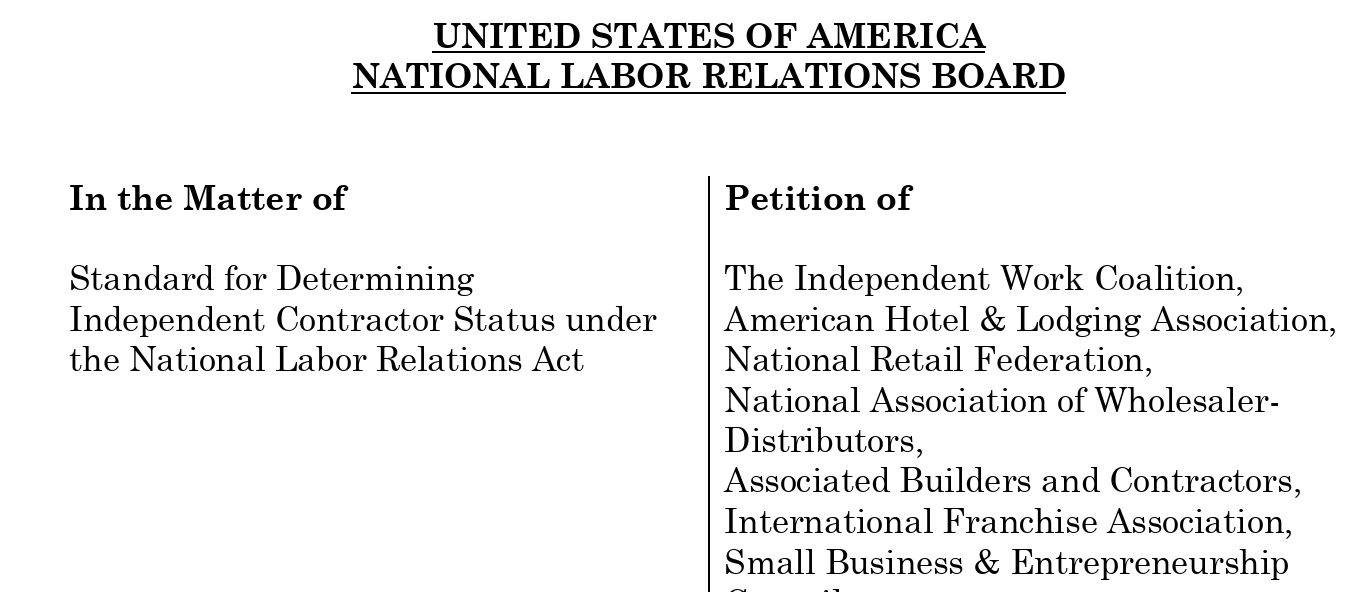
This petition is signed by attorneys Alex MacDonald and Jim Paretti from the Workplace Policy Institute at Littler Mendelson P.C. It’s the same firm that donated its services pro bono several years ago to help my fellow freelancers and I file an amicus brief with the U.S. Supreme Court.
The petition they filed on behalf of the industry groups last week opens with a description of the status quo that sure feels spot on to me:
“The law of independent contracting is at a crossroads. After decades of steady and consistent application, the Board has gyrated in recent years between wildly different approaches. In some cases, it has applied a historical test grounded in the statutory text and judicial precedent. But in others, it has deployed a freewheeling analysis aimed at expanding coverage beyond the NLRA’s historical moorings. These shifts have increasingly brought it into conflict with Congress, the courts, and even its own administration. The time for these shifts is over: the Board should adopt a rule.”
The petition goes on to detail just how confusing some of these shifts have been:
“In less than two decades, the Board has articulated at least four different standards. It has frequently reversed course on the role entrepreneurialism, and the opportunity for profit or loss, plays in the equation. As discussed below, in a series of decisions beginning in 2007, the Board has emphasized, de-emphasized, re-emphasized, and again deemphasized what the D.C. Circuit has determined to be ‘the animating principle’ of the analysis—entrepreneurial opportunity. The result has been confusion: workers and businesses cannot know how the Board will classify their relationship. Without a stable test, they cannot plan and structure their businesses to comply with the law—a law the Board has made a moving target.”
That’s the petition’s setup for why the industry coalition is urging the National Labor Relations Board to undertake rulemaking now.
This petition also lays out a suggested rule that the coalition would like to see the Board consider when determining independent-contractor status under the National Labor Relations Act.
The Suggested Rule
The petition suggests the following rule:
“(a) In determining whether an individual is an employee or independent contractor within the meaning of Section 2(3) of the National Labor Relations Act, the Board will examine, among others, the following factors:
(1) the extent of control which, by the agreement, the master may exercise over the details of the work;
(2) whether or not the one employed is engaged in a distinct occupation or business;
(3) the kind of occupation, with reference to whether, in the locality, the work is usually done under the direction of the employer or by a specialist without supervision;
(4) the skill required in the particular occupation;
(5) whether the employer or the workman supplies the instrumentalities, tools, and the place of work for the person doing the work;
(6) the length of time for which the person is employed;
(7) the method of payment, whether by the time or by the job;
(8) whether or not the work is a part of the regular business of the employer;
(9) whether or not the parties believe they are creating the relation of master and servant; and
(10) whether the principal is or is not in business.
(b) In examining these factors, the Board will assess and weigh all incidents of the relationship in light of common-law agency principles with no one factor being decisive or given undue weight. In evaluating the significance of the foregoing agency factors, the Board will assess the effect of each of the factors on an individual’s opportunity for profit or loss.
(c) In determining whether an individual is an independent contractor or an employee, the Board will give no weight to:
(1) steps taken to apply with legal or regulatory requirements;
(2) an individual’s failure to exercise entrepreneurial opportunities available to the individual;
(3) reasonable safeguards adopted to protect the health or safety of the individual or other individuals or to prevent damage to property;
(4) constraints imposed by customer demands.
(d) When determining whether an individual is an independent contractor or an employee, the Board will permit parties to present evidence on the typical circumstances of individuals in substantially similar roles to evaluate the circumstances typical of those roles and need not limit its consideration to circumstances specific to the single individual.”
The petition argues that such a rule would restore the certainty and clarity provided by application of the common-law test as set forth in the Board’s decision in SuperShuttle.
It also states that the rule would better align with judicial precedent and the current administration’s views.
Thanks Kim. Even though I am a lawyer and a libertarian I understand that state rights are important but it seems there should be a creative way to get this accomplished as it impacts interstate commerce. Perhaps we could offer a national incentive to encourage states NOT to adopt laws like AB 5 though it looks like your home state of NJ is about to do so.
I have the same trouble with the issue of rent control.
Keep up your most excellent work.
Vicky
Great summary. Shouldn't we encourage NLRB to add language to overrule states that adopt laws like CA horrifically damaging AB 5?